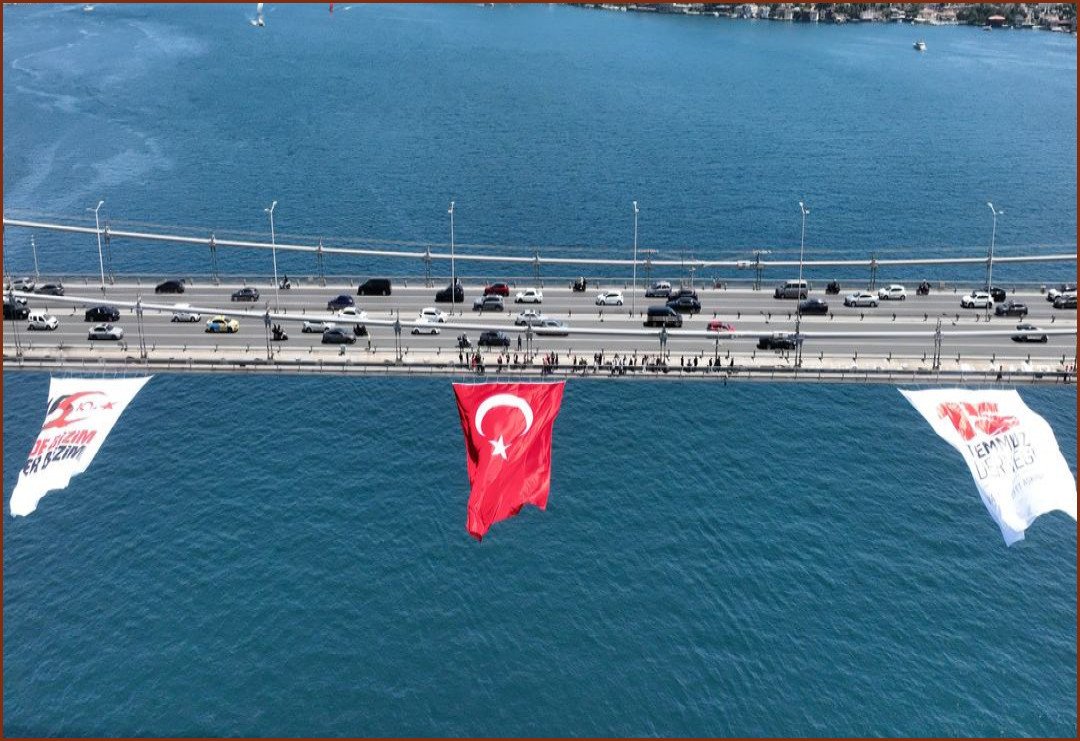
Wednesday marks the 10th anniversary of the July 15, 2016, failed coup attempt in Türkiye. Orchestrated by members of the Fetullah Terrorist Organization (FETO), the insurrection sought to overthrow the country's democratically elected government and resulted in the deaths of 253 civilians and security personnel. FETO, which presented itself as a religious movement while covertly infiltrating state institutions, including the Turkish Armed Forces, had spent years organizing to seize power.
Before the coup, the group carried out several operations against the government, including attempts to summon then-National Intelligence Organization (MIT) Undersecretary Hakan Fidan for questioning, the December 17-25 investigations, and the interception of MIT trucks. Following the Justice and Development (AK) Party's victory in the November 1, 2015, elections, the organization anticipated the removal of FETO-linked officers through Supreme Military Council decisions and accelerated its coup plans. FETO ringleader Fetullah Gulen publicly called for the military coup during a televised appearance on March 19, 2016. Senior civilian and military members later finalized preparations through meetings held in Türkiye and the US, where Adil Oksuz and Kemal Batmaz presented a plan to Gulen before returning to Türkiye days before the coup.
The conspiracy was partially exposed hours before its launch when a major at the Army Aviation Command informed MIT that FETO members were planning to detain Fidan. This information was relayed to then-Deputy Chief of the General Staff General Yasar Guler, who informed then-Chief of the General Staff Hulusi Akar. Akar ordered military aircraft back to their bases, closed the airspace, and instructed commanders to restrict military movements. Realizing their plans had been exposed, the plotters moved their start time forward from 3:00 am on July 16 to 8:30 pm on July 15.
The coup involved the deployment of approximately 9,000 military personnel, 35 aircraft, 37 helicopters, 246 armored vehicles—including 74 tanks—and nearly 4,000 light weapons. Military vehicles occupied strategic sites in Ankara, while F-16 fighter jets performed low-altitude flights and soldiers blocked the Bosphorus Bridge and the Fatih Sultan Mehmet Bridge in Istanbul. Staff Sgt. Bulent Aydin became the first person killed during the attempt after being shot at the General Staff Headquarters. As plotters bombed the Police Aviation Department and the Special Operations Department in Golbasi, attacked the MIT compound in Yenimahalle, and seized the state broadcaster TRT to force staff to read a coup declaration, then-Prime Minister Binali Yildirim confirmed the government remained in office and prosecutors launched a criminal investigation.
The tide turned after President Recep Tayyip Erdogan appeared live on CNN Turk at 12:24 am on July 16, urging citizens to take to the streets. Thousands of civilians responded, confronting coup forces across the country. In a pivotal moment, Staff Sgt. Omer Halisdemir, acting on orders from Special Forces Commander Lt. Gen. Zekai Aksakalli, shot and killed coup Brig. Gen. Semih Terzi as he arrived to seize the Special Forces Command. Halisdemir was immediately killed by accompanying FETO terrorists. The plotters also bombed the Turkish Grand National Assembly twice and attacked TURKSAT facilities, while police regained control of TRT and detained those occupying the broadcaster.
Violence continued into the morning before security forces regained control. Then-Prime Minister Yildirim authorized Lt. Gen. Ziya Kemal Kadioglu to shoot down aircraft controlled by the plotters. Akar was rescued from Akinci Air Base, and on Erdogan's instructions, the base's main runway was struck to prevent further take-offs. By 12:57 pm on July 16, Yildirim announced that the coup attempt had been suppressed, having been defeated within about 21 hours through public resistance and the actions of loyal security forces.
FETO founder Fetullah Gulen, who had founded the organization in the 1960s and fled to the US in 1999, was accused by Turkish authorities of directing the July 15 coup attempt and other operations from Pennsylvania. Despite Türkiye submitting seven extradition requests covering 27 charges, US authorities did not extradite him. Gulen died on October 20, 2024, at St. Luke's Hospital's Monroe campus in Pennsylvania, with Turkish authorities confirming that the US Department of State verified his death through a formal document.