President Donald Trump has publicly suggested he has issued standing orders for the U.S. military to retaliate against Iran with an attack “at levels they’ve never seen before” if Tehran follows through on its long-standing threats to assassinate him. Despite these claims, U.S. government protocol does not allow for an automatic, preauthorized “dead man’s switch” to trigger immediate military action.
Instead, the transfer of power following the death of a president is governed by the 25th Amendment and the Presidential Succession Act of 1947. In such an event, Vice President JD Vance would instantaneously assume the role of commander in chief, thereby holding the authority for any decisions regarding retaliation. Garrett M. Graff, author of “Raven Rock: The Story of the U.S. Government’s Secret Plan to Save Itself — While the Rest of Us Die,” confirmed that the U.S. has never utilized a technical “dead man’s switch.”
While the United States maintains extensive contingency plans for continuity of government in the face of a nuclear attack or other major catastrophes that could incapacitate Washington, these plans do not permit the immediate launch of retaliatory strikes upon a president’s death, even if the president had demanded such readiness from the military.
On Saturday, President Trump posted on his social media website that Iran had made threats “to assassinate, or attempt to assassinate” him. He further claimed that 1,000 “missiles are Locked and Loaded and aimed at the Islamic Republic of Iran, with thousands more to immediately follow, should the Iranian Government act on its threat.”
Hours after Trump’s post, Iran’s supreme leader, Mojtaba Khamenei, stated on state television that Iranians would continue to avenge the killing of his father, Ayatollah Ali Khamenei. The elder Khamenei died in the initial U.S. and Israeli strikes that marked the beginning of the war in late February, and his passing was mourned during funeral events across Iran this week. Mojtaba Khamenei declared, “We pledge to take revenge for the pure blood of you and all the martyrs of these two wars from the criminal and disgraceful killers. This revenge is the will of our nation and must certainly be carried out.” The White House did not immediately respond to questions on Saturday regarding the fate of Trump’s military orders if he were to be killed.
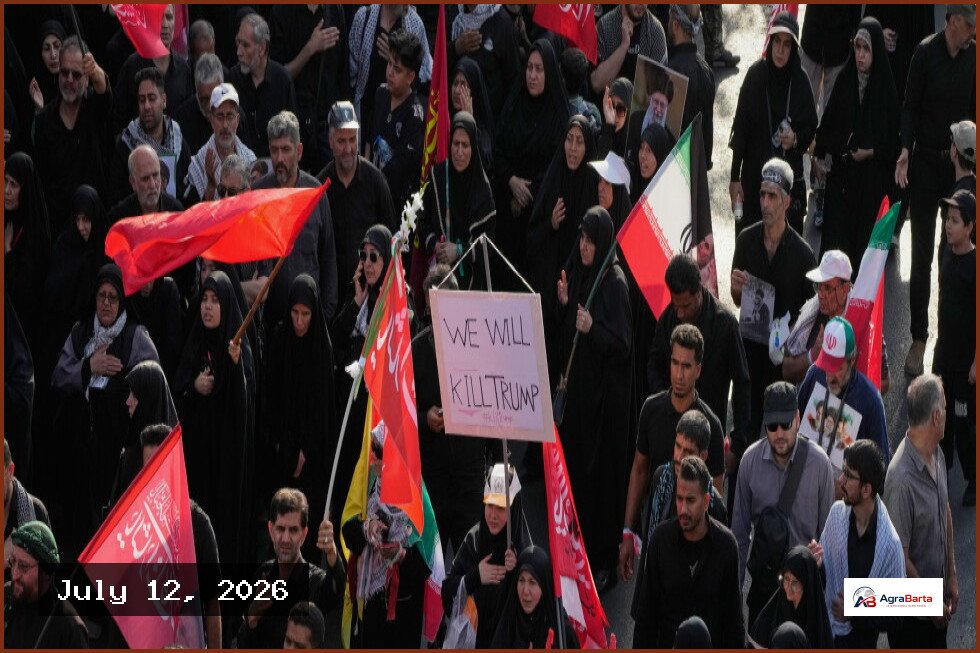
During the recent funeral ceremonies for Ayatollah Ali Khamenei, mourners in Tehran, Iran, were seen carrying signs and banners calling for the killing of both Trump and Israeli Prime Minister Benjamin Netanyahu. These events included a funeral procession on Monday, July 6, 2026, and ceremonies at the Imam Khomeini Mosalla Grand Mosque on Saturday, July 4, 2026, where messages like “We will kill Trump” were written on a wall.
The Wall Street Journal reported this week that Israel had alerted U.S. officials to new Iranian plots targeting President Trump. While the White House declined to comment on the report, Trump appeared to allude to these threats during the NATO summit in Turkey this week, stating, “They want to take out the U.S. leader — me.” Sabrina Singh, a former Biden administration deputy Pentagon press secretary, affirmed that “Iran wanting to target senior American leaders is something that we know is happening” and that these should be considered “credible threats.”
President Trump has faced security concerns previously, including two domestic assassination attempts during his 2024 presidential campaign and an incident in April when a gunman stormed the White House Correspondents’ Association dinner he was attending. Furthermore, questions regarding presidential security arose this week when Trump returned from Turkey on an older Air Force One jet instead of a newer, Qatari-gifted aircraft. The newer jet, retrofitted at an estimated cost of $400 million, reportedly lacks some missile detection and countermeasure systems present in earlier versions.
Graff explained that the U.S. has developed years of plans for the devolution of nuclear launch authority in the event of a surprise attack. During the 30 years of the Cold War, for instance, fleets of airborne command posts flew 24 hours a day with a general on board, ready to assume nuclear launch orders if Washington were incapacitated. Graff noted that while Trump might believe he has left standing orders to attack if killed, the legality of such orders is questionable because nuclear launch authority would immediately transfer to the vice president or designated successor, who would then make the ultimate decision. Trump’s social media post specifically mentioned firing missiles at Iran, an action the U.S. has taken numerous times since its war with Iran began, and did not expressly threaten the use of nuclear weapons. Graff added that a direct instruction from Trump to Vance, such as “‘If I’m killed, nuke Iran,’” would be “absolutely legal” and make more sense.
While Washington frequently receives credible threats against the president and other top U.S. leaders from Iran and other foreign adversaries, often disclosed through classified channels, it is less common for Trump to publicly declare himself a personal target. This is not the first instance of Washington issuing warnings to Iran over threats against Trump. In 2022, the Biden administration cautioned Iran against attacking U.S. citizens after the Justice Department revealed that a member of Iran’s Islamic Revolutionary Guard Corps had planned to assassinate John Bolton, Trump’s first-term national security adviser. Bolton, now a critic of Trump, pleaded guilty last month to illegally retaining classified documents in a case led by Trump’s Justice Department. Jake Sullivan, President Joe Biden’s national security adviser, stated in 2022 that “should Iran attack any of our citizens… Iran will face severe consequences.” Two years later, amidst Trump’s campaign against Vice President Kamala Harris, the Biden administration again quietly warned Iran, making it clear that an attack on Trump would be considered an act of war.
President Donald Trump speaks with reporters in flight on Air Force One after landing at U.S. Air Force Base at RAF Mildenhall, in Suffolk Eastern England, Wednesday, July 8, 2026. (AP Photo/Alex Brandon)
Vice President JD Vance speaks on the flight deck of the USS Kearsarge (LHD-3) in the New York harbor during The International Naval Review honoring America’s 250th Anniversary, Saturday, July 4, 2026, in New York. (AP Photo/Frank Franklin II)