French President Emmanuel Macron departed Cambodia on Monday following the conclusion of the Organisation Internationale de la Francophonie summit, where member states resolved to defer a bitter leadership contest between Rwanda and the Democratic Republic of Congo for one year.
Intense negotiations in Siem Reap led the 90-member bloc—comprising 53 full members, five associate members, and 32 observers—to permit incumbent Secretary-General Louise Mushikiwabo of Rwanda to remain in her post for an additional year before stepping aside for a new leader. Mushikiwabo had been seeking a third term, a bid strongly opposed by Congo, which threatened to withdraw from the organization if she were re-elected.
A Congolese exit would represent a major blow to the OIF, as Congo's population of more than 110 million vastly exceeds France’s 70 million. Tensions between the two African nations remain high over allegations from Congo, the United States, and United Nations experts that Rwanda supports the M23 rebel group operating in mineral-rich eastern Congo along the border. Rwanda’s government consistently denies backing armed groups in the region, where around 100 armed factions are active.
The French president’s office welcomed the one-year postponement, stating that the delay would allow the organization to overcome internal divisions and maintain consensus within the Francophone family. Congolese Foreign Minister Thérèse Kayikwamba Wagner echoed that sentiment in a post on X, calling the decision a "wise compromise" that safeguards unity. France holds substantial leverage within the bloc as the largest financial contributor to the OIF’s 2026 budget of 71.7 million euros ($79 million).
Prior to the agreement, Macron met on Sunday with Rwandan President Paul Kagame and urged the three African nations presenting candidates for the OIF leadership—including Mauritania—to negotiate a consensus solution. During the summit, Macron also held bilateral discussions with Cambodian Prime Minister Hun Manet and Vietnamese leader To Lam.
Human rights groups and UN Special Rapporteur Tom Andrews called on attending international leaders to pressure Cambodia to release detained rights activists and permit broader democratic freedoms within the de facto one-party state. Meanwhile, Hun Manet, who chaired the summit, used his opening remarks on Sunday to criticize neighboring Thailand, reiterating that Cambodia did not initiate the 2025 border clashes over contested territory. That conflict resulted in several dozen civilian and military casualties and displaced hundreds of thousands of people.
Macron praised Hun Manet for adopting peace as the central theme of the summit and encouraged both nations to engage in dialogue toward a peaceful, negotiated settlement. In response, Thai Prime Minister Anutin Charnvirakul stated in a Facebook post on Sunday that Thailand has always adhered to international law and respected agreements with Cambodia. He emphasized Bangkok's position that bilateral disputes must be resolved directly without third-party intervention—a stance tied to past International Court of Justice rulings that awarded Cambodia ownership of a centuries-old border temple.
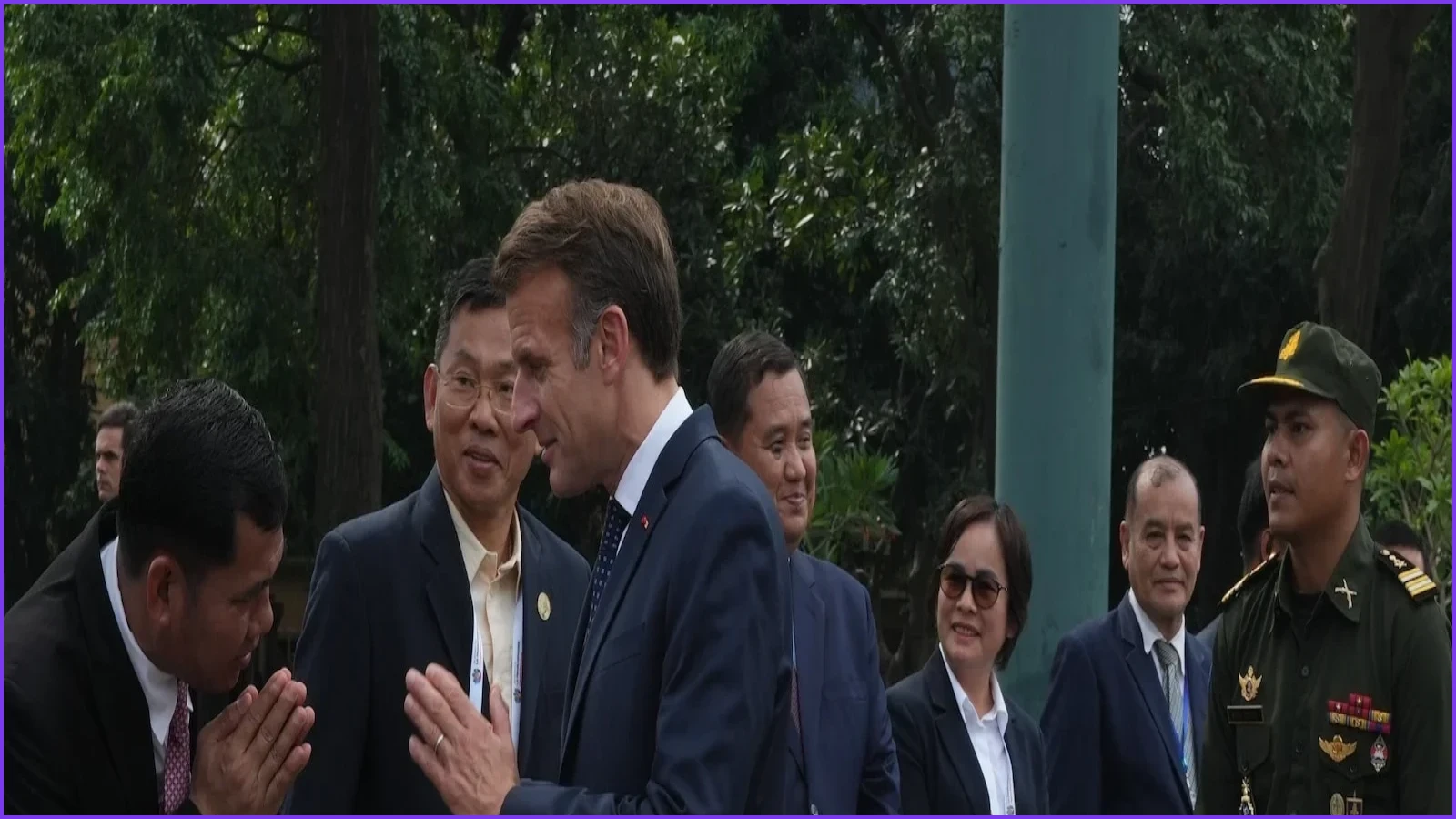
On Monday, Macron visited the UNESCO World Heritage area of Siem Reap alongside King Norodom Sihamoni to mark the completion of a French-funded restoration of the 11th-century West Mebon temple in the Angkor complex. According to Cambodia's Apsara National Authority, the 14-year restoration project cost $12 million. The joint French-Cambodian effort required transporting heavy machinery and replacement stones by boat to the island temple while carefully regulating water levels during seasonal rains to repair damage caused by natural elements, human activity, and past warfare.
Macron subsequently traveled to Malaysia on Monday evening to meet with Prime Minister Anwar Ibrahim for talks focused on defense partnerships and critical mineral supplies. The diplomatic tour in Southeast Asia comes amid severe domestic turmoil in France, where more than 600,000 protesters took to the streets earlier this month to demand higher wages and express solidarity with student movements, leading to thousands of arrests, hundreds of injuries, and arson attacks on schools.