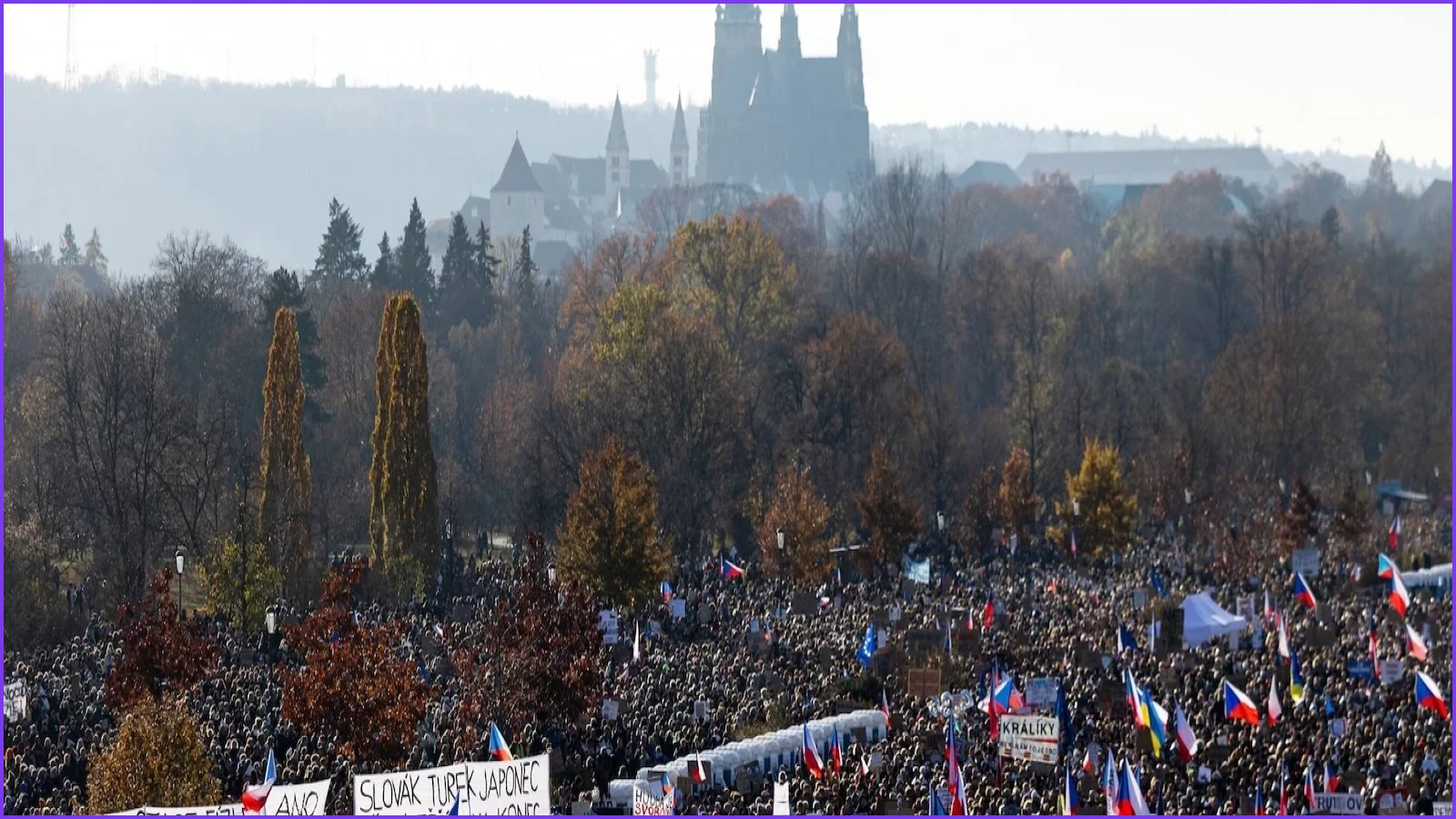
An estimated 350,000 demonstrators gathered in Prague on Sunday to demand that the Czech government withdraw a contentious plan to overhaul the funding mechanism for public broadcasters. The massive protest in Letná Park took place just two days prior to the anniversary of the 1989 Velvet Revolution demonstrations that ended over four decades of communist rule at the same historic site. Demonstrators raised grave concerns that the proposed reform, advanced by Prime Minister Andrej Babiš and his governing coalition, poses a direct threat to media independence and democratic institutions.
Mikuláš Minář, the lead organizer from the protest group Million Moments for Democracy, described the turnout as historic. “We do witness here something extraordinary today,” Minář declared to the crowd. Protesters held banners carrying messages such as “Hands off the media” and “We refuse the Slovak scenario,” expressing fears that the Czech Republic could follow the path of populist leadership in neighboring Slovakia under Prime Minister Robert Fico, as well as political developments in Hungary before former Prime Minister Viktor Orbán was ousted from power in April.
Under the proposed legislation, Czech public television and radio stations would no longer be funded through regular license fees paid by individuals, households, and businesses. Instead, financing would be drawn directly from the state budget. Opponents warn that shifting control to state coffers would reduce broadcaster funding by approximately 15%, likely forcing staff layoffs, restricting production capacity, and triggering program cancellations. Critics argue this structure provides the three-party coalition with financial leverage to exercise political control over news coverage.
The legislative fight escalated on Oct. 24 when ruling coalition lawmakers unexpectedly moved the bill forward in the lower house of Parliament. After restricting opposition speaking time, lawmakers voted at 4:36 a.m. to pass the measure through its initial reading. The early-morning procedure triggered immediate pushback, drawing thousands of protesters to the streets the next day. By Nov. 3, public media staff launched a strike that received widespread backing from labor unions, universities, student bodies, churches, artists, athletes, and international media organizations. Addressing the Letná Park gathering, Minář underscored their opposition to the government's parliamentary tactics, saying, “We are here to stand up against the rule by force in the style of 4:36.”
The legislative overhaul also prompted international scrutiny. On Wednesday, the European Parliament conducted a debate regarding media freedom and rule-of-law standards in the Czech Republic. EU Justice Commissioner Michael McGrath emphasized that national laws governing public broadcasting must guarantee “adequate, sustainable and predictable financial resources” while relying on transparent and objective allocation criteria.
Despite the widespread opposition, Babiš vowed to push the funding reform through Parliament, dismissing claims that it compromises media freedom. The billionaire populist regained power following last year's election, when his ANO (YES) movement formed a governing alliance with two smaller factions: the right-wing Motorists for Themselves and the anti-migrant, pro-Russian Freedom and Direct Democracy party. Babiš has routinely contested major European Union policies on environmental regulation and migration. Furthermore, his government rejected financial aid and loan guarantees intended to help Ukraine resist the Russian invasion. Confronting criticism from NATO allies over insufficient defense spending, the Letná Park demonstrators also condemned the administration's defense stance and demanded the immediate resignation of Defense Minister Jaromír Zůna, who represents the Freedom party.