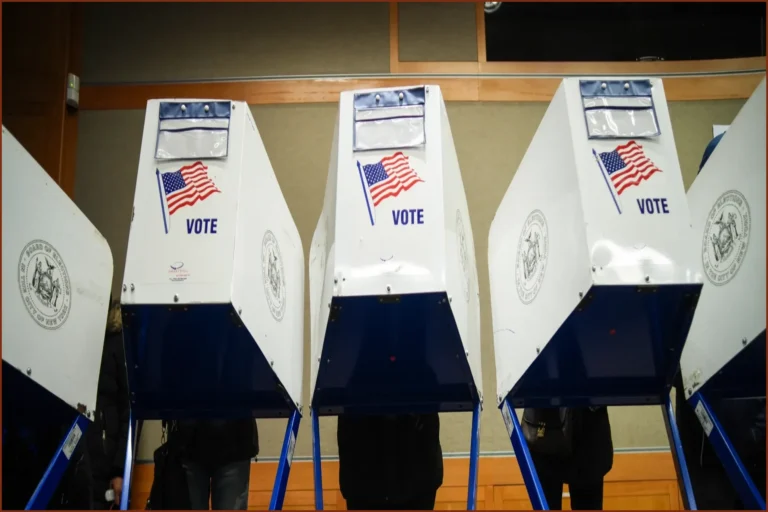
The United States is currently engaged in midterm elections to determine the composition of the Senate, the House of Representatives, and the leadership of state executive branches. Because most legislative seats are considered reliably held by one party, the overall control of Congress depends on a limited number of competitive battleground races. Experts monitor these contests to predict the final outcome; a party winning seats they were expected to lose is often a signal of a successful election night. In tracking these results, blue shapes represent Democratic gains, while red shapes indicate Republican successes.
The Cook Political Report identified six Senate races as genuine toss-ups prior to the election. To achieve a majority, Democrats must secure at least three of these, in addition to the seats they are expected to win. In the House of Representatives, where Republicans are defending their majority, Democrats hold 212 seats and need 218 to gain control. Democrats are currently favored in enough seats to win the chamber without needing any of the 18 races classified as toss-ups by the Cook Political Report. If they hold all seats rated as lean-Democratic, they will secure a majority. Conversely, Republicans, who are favored in 195 seats, would need to sweep all 18 toss-ups and flip five Democratic-leaning seats to maintain their control of the 435-member House.
The legislative branch is divided into two chambers. The House of Representatives has 435 voting seats, with members serving two-year terms. The speaker of the House is elected by the representatives to serve as the presiding officer. The House holds exclusive powers, including the initiation of revenue bills, the impeachment of federal officials, and the authority to elect the president if there is an electoral college tie. The Senate consists of 100 members serving six-year terms, with one-third of the chamber up for election in each two-year cycle. Each state is represented by two senators, regardless of population size. Beyond passing legislation, the Senate holds the power to approve senior presidential appointments, such as those to the supreme court, provide advice and consent on treaties, and conduct impeachment trials for federal officials.
Gubernatorial elections are occurring in 36 states and three territories. Before this election, Republicans and Democrats each held 18 of these governorships, with three incumbents retiring. Governors are elected by direct vote and serve four-year terms, except in Vermont and New Hampshire, where terms are two years. They are responsible for implementing state laws and possess powers including the use of executive orders, budget management, and legislative vetoes.
Voting systems vary across the country. Most states use a first-past-the-post system, but Georgia and Louisiana require a winner to receive at least 50% of the vote, triggering a runoff between the top two candidates if no one reaches that threshold. Maine and Alaska utilize ranked-choice voting, where voters rank candidates by preference. Additionally, some states use top-two or jungle primaries where candidates from all parties compete, and the top two vote-getters advance. Florida and Ohio are holding special elections for the Senate this year because the previous officeholders, Marco Rubio and JD Vance, resigned to join the executive branch following the 2024 presidential election. Election results are reported by the Associated Press, which calls a state for a candidate once it determines the trailing opponent has no path to victory, even if 100% of the votes have not yet been counted.