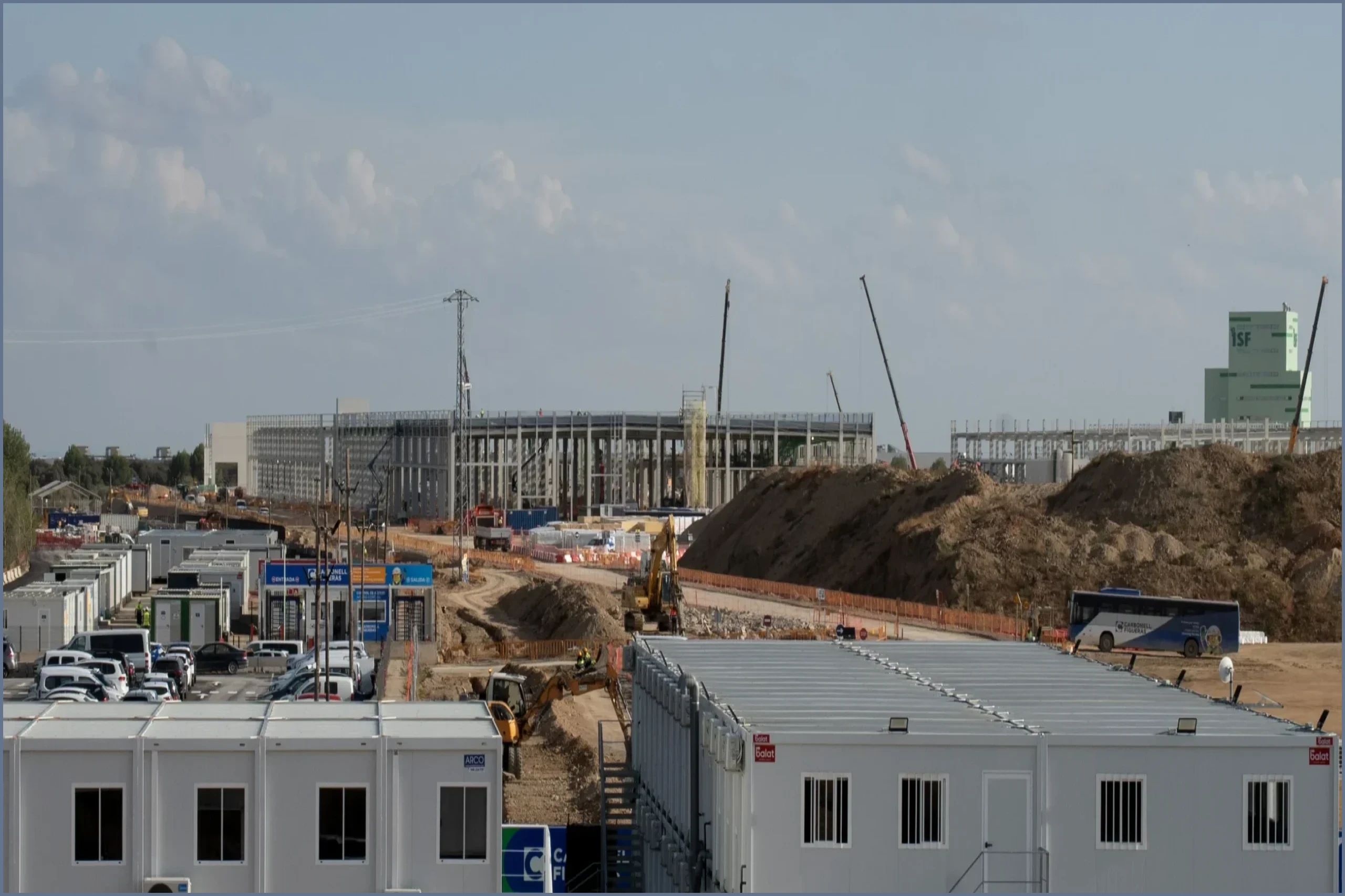
Heavy excavators are carving deep into the rugged, sun-baked plains of northeastern Spain as global technology companies compete to establish massive infrastructure for the expanding artificial intelligence industry. Across the drought-stricken landscape of Aragon, vast construction sites are replacing traditional rural scenery with high-security data facilities, reshaping the environment and dividing local communities.
Decades ago, author George Orwell described this arid terrain during the Spanish Civil War in 1930s Homage to Catalonia, writing of scattered structures visible as "a few tiny cubes sprawled like a throw of dice." Today, that open countryside is being reconfigured by multinational corporations seeking land, power, and operational capacity for energy- and water-intensive computing centers. Amazon Web Services has committed to spending almost $40 billion across multiple sprawling complexes in the region, including a single installation designed to cover an area equivalent to 600 American football fields. Asset management giant Blackstone and tech giant Microsoft are also expanding their footprint in Aragon through major data center development agreements.
While nations elsewhere in Europe adopt stricter regulatory limits on data center expansion—and as Spain's central government considers fresh national rules—Aragon's regional leadership is pursuing the opposite path. Striving to establish the region as the "Virginia of southern Europe," modeled after the U.S. state known for hosting the world's dense concentration of data centers, regional authorities are betting that tech infrastructure will anchor future economic growth and generate local employment. Regional government economic counsellor Eva Valle defended the initiative, stating that a new economy is evolving and, while it remains difficult to foresee how many secondary activities will surround it, those developments are actively arriving.
To entice corporate developers, regional officials granted projects a special regulatory status typically reserved for developments serving the direct general interest of the public. This designation grants developers fast-tracked planning permissions, provides significant tax breaks, empowers land expropriation, and strips local municipal mayors of their traditional veto powers. Furthermore, the framework restricts the formal public window for filing legal objections to just 23 working days. During a recent Amazon Web Services proposal, the regional government opened the public opposition window over the Christmas holiday period. Opponents accused officials of trying to push the measures through while citizens were distracted, though regional representatives denied the allegation.
The speed and structure of these administrative approvals have alienated many small-town residents and local municipal leaders who feel excluded from decisions fundamentally reshaping their surroundings. In the hilltop village of Botorrita, farmland located right next to residential properties is designated for conversion into a vast data complex. Resident Silvia Baselga and her family first discovered the impending construction when survey markers appeared in the earth just beyond their garden wall. When they sought clarification at the local city hall, municipal officials admitted they had received no prior information. Planning documents made public later revealed that the facility's outer perimeter would sit within 300 feet, or approximately 80 meters, of their residence, with the overall footprint of the complex expanding larger than the village itself.
Baselga explained that her parents had retired to Botorrita specifically to enjoy the quiet routine of a tight-knit rural community overlooking open fields and rolling hills. To dampen operational sound, the operating firm is expected to erect a 20-foot-high sound barrier wall, similar to structures placed near developments in neighboring towns. Baselga noted that opening their home windows will yield a view of nothing but a tall wall, while 24-hour security floodlights will erase the view of the night sky, creating living conditions akin to residing next to a prison facility.
Official documents show that at least 27 data centers are slated for construction across Aragon, spanning roughly 7 square miles of land. While Spanish and other international developers hold a minor share, American tech corporations dominate the development pipeline. At least one planned installation partially encroaches on land originally set aside and classified as protected for natural ecosystems. In response to community concerns, Amazon Web Services stated that its regional facilities will create 6,200 permanent operations jobs once construction is fully finalized. However, local residents and environmental organizations contend that the influx of heavy industry brings severe ecological instability.
A principal source of friction is the massive volume of water required to cool thousands of high-performance computing servers in one of Spain's most climate-vulnerable zones. Aragon experiences recurring severe droughts, and key water resources like the Sotonera reservoir—which supplies critical drinking water and agricultural irrigation to communities across the Huesca and Zaragoza provinces—are under sustained stress. Generational farmer Julio Enfedaque, working parched fields in Villanueva de Gallego, recalled that his land received virtually no rain for four straight months this year, forcing government authorities to cut agricultural water allocations by two-thirds. Enfedaque expressed deep skepticism that agricultural water supplies would remain unaffected, noting that competing with hungry corporate facilities will make continuing his family's ancestral farming traditions increasingly unviable. Consequently, he has urged his nephews to abandon agricultural work and seek alternative careers.
Addressing water usage concerns, Amazon Web Services policy head for Spain and Portugal, David Blázquez, stated that company facilities engage evaporative cooling systems only when ambient temperatures reach 86 degrees Fahrenheit. Blázquez added that the corporation is investing millions of dollars into local public infrastructure to repair leaking pipelines and is collaborating with local farmers to integrate artificial intelligence software for optimized irrigation efficiency. He emphasized that the company aims not only to minimize its direct water intake but also to improve overall municipal infrastructure in host communities.
Despite those assurances, tech firms maintain strict secrecy surrounding site-specific natural resource consumption, keeping individual location metrics confidential under corporate disclosure policies. Nevertheless, regional governmental records show that Amazon's three existing, smaller operational data centers in Aragon consumed 68 million liters of water—a figure 48 percent higher than the initial estimates the corporation originally submitted to regional authorities.
Electricity consumption presents an equally significant challenge. The sheer volume of power required to operate planned facilities far outpaces the existing local grid demand. While data centers in North America often rely on natural gas, developers in Aragon maintain that their operations will draw primarily from renewable energy infrastructure, supported on-site by industrial diesel backup generators. Blázquez highlighted that Amazon Web Services has secured 100 renewable energy power agreements across Spain, including 17 designated clean energy projects located directly within Aragon.
However, field biologists and ornithologists caution that the rapid, unchecked expansion of utility-scale wind farms and solar arrays presents catastrophic threats to regional wildlife. Aragon serves as a vital feeding habitat for native raptors and acts as an essential flight corridor for migratory birds. Ornithologist José Antonio Pinzolas explained that large birds like vultures rely on warm thermal air currents to lift them into the sky, leading them directly into high-speed wind turbine blades that function, from the birds' perspective, like flying knives.
Aragon's official environmental protection agency has formally warned that expanding wind turbine installations poses an extreme collision risk to protected species, including the endangered red kite. Regional data shows a marked increase in bird and bat fatalities tracking the growth of the renewable energy sector. Juan Ballesteros, an agent with the local government's Environmental Protection unit (Protección de la Naturaleza), reported routinely collecting the remains of ospreys, golden eagles, kestrels, and black vultures from wind power sites. Ballesteros recounted having to place splayed corpses of young Eurasian black vultures into body bags at the foot of tall wind turbines, describing how his professional duties have shifted from active wildlife preservation to managing industrial animal mortalities.
When questioned about wildlife destruction caused by renewable energy expansion, Blázquez stated that Amazon Web Services definitely shares those ecological concerns, adding that the corporation exclusively contracts with renewable energy developers that comply with standing environmental regulations. Pinzolas countered that persistent mortality rates prove existing regulatory protocols are failing to safeguard vulnerable bird populations.
In response to mounting environmental impacts, local advocacy groups have joined forces to take formal action. Activist organization Ecologistas en Acción, alongside several partnered environmental groups, raised funds through public crowdfunding to initiate legal proceedings against Amazon Web Services' development plans in Aragon. The lawsuit targets the regional government's fast-track approval process, challenging the administrative mechanisms used to bypass standard public oversight. Ecologistas en Acción spokesperson Luis García stressed that serious risks concerning water depletion, high power grid consumption, regional industry disruption, and ecosystem loss outweigh any potential corporate economic contributions.
Resistance has also spilled onto city streets. In the regional capital of Zaragoza, hundreds of demonstrators recently marched down major avenues to protest a proposed data facility located adjacent to an urban pine forest. Protesters expressed deep concern that heat generation and constant ambient noise from the facility would ruin a serene natural sanctuary heavily relied upon by urban residents during extreme summer heatwaves.
During the demonstration, local resident Marian Rams emphasized that standing up against rapid industrialization is necessary to preserve remaining pine forests and shield the local environment from aggressive corporate interests that prioritize profit over community wellbeing. Nearby, demonstrator Ana Domezian, marching alongside her young children, echoed those sentiments, stressing that failing to defend local natural resources now will leave future generations without an ecological heritage.