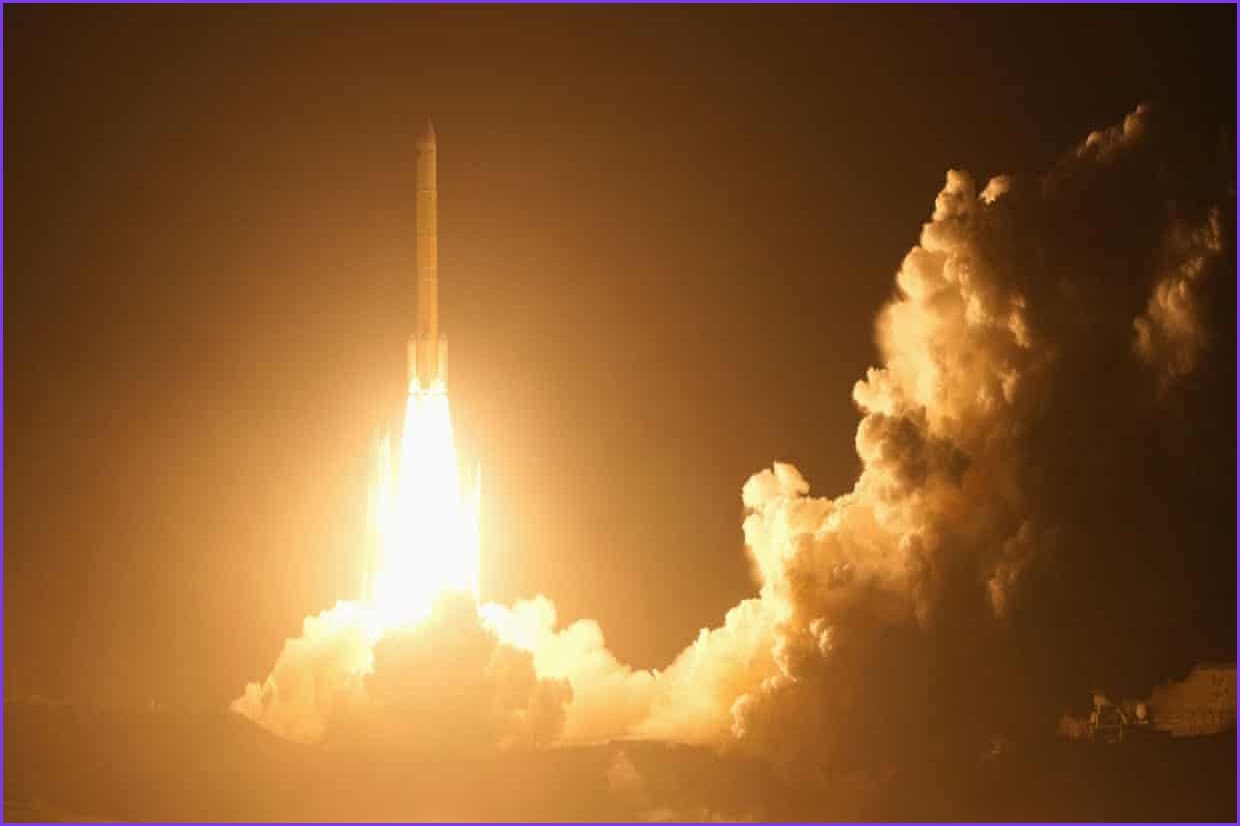
Japan has successfully launched an ambitious space mission aimed at retrieving samples from one of Mars's moons, a project scientists believe could provide vital evidence regarding the origins of the solar system and the development of life on Earth. The Martian Moons Exploration (MMX) spacecraft lifted off from the Tanegashima Space Centre in Japan’s far south-west at 4:41am, carried by the country’s flagship H3 rocket.
Witnessed by thousands who gathered to watch the event, the launch was declared a success by the Japan Aerospace Exploration Agency (Jaxa) approximately an hour later, once the spacecraft had separated from the rocket’s upper stage. The mission is expected to reach the Martian orbit by August of next year.
The primary target of the $578m mission is Phobos, a small, pock-marked moon measuring 14 miles (22.5km) in diameter. The moon orbits Mars three times daily at an altitude of approximately 6,000km. Once the five-tonne spacecraft syncs with the orbit of Phobos, it will deploy a French-German rover named Idefix. Due to the moon's extremely low gravity, which is only 1/1,000th as strong as that on Earth, the four-wheeled rover is designed to bounce across the surface for several minutes before stopping. Idefix will spend 100 days surveying the terrain to identify safe landing and sampling locations.
Following the survey, the main stationary lander will touch down on Phobos, where it will spend two hours drilling and vacuuming up at least 10g of soil and rock. The craft is then scheduled to return to Earth in 2031, following observations of Mars’s smaller moon, Deimos, during several flybys. The mission is set to conclude its time in Mars’s orbit in November 2030.
This mission involves collaboration between five space agencies and marks the first attempt to land on Phobos or Deimos. Experts are divided on the origin of these moons; the “giant impact” hypothesis suggests they formed from debris following a collision with Mars, while the “capture” hypothesis posits they are asteroids pulled in by the planet's gravity. Determining the correct theory will help scientists understand how habitable environments arose on terrestrial planets.
While the US and China are also competing to return Martian surface samples, the Japanese-led mission represents a unique opportunity. Nasa’s Perseverance rover has collected samples, though their return was halted by the Trump administration after a congressional vote in January this year, and China’s Tianwen-3 mission is currently scheduled for a 2028 launch.