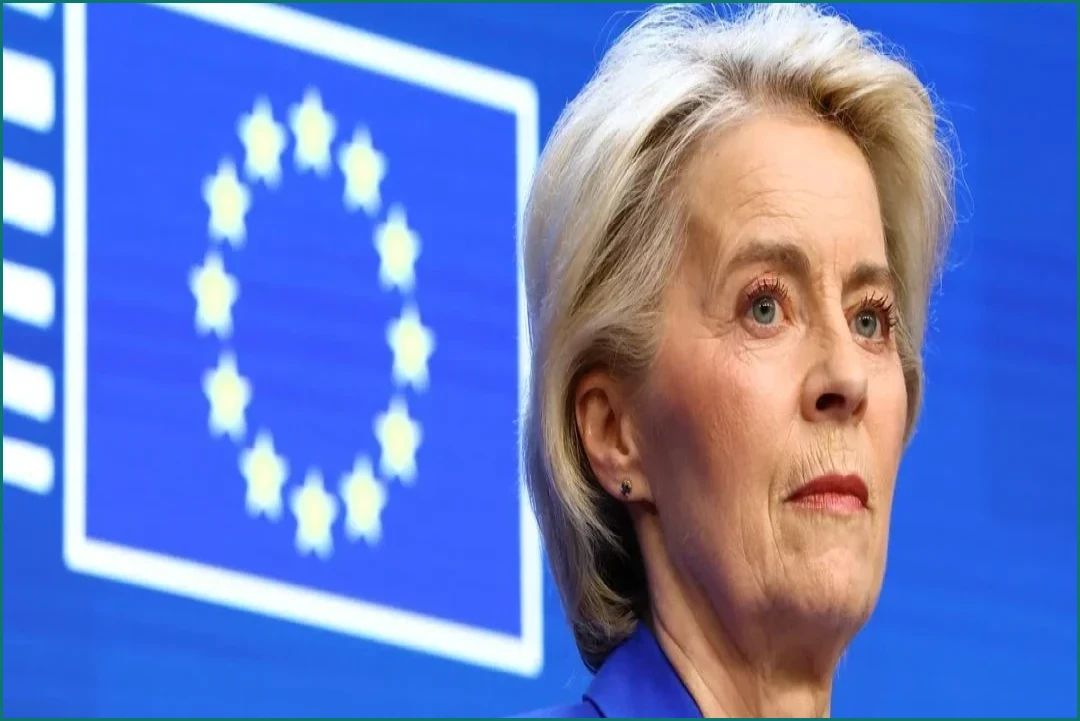
European Commission President Ursula von der Leyen has announced that the European Union will develop a new mechanism designed to swiftly block access to the bloc’s single market during a trade war. This strategic move follows recent calls from France and Germany to bolster the EU’s legal defenses in anticipation of potential trade conflicts, specifically concerning China. Addressing reporters in Brussels, von der Leyen stated that the new instrument would allow for decisive action by limiting market access where it serves the union’s interests, ensuring such measures can be implemented quickly and immediately.
Beyond market access, von der Leyen emphasized the urgent need for Europe to overhaul its energy consumption patterns. She warned that the bloc’s continued reliance on imported fossil fuels has inflated costs by $119 billion without providing any additional energy benefits. During a press conference following the summit, she highlighted that this dependence leaves the European economy vulnerable to uncontrollable geopolitical developments. Statistics shared by the Commission indicate that gas prices have surged by approximately 140 percent since late February, while diesel prices have doubled, underscoring the severity of the ongoing energy crisis. She urged a transition toward clean, domestically produced energy, including renewables and nuclear power.
European Council President Antonio Costa reinforced these concerns, noting that high and volatile energy prices significantly impact businesses and households, thereby threatening Europe’s overall competitiveness. Costa attributed these challenges to the bloc's fossil fuel dependence and the lack of a fully integrated single energy market. To track progress on competitiveness and defense, Costa announced he would convene an informal meeting of EU leaders in Alden Biesen, Belgium, in February 2027.
The Commission also outlined several short-term measures to mitigate the impact of rising energy prices. These actions include the release of 100 million barrels of oil and diesel over the next four months through the International Energy Agency, the extension of a temporary state aid framework originally introduced in February, and a one-year postponement of methane regulation implementation. Furthermore, the EU plans to launch a strategic dialogue on European refineries to boost domestic refining capacity and lower consumer prices.
Addressing trade relations with China, von der Leyen called for a substantial and rapid rebalancing of economic ties. She reported that the EU’s trade deficit with China reached €1 billion per day in 2025 and cautioned that this imbalance is projected to worsen throughout 2026. Regarding the bloc’s geopolitical commitments, Costa affirmed that support for Ukraine remains a priority, noting that financial needs for the current year have been identified. He requested that the European Commission propose additional measures to cover financial requirements for 2027.