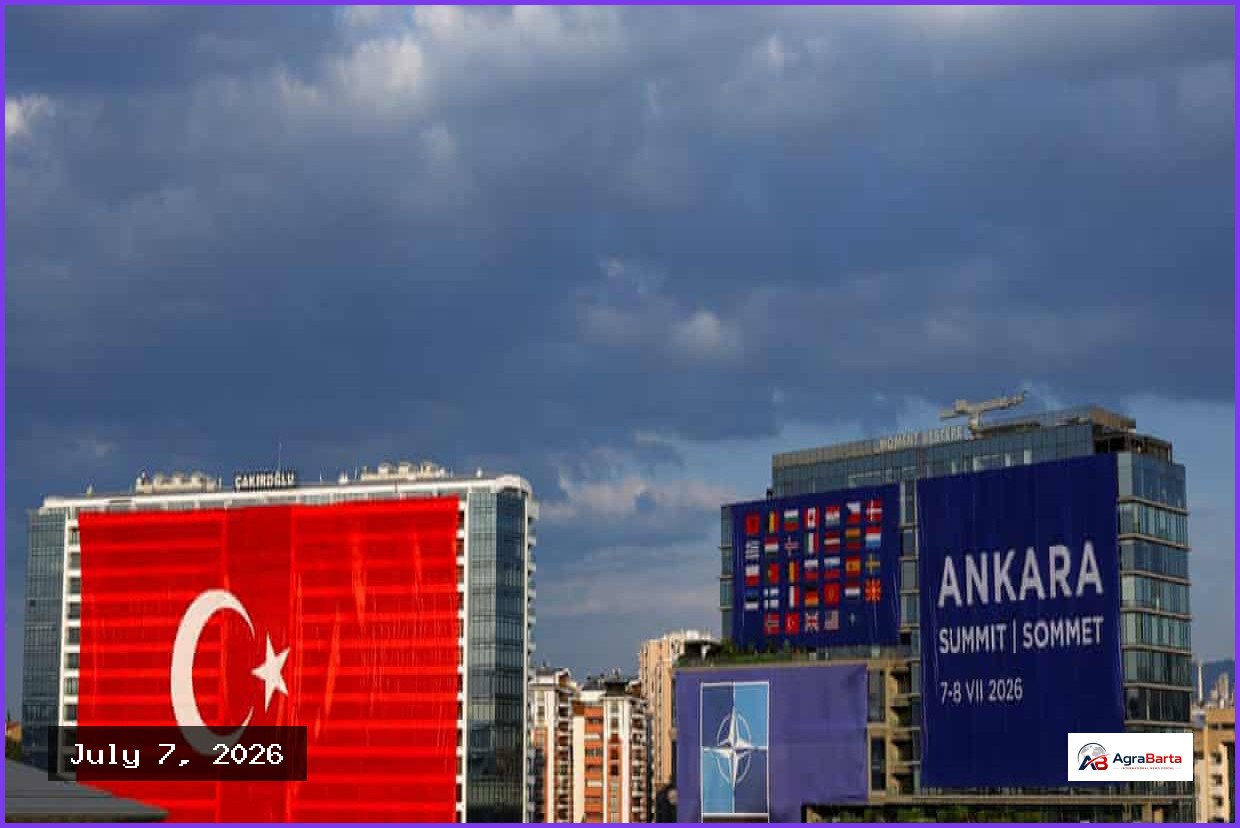
Nato leaders are set to gather in Ankara this Tuesday for a two-day summit, marking the conclusion of a turbulent six-month period for the 32-member alliance. The meeting comes as the organization seeks to manage an unpredictable relationship with Donald Trump, who continues to demand that member states significantly increase their defence spending.
Nato Secretary General Mark Rutte emphasized the urgency on Monday, calling for allies to provide clear, concrete, and credible plans to reach spending targets. Rutte noted that President Trump expects members to move toward a 5% spending path immediately. To demonstrate their commitment, allies are expected to unveil tens of billions of dollars in new arms contracts during an industry forum on the sidelines of the summit.
A primary point of focus for the summit is a planned commitment of €70bn (£60bn) in military aid for Ukraine for the current and coming year, though officials acknowledge these are largely pre-existing pledges. In recent discussions, Rutte has attempted to highlight the progress made by non-US members, presenting Trump with data on the “Trump trillion”—the cumulative defence spending by European allies and Canada since 2017. Despite these efforts, Trump recently posted a graphic on Truth Social criticizing the disparity between the US’s $999bn (£747bn) expenditure and the contributions of allies, labeling the current relationship as non-reciprocal.
Diplomatic tensions have been further exacerbated by a series of unilateral US actions. These include Trump’s threat to take control of Greenland from Denmark, the lack of consultation regarding the US-Israel military operation against Iran, and subsequent complaints when allies refused to permit US jets to launch strikes from their territory. Additional friction has emerged from public spats with leaders including Keir Starmer of the UK, Giorgia Meloni of Italy, and Mark Carney of Canada.
The US is also planning to cut the number of troops and materiel it assigns to Europe in the event of a war with Russia, reducing the number of F-15 and F-16 jets by a third. Last month, Pete Hegseth, the US defence secretary, said he would hold a further review, looking at US current forces in Europe, and threatening to cut numbers the most in countries that were spending the least. In preparation for the summit, efforts have been made to “Trump-proof” the proceedings, with former spokesperson Oana Lungescu suggesting the final communique will likely be a brief, one-page document reaffirming core principles, including the “ironclad” Article 5 commitment.
Despite the high-stakes environment, the US delegation will be substantial, with 1,400 staff accompanying Trump. The president’s itinerary in Turkey includes a meeting with Syrian president Ahmed al-Sharaa and Ukraine’s Volodymyr Zelenskyy, alongside the scheduled summit events at President Recep Tayyip Erdoğan’s palace. Success for the alliance, according to observers, will be measured by the avoidance of public outbursts from the US president and a clear reaffirmation of unity.
The elementary communication was intended to show, in Rutte’s words, that Trump “is successful in terms of getting the Europeans to spend more”. But with transatlantic relations already at a low, and with the US keen to ensure steps are being taken to honour the 3.5% commitment, a diplomatically harmonious summit cannot be guaranteed.
Introducing the graphic, he wrote: “Ridiculous for the U.S.A. to continue along this one-sided path when the relationship is not reciprocal.”