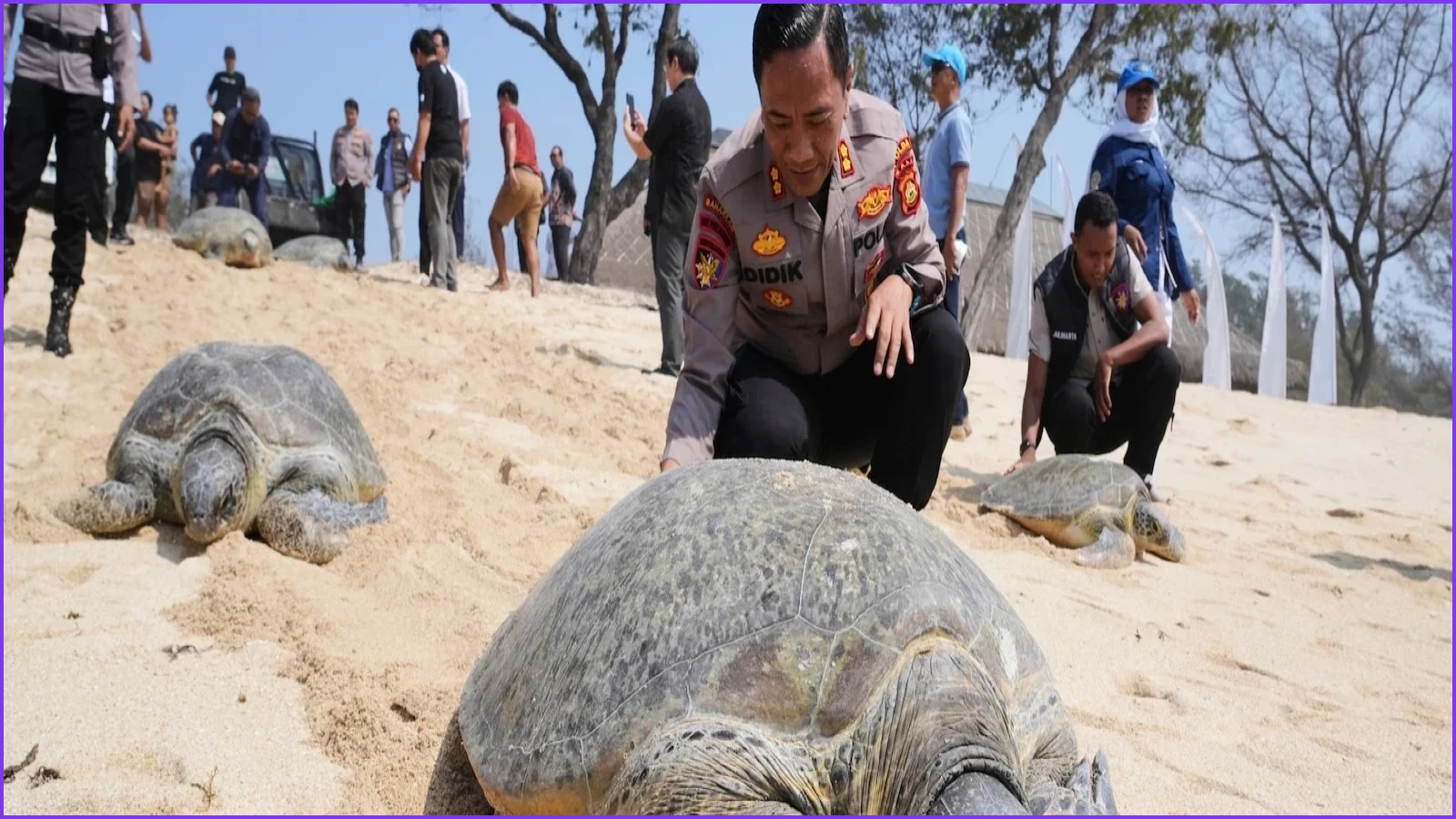
Indonesian officials on the tourist island of Bali successfully released 20 protected green sea turtles back into the ocean on Tuesday. The animals had been seized by authorities after being discovered on an empty boat, which appeared to have been abandoned by wildlife smugglers fleeing a police operation.
The rescue mission took place following an incident on Saturday, when marine police in Bali intervened to stop a suspected smuggling attempt involving 22 green sea turtles, scientifically known as Chelonia mydas. Officers acted after receiving reports from local residents regarding suspicious activity in the waters near Serangan Island. While all 22 turtles were found alive on the vessel, the suspected smugglers had already escaped the area by the time law enforcement arrived.
Before the release, the turtles underwent final health evaluations at a conservation center located on Serangan Island, commonly referred to as Turtle Island, in southern Bali. Following these checks, officials used blue cloths to carefully lift the animals and transported them to the shoreline via a small truck. According to Gusti Agung Purnama Wirahadi of the Bali Water and Air Police, two of the rescued turtles remain ill and are currently receiving medical treatment before they can be cleared for release.
Wirahadi expressed a firm stance against the illegal trade, stating, “We hope that no one will dare to capture, keep, or trade these protected species anymore.”
Sea turtles have been protected in Indonesia under fisheries and conservation laws since 1990, with a 2018 Environment Ministry regulation providing further clarification on the protections afforded to the six species found in the nation's waters. The trade of these animals is strictly prohibited by government regulations. A 2022 global study from Arizona State University highlighted the severity of the threat, noting that green sea turtles accounted for 56% of all sea turtle killings recorded during the 30-year period ending in 2020. Historically, Bali served as a significant hub for this trafficking, partly due to the traditional use of turtle meat in offerings within Balinese Hinduism.