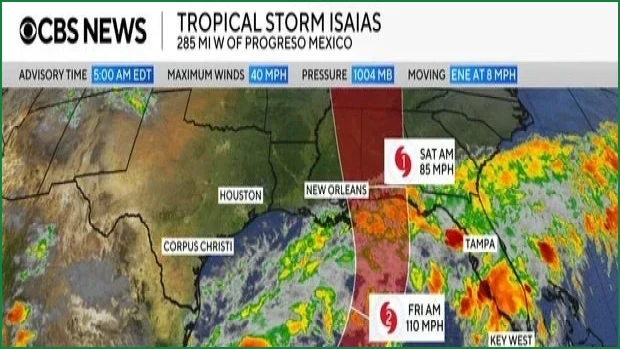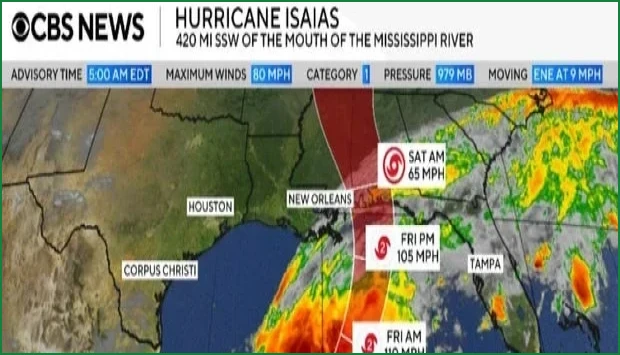
Hurricane Isaias has officially become the first hurricane of the 2026 Atlantic season after intensifying from a tropical storm late Wednesday night. Early Thursday, the storm was continuing to strengthen, with forecasters projecting a landfall along the U.S. Gulf Coast late Friday or early Saturday. The system currently poses a significant threat to coastal regions in Mississippi, Alabama, and the western portion of the Florida Panhandle.
According to the National Hurricane Center, Isaias—pronounced "ees-ah-EE-ahs"—carried maximum sustained winds of 80 mph as of early Thursday. Its core was positioned approximately 420 miles south-southwest of the mouth of the Mississippi River. The Miami-based center expects additional strengthening through early Friday, noting that the system should remain a strong hurricane as it nears the northern Gulf Coast on Friday night. Officials have stressed that preparations to protect life and property from storm surge and damaging winds within the warning area must be rushed to completion today.
A hurricane warning is currently in effect for the northern Gulf Coast, stretching from Ocean Springs, Mississippi, across Alabama to the Bay/Gulf County line in Florida. Additionally, a tropical storm warning has been issued for the coastline from Louisiana's Jefferson/Plaquemines Parish line to west of Ocean Springs, and from east of the Bay/Gulf County line to Florida's Aucilla River. A storm surge warning is also active from the mouth of the Mississippi River to the Steinhatchee River in Florida.
In response to the threat, Florida Governor Ron DeSantis has declared a state of emergency for more than two dozen counties. Alabama Governor Kay Ivey has also issued a state of emergency covering 40 counties. Rainfall forecasts indicate that 3 to 7 inches of rain are expected, with some locations potentially seeing up to 10 inches along the coast from southeastern Louisiana to the Florida Panhandle. Heavy rainfall is also anticipated across much of the Southeast, extending as far north as the Tennessee Valley and the Carolinas.
The 2026 Atlantic hurricane season, which runs from June 1 through November 30, has been unusually quiet. Data from the National Hurricane Center, based on climate figures from 1991 to 2020, indicates that an average season typically produces 14 named storms, seven hurricanes, and three major hurricanes. While the first named storm usually forms in mid-to-late June and the first hurricane in early-to-mid August, this year has seen less activity than anticipated. Meteorologists attribute the quiet season to a strong El Niño, which has led to cooler water temperatures and wind patterns that dampen the development of tropical systems.