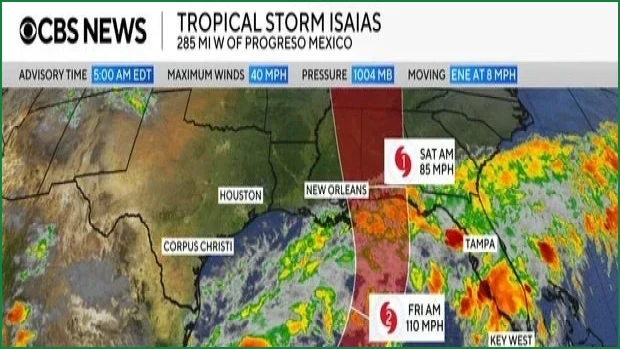
The National Hurricane Center has issued hurricane, tropical storm, and storm surge watches across portions of the U.S. Gulf Coast as Tropical Storm Isaias undergoes a period of rapid intensification. Currently swirling within the Gulf, the system is expected to approach the region by Friday after transitioning into a hurricane. Isaias represents the ninth named storm of the 2026 Atlantic season and stands to be the season's first hurricane, a notable development with less than two months remaining before the season officially concludes on November 30.
Originating from Tropical Depression Nine on Wednesday, the storm is projected to move north of Mexico's Yucatan Peninsula on Thursday. Forecasters anticipate landfall along the northern U.S. Gulf Coast late Friday or early Saturday. As of Wednesday evening, the storm maintained maximum sustained winds of 65 mph, with tropical storm-force winds extending outward up to 60 miles from the center. Meteorologists expect the system to reach hurricane status, requiring wind speeds of at least 74 mph, by Thursday morning.
A hurricane watch is currently in effect for the northern Gulf Coast from Bay St. Louis, Mississippi, to Indian Pass, Florida. Additionally, tropical storm watches cover areas from Bay St. Louis to the Jefferson/Plaquemines Parish line in Louisiana, and from Indian Pass to the Aucilla River in Florida. A storm surge watch has also been established from the mouth of the Mississippi River to Yankeetown, Florida.
The storm is forecast to bring heavy rainfall to the Gulf Coast and the Southeast through early next week, with projected totals of 3 to 6 inches, and isolated areas potentially seeing up to 10 inches from southeastern Louisiana to the Florida Panhandle. Long-range models indicate this moisture could extend into the Ohio Valley and the Northeast by midweek. The hurricane center has further warned of potential urban and isolated river flooding.
State officials have begun active preparations. Florida Governor Ron DeSantis signed an executive order declaring a state of emergency for 25 counties to allow for resource allocation in the Panhandle and Big Bend regions. Similarly, Alabama Governor Kay Ivey issued a state of emergency for 40 counties on Wednesday to facilitate necessary preparations ahead of the storm's arrival.
Historically, "I"-named systems in the Atlantic basin are frequently retired, including notable storms such as Ian in 2022, Ida in 2021, Irma in 2017, and Irene in 2011. Isaias was added to the rotating six-year list after the retirement of Ike in 2008.