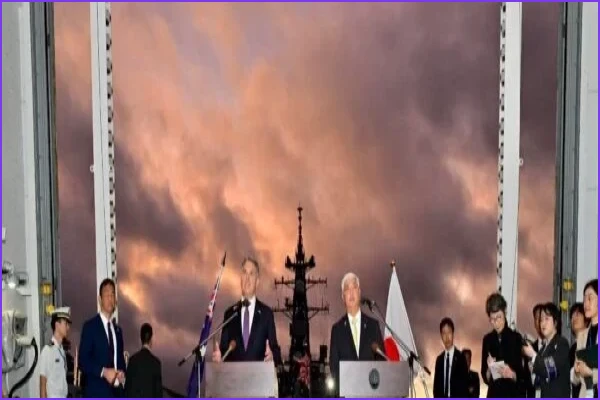
Japan’s Defense Minister Nakatani Gen and Australia’s Defense Minister Richard Marles held a joint press announcement on September 5, 2025, aboard the Japan Maritime Self-Defense Force’s Mogami-class stealth frigate JS Mikuma. The event took place at the Japanese naval base in Yokosuka, Japan, highlighting a significant step in their comprehensive security partnership.
The ministers emphasized the profound transformation occurring in the Indo-Pacific security environment. This includes deepening cooperation among revisionist powers such as China, Russia, and North Korea, alongside shifts in the strategic priorities of the United States, which has historically anchored regional order. Concurrently, rapid technological advancements in areas like artificial intelligence, autonomous systems, unmanned platforms, quantum technologies, and cyber capabilities are fundamentally altering the nature of warfare and sources of military advantage.
Against this complex backdrop, Japan and Australia are deepening their security ties across both military and economic domains, with a growing focus on building strategic autonomy and strategic resilience. Strategic autonomy, in this context, does not imply independence from the United States but rather aims to reduce excessive reliance on any single major power, thereby preserving greater strategic choice and freedom of action. Strategic resilience, meanwhile, refers to the capacity to withstand and recover from significant shocks, whether from military conflict, economic coercion, supply-chain disruptions, or energy crises. These concepts provide a framework for the current and future direction of Japan-Australia cooperation.
For much of the post-Cold War era, both nations benefited from what was termed “dual dependence,” relying heavily on the United States for security while developing deep economic interdependence with China. This arrangement offered security at relatively low defense costs and substantial economic benefits from China’s growth. However, as U.S.-China rivalry and broader great-power competition intensify, this model is becoming increasingly unsustainable. Neither replacing U.S. dependence with Chinese dependence nor pursuing economic decoupling from China is considered a viable option. Instead, the objective is to diversify dependence itself, expanding the range of available partners and capabilities to mitigate vulnerability to any single major power’s decisions.
This diversification has guided the Japan-Australia relationship in recent years. While maintaining their respective alliances with the United States, both countries have strengthened their own capabilities and forged a more autonomous bilateral security relationship. This partnership now extends beyond merely supplementing the U.S. military presence in the region.
A prime example of this enhanced cooperation is Australia’s acquisition of Japanese-designed Mogami-class frigates. This collaboration signifies more than just a platform transfer; it is evolving into sustained cooperation across joint development, production, maintenance, and future technologies. Such efforts are expected to bolster the defense industrial bases of both countries, enhancing their ability not only to acquire military capabilities but also to produce, maintain, and sustain them over time.
Australia’s strategic depth also plays a crucial role. Japan is geographically situated on the front line of the First Island Chain, whereas Australia offers vast training areas, logistics, maintenance, and rear-area support. By developing these arrangements during peacetime, Japan and Australia can build the capacity to sustain military operations over prolonged periods during a crisis or conflict. This aspect will become increasingly vital as the operational horizon of the Japan Self-Defense Forces expands beyond the First Island Chain into the wider Pacific.
The same logic applies to economic security. Diversifying supply chains for energy, critical minerals, critical technologies, and other strategic goods is seen as essential for enhancing the autonomy and resilience of both Japan and Australia. These efforts are not confined to the bilateral relationship but extend to regional initiatives.
One such initiative is “POWERR Asia,” through which Japan and Australia could strengthen energy resilience across the broader Indo-Pacific via mechanisms for energy stockpiling, sharing, and emergency supply arrangements. The goal is to create regional networks capable of absorbing shocks, preventing individual countries from being vulnerable to sudden disruptions or external pressure.
A similar approach guides engagement with Pacific Island countries. Assistance to these nations is not viewed solely through the lens of strategic competition with China. Instead, Japan and Australia focus on strengthening resilience in areas such as infrastructure, energy, communications, and economic security. The aim is to create an environment where smaller states are not compelled to choose between the United States and China due to a lack of viable alternatives.
Ultimately, this strategy is neither about achieving independence from the United States nor about containing China. The U.S. military presence remains indispensable for regional stability, and economic and diplomatic relations with China continue to be highly important. The challenge, therefore, is not to eliminate dependence, which is deemed neither possible nor desirable, but to diversify it in ways that preserve greater freedom of action.
This logic is intended to eventually extend across the entire region. By building networks through which Indo-Pacific countries complement one another’s capabilities across defense, energy, technology, infrastructure, and economic security, the region can become more resilient to strategic shocks and less vulnerable to sudden changes in the policies or preferences of major powers. The ultimate purpose of Japan-Australia cooperation, therefore, transcends conventional alliance management or burden-sharing with the United States. It aims to foster a region where Indo-Pacific countries possess greater agency and capacity to sustain stability and order, evolving from a partnership primarily adapting to a great-power-dominated order to one that enables regional countries to play a greater role in shaping the regional order themselves.
You have reached the limit of 2 free articles this month.