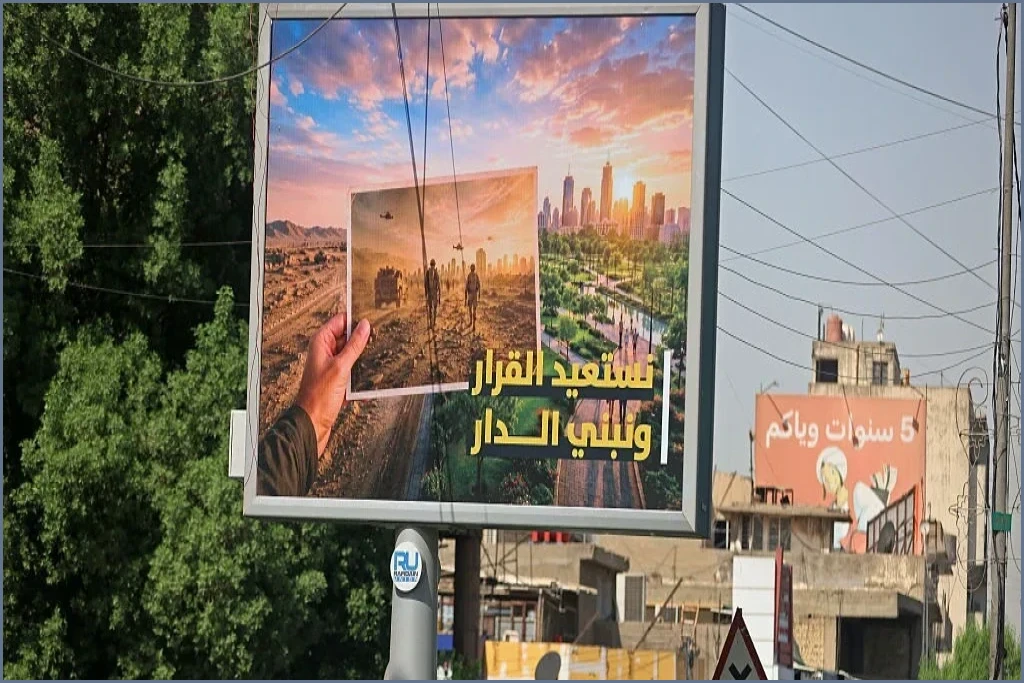
BAGHDAD – The U.S. military has officially completed its withdrawal from Iraq, 23 years after its invasion of the country, a move that sparked an insurgency and civil war and opened the door to significant Iranian influence. The final 1,500 U.S. service members, who had remained in Iraq's semi-autonomous Kurdish region, departed Erbil Air Base in the Kurdistan Region of Iraq on Wednesday.
U.S. Central Command confirmed the departure, noting that the anti-ISIS coalition, previously headquartered in Iraq, would now relocate to Jordan as U.S. forces continue counterterrorism operations in Syria. The withdrawal from most of Iraq had already occurred earlier this year in January, with only personnel in the Kurdistan Region remaining until now.
In Baghdad, a ceremony was held Wednesday at the former joint military command center, across from the American Embassy, where Iraqi leaders and U.S. military commanders formally marked the conclusion of the U.S.-led mission. The event, closed to the press, was slated for later broadcast by state TV.
Iraqi Prime Minister Ali al-Zaidi declared a two-day holiday, dubbing Wednesday 'sovereignty day,' to commemorate the end of the U.S. military presence. In a statement, al-Zaidi proclaimed, "A new phase has begun, characterized by Iraq's sovereignty, the strength of its institutions, the readiness of its forces, the unity of its decision-making, and balanced partnerships with its friends."
Sabah al-Numan, spokesman for the chief of the Iraqi armed forces, expressed national pride, stating, "We are very proud to reach this day. It is due to the sacrifices of the Iraqi armed forces." Numan also indicated Iraq's interest in exploring bilateral military agreements with the United States. "We are moving from working under the umbrella of the coalition to an equal relationship with them," he said, adding, "We thank all efforts that the coalition did and all the country and we will continue this relationship and that way. But at the end they have to go."
This is not the first time U.S. forces have withdrawn from Iraq; they initially pulled out in 2011, declaring their mission over amidst growing Iraqi political opposition. However, three years later, the Iraqi government invited them back to combat ISIS after the militant group seized roughly one-third of Iraq following the collapse of key Iraqi army divisions. The U.S. military, alongside Iraqi forces and Iraqi Kurdish fighters, territorially defeated ISIS in 2017, driving remnants into Syria, where they were defeated by U.S.-backed Syrian Kurdish forces two years later.
Despite the territorial defeat, ISIS maintains sleeper cells in Syria and Iraq, particularly in disputed northern Iraqi territory claimed by both Baghdad and the Iraqi Kurdish government. As an illustration of this ongoing threat, Iraqi special forces on Sunday reported killing two suicide bombers in Alton Kupri, near Kirkuk, before they could detonate their vests, though one civilian was also killed. Numan confirmed that Iraq has established two joint Iraqi-Kurdish brigades specifically for counter-ISIS operations, calling it "a symbol that all Iraqis can work together in one unit and with one mission."
The withdrawal comes amid long-standing pressure from Iran on the Iraqi government to expel U.S. forces. The removal of Saddam Hussein, toppled by U.S. forces and later executed by new Iraqi authorities, had opened the door for Iranian influence in Iraqi security, politics, and the economy. President Trump has also publicly expressed his desire to end what he termed 'endless wars' in Iraq and Afghanistan.
Kurdish leaders have voiced concerns that the U.S. withdrawal leaves them vulnerable to attacks from Iran and Iran-backed militias. Historically, the Kurds have been close U.S. security allies, relying on American protection, notably after the 1991 war when the U.S., U.K., and France established a no-fly zone in Kurdish-majority territory, which evolved into the semi-autonomous Kurdistan Region. Numan assured that the Iraqi military would not leave the Kurdistan region undefended, mentioning discussions to purchase air defense systems from South Korea and Turkey, as well as the United States, to protect against missiles and drones.
Armed Iranian opposition groups have been based in the Kurdistan region for decades, some invited by Saddam Hussein. While the regional government bars them from launching attacks on Iran from Iraq, Iran has long pressed for the closure of these bases. Iran and Iranian-backed militias in central government-controlled Iraq have launched hundreds of attacks on these opposition bases since the U.S. began the war in Iran, in addition to targeting U.S. forces and diplomatic missions in the Kurdish region.
U.S. military leaders acknowledge significant strides made by Iraqi forces after years of coalition and NATO training. However, in recent years, the primary U.S. military contribution, beyond air assets, has been intelligence, particularly signal intelligence through technology Iraq lacks, and surveillance. Numan indicated that Iraq and the U.S. would discuss bilateral agreements for potential continued U.S. support.
Iraq is also under intense U.S. pressure to disarm Iran-backed paramilitaries operating outside government control, which have attacked U.S. military and diplomatic posts. In a White House meeting with President Trump in July, Prime Minister Ali al-Zaidi agreed to disarm these militias by September 30. However, he has since requested an extension to next June. While not explicitly confirming agreement, Secretary of State Marco Rubio stated last week that they recognize Zaidi's commitment to the disarmament process. Three of the most powerful Iran-backed militias have declared they will not surrender their weapons while Iraq remains vulnerable. Sheikh Kadhim al-Fartousi, spokesman for the Kitaib Sayid al-Shuhada paramilitary group, stated that the departure of U.S. forces was a victory but insufficient. He argued that U.S. control over Iraq's economy and interference in internal affairs also constituted occupation, referencing Iraq's oil revenue being deposited into accounts at the Federal Reserve Bank in New York since 2003, giving the U.S. significant leverage over Iraq's currency. President Trump had publicly supported Zaidi as prime minister over former prime minister Nouri al-Maliki, who was deemed too sectarian.
Separately, Iraq has initiated talks with Turkey regarding the closure of its military bases within Iraq, including the Bashiqa-Zilkan camp near Mosul. Both countries announced last week that Turkey would commence a gradual withdrawal from the base.
Many Iraqis continue to grapple with the legacy of the U.S. invasion and the subsequent eight-year occupation. Conservative estimates from Iraq Body Count, a U.K.-based organization tracking civilian deaths, place the number of Iraqi civilians killed at least 200,000. More than 4,400 U.S. military personnel also died in Iraq.
Younger Iraqis, while navigating a country rebuilding itself, have no memory of U.S. forces. Baghdad and most other cities are largely calm, with the capital seeing extensive construction of apartment complexes, malls, and restaurants, though many remain unaffordable for most citizens. In the United States, the war, once portrayed as necessary to destroy weapons of mass destruction and prevent attacks on U.S. soil, is now widely viewed as misguided, as no such weapons were found, and Iraq had no connection to the 9/11 attacks.
Ali al-Makhzomy, an Iraqi entrepreneur who founded one of Iraq's first post-2003 tourism companies, noted that American military veterans occasionally join his tours on what they call 'healing trips.' He recounted one veteran's emotional visit to Fallujah, a site of fierce battles, who cried over lost friends but was also happy to see the city transformed into a peaceful and relatively prosperous place. Makhzomy added that American civilians are generally welcomed, stating, "Iraqi people never saw American people as their enemy."