At the 63rd session of the United Nations Human Rights Council in Geneva, advocates and diplomats gathered with a shared focus on the deteriorating situation in Myanmar. While the session provided a platform to present evidence of ongoing atrocities, it also highlighted a persistent gap between the availability of information and the political will to enact meaningful change. Attendees included those who have spent years monitoring human rights violations on the ground and those who have long engaged in high-level advocacy within the United Nations.
United Nations High Commissioner for Human Rights Volker Türk underscored the severity of the crisis, detailing a pattern of military junta-led attacks. These include airstrikes, forced conscription, arbitrary detention, sexual violence, displacement, and the strategic weaponization of humanitarian aid. Türk urged member states to refer the Myanmar situation to the International Criminal Court via the Security Council and to cease the transfer of arms, ammunition, jet fuel, and other dual-use items that facilitate international law violations.
The Independent Investigative Mechanism for Myanmar, headed by Nicholas Koumjian, reported that international crimes are occurring with increased frequency and intensity, confirming that the body continues to preserve evidence for future accountability. Despite this, the response from the 39 governments and entities present was fragmented. Fewer than half explicitly addressed justice or accountability mechanisms. While 20 speakers expressed support for stronger action, eight nations—including Indonesia, Malaysia, Thailand, India, and Vietnam—remained cautious, favoring regional dialogue and a process led by Myanmar or ASEAN. Conversely, Laos, Belarus, Russia, China, and Venezuela actively shielded the military regime, citing sovereignty and non-interference.
Diplomatic discussions following the session revealed that the challenge is not a lack of awareness but a lack of political priority. The situation is further complicated by disputes over Myanmar’s official representation at the United Nations and varying international relationships with the military junta, the National Unity Government, and ethnic resistance organizations. However, advocates argue these complexities cannot justify continued impunity. In their view, while a Myanmar-led or ASEAN-led process and humanitarian assistance are essential, they should not mean putting accountability or the protection of civilians on hold. Dialogue with a brutal regime cannot become a substitute for accountability, and sovereignty cannot serve as a shield against international scrutiny.
Fortify Rights has documented the military’s aerial attacks on civilians, including the chain of command behind attacks in Kachin and Karenni states, and has continued to record new methods of aerial warfare. Some international actors have already taken unilateral steps. Canada maintains an arms embargo and aviation-fuel prohibitions, while the United Kingdom and the European Union have imposed sanctions on entities linked to the military’s aviation fuel supply. Additionally, legal efforts are moving forward, including universal-jurisdiction cases in Argentina, Germany, Indonesia, the Philippines, Timor-Leste, and Turkiye. In November 2024, the International Criminal Court prosecutor requested an arrest warrant for Min Aung Hlaing, and in January 2026, the International Court of Justice held merits hearings regarding The Gambia’s genocide case against Myanmar.
Ultimately, while documentation of aerial attacks and military methods continues, there remains a critical absence of coordinated political machinery to match the scale of the crisis. The evidence is being collected, and governments should continue to fund human rights documentation, but the pieces are still not coming together at the scale needed to match the crisis.
You have reached the limit of 2 free articles this month.
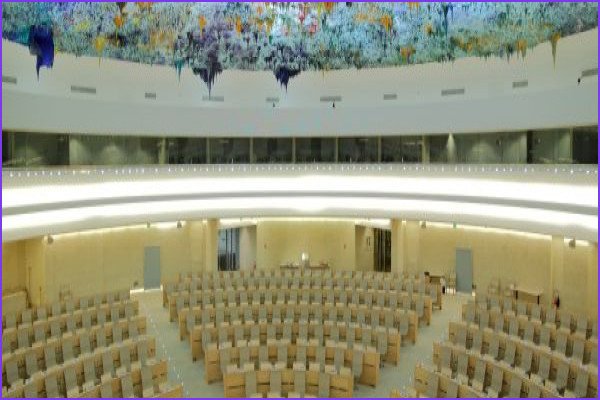
Inside the Human Rights Council chamber, the scale of the crisis was once again laid bare.