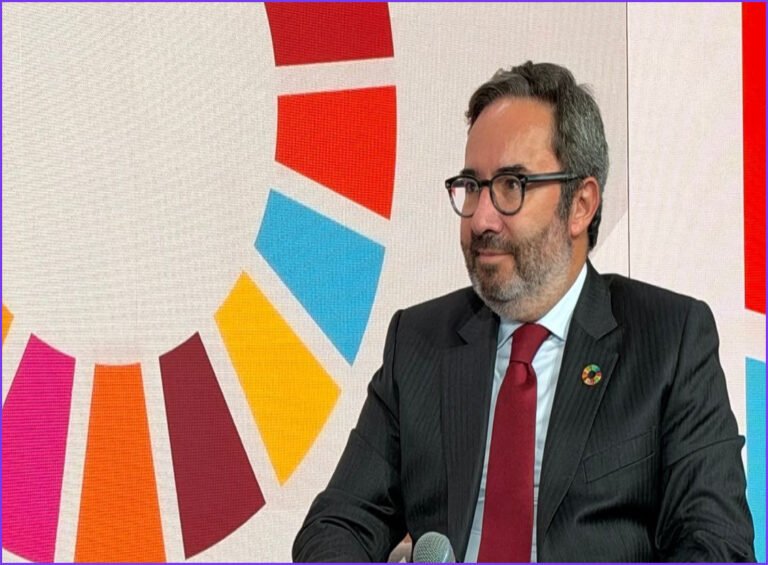
The United Nations is facing a profound crisis of relevance and effectiveness as it struggles to navigate a historic surge in global instability, according to former U.N. Deputy Secretary-General Mark Malloch-Brown. Speaking from South Africa, Malloch-Brown offered a candid assessment of the international body’s current limitations, its failure to resolve devastating regional crises such as the conflict in Sudan, and the high-stakes diplomatic race to succeed outgoing Secretary-General António Guterres.
Malloch-Brown, who served as the U.N. deputy secretary-general in 2006 and currently co-hosts "The World's Toughest Job"—a podcast series focusing on the immense challenges awaiting the next secretary-general—described the global organization as a "mirror held up to the state of the world." In an era defined by deep geopolitical fragmentation, he argued that the U.N.'s capacity for action is always structurally tied to and limited by the broader global environment. Today, that environment is more fractured than it has been in decades, with 65 active interstate conflicts currently underway—a figure higher than at any point since the end of the Second World War.
While Malloch-Brown acknowledged that exceptional leadership can occasionally elevate the U.N. a step or two above the prevailing global discord, he admitted that the organization currently holds a "pretty sorry record." He expressed deep frustration over the U.N.'s inability to make meaningful progress on what are often categorized as second-tier conflicts. Despite being overshadowed in the headlines by high-profile superpower standoffs in Ukraine or involving Iran and the wider Middle East, these secondary conflicts frequently result in far more devastating losses of human life.
A prominent example of this diplomatic failure is the ongoing war in Sudan. The crisis has triggered what is widely recognized as the world's worst humanitarian crisis, leaving millions of people displaced both internally and externally. Malloch-Brown pointed out that various regional actors continue to actively stoke the violence in Sudan, while national actors remain entirely uncommitted to making any progress toward peace. He argued that the right kind of determined, active diplomacy capable of bringing these disparate players to the negotiating table could yield a real breakthrough, but such initiatives are currently non-existent.
As António Guterres prepares to conclude his term, questions have mounted over whether the U.N.'s persistent gridlock stems from a failure of individual leadership. Malloch-Brown explained that while leadership plays a role, the paralysis is deeply rooted in the structural gridlock of the U.N. Security Council. Furthermore, the U.N. General Assembly, which now comprises 193 member states, has grown far too large to exercise any practical executive authority.
However, Malloch-Brown emphasized that this institutional paralysis actually creates a unique window of opportunity for an energetic and diplomatically creative leader. A secretary-general who can identify common ground and overlaps in the positions of competing nations can initiate vital mediations and drive diplomatic processes forward. The first 100 days of the next secretary-general's term will be absolutely critical, he noted, as the global spotlight will afford them a brief window to secure early victories, build institutional authority, and demonstrate that the U.N. still possesses the energy to resolve major global crises.
The race to succeed Guterres currently features seven declared candidates, with two prominent women leading the field. Rebeca Grynspan of Costa Rica, a longtime U.N. official and veteran administrator, and Carolyn Rodrigues-Birkett, a former foreign minister of Guyana who is highly regarded by permanent representatives in New York, are currently viewed as the frontrunners. While both are respected within U.N. circles for their high integrity and capability, Malloch-Brown observed that neither has yet generated widespread enthusiasm. Consequently, many diplomatic insiders suspect that the eventual winner of the selection process has not yet officially entered the race.
MARK MALLOCH-BROWN: Good morning, Michel.
MARTIN: So as we heard, the U.N. is increasingly seen as ineffective. What do you think?