At the Kasimedu Fishing Harbour in the southern Indian city of Chennai, the daily rhythm begins long before dawn. Built to accommodate fewer than 600 boats, the overcrowded harbor now serves an estimated 1,000 vessels, acting as a relentless engine of survival for around 30,000 people. Among them are fishermen, auctioneers, fish hawkers, wholesalers, transport workers, and ice suppliers. Their lives are defined by grueling physical labor, systemic vulnerability, and an enduring, complex relationship with the ocean.
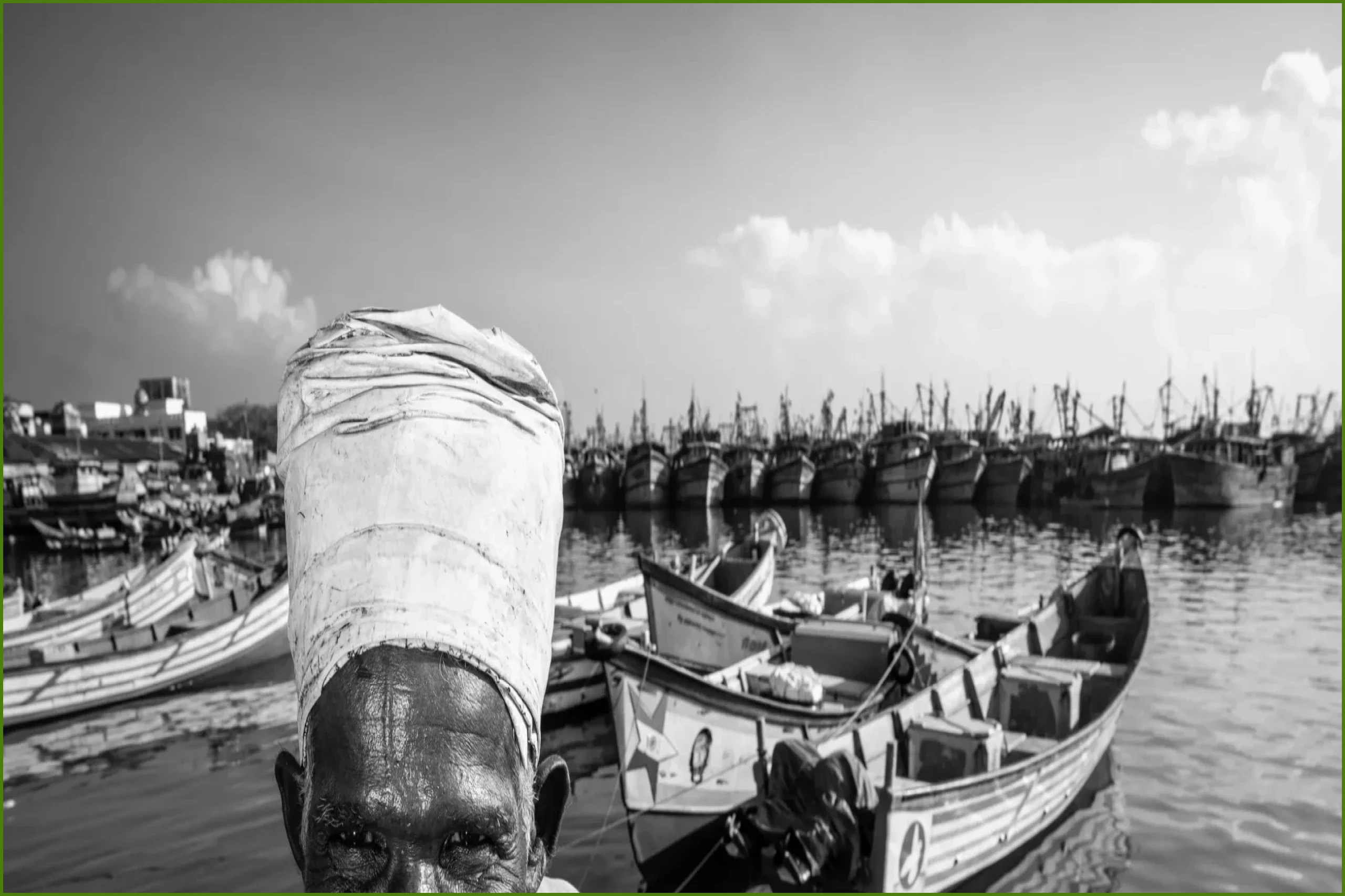
Among the most marginalized workers in this bustling ecosystem are the "basket men," a group of about 1,000 migrant laborers out of the harbor's 5,000 total workers who earn approximately $5 a day. Pavadairayan, a 60-year-old migrant laborer who goes by a single name, is one of them. Every morning from 2 a.m. to 7 a.m., Pavadairayan navigates the pitch darkness of the harbor, carrying heavy baskets of fish on his head from incoming boats to the auction house. The journey is a third of a mile each way, along slimy, damp pathways covered in fish scales and wet with seawater. During his five-hour shift, he repeats this trek 40 to 50 times to prepare for the daily auction, which starts at 4 a.m.
Each basket Pavadairayan carries weighs roughly 35 pounds. Beyond the physical toll, the job is marked by a severe lack of labor rights and constant suspicion from employers. "If supervisors think that fish are missing, they can dock your pay and fine you several thousands of rupees. Basket men have few rights," Pavadairayan explains. Yet, despite these hardships, he finds a unique sense of peace in his routine. Because his work ends in the early morning, the rest of the day belongs entirely to him. While other basket men take on additional odd jobs to supplement their income, Pavadairayan refuses. For him, the modest earnings from the harbor are sufficient. "This money is enough for me. Sleeping with a full belly under open skies, a salt sea breeze fanning your face: that's what I call heaven," he says.
For others at the harbor, the sea has been a backdrop for survival in different, sometimes illicit, ways. Nandu Kumar, 65, now runs a brisk fish-selling business from a shop at the harbor, but his path to this point was long and painful. Dressed in a grey shirt and a checkered lungi—a traditional light cotton garment wrapped around the waist—Kumar sits on an overturned boat on the sandy shore, reflecting on a lifetime spent at Kasimedu. In the early 1980s, desperate to make a living during a period when India imposed steep customs duties and strict limits on consumer-goods imports, Kumar used his fishing boat to smuggle imported alcohol and cigarettes. The illegal enterprise was highly profitable until 1991, when India introduced sweeping economic reforms that diminished the smuggling trade.
With the end of his smuggling days, Kumar returned to full-time fishing. However, the physical demands of the profession and personal tragedy eventually forced him ashore. In December 2010, his son-in-law, who struggled with heavy drinking, fell from a boat and drowned. Kumar notes the connection between the physical suffering of the job and substance abuse: "This fishing life — it's harshest on the body. Your shoulders ache all the time. Sometimes, alcohol is the only way you can cope and forget the pain."
The tragedy deepened months later when Kumar's daughter, unable to cope with the loss of her husband, committed suicide by ingesting a pesticide she had purchased to weed her garden. Left to care for her infant daughter and young son, Kumar realized that spending weeks or months at sea was no longer viable. Deep-sea fishing was a massive gamble; groups of ten fishermen would often spend up to three weeks or months at sea, only to return empty-handed. To secure a steady income for his grandchildren, Kumar, with the support of his two sons, transitioned from catching fish to selling them.
The precarious nature of this lifestyle is a constant concern for advocacy groups working in Chennai. Bhagat Singh, a researcher, social worker, and member of the Coastal People Rights Movement, understands these vulnerabilities intimately. His own father was a fisherman. The grassroots movement he represents campaigns to protect traditional marine livelihoods against corporate displacement and unregulated development. "It's feast or famine. That is the rhythm of life at the harbor. For workers and fishermen here, earning a living is hard enough. One bad season, one poor catch, or one spell of illness can be enough to push a family into dire poverty. There are no safety nets. Worse, they have little access to government support and their labor remains largely invisible," Singh says.
This invisibility and hardship have driven many younger people away from the trade, making 25-year-old Nizamuddin a rare sight at Kasimedu. He is the only fisherman in the entire harbor who wears a wet suit. When he is not out at sea, Nizamuddin helps dock boats, repair nets, and haul fish from the holds of the vessels to hand over to the basket men. While he acknowledges that people his age are largely absent from the harbor, he remains proud of his profession. "It's a hard life but I wasn't very good at studying," Nizamuddin says. "This is the only work I know and it has helped my family survive." Through his labor, he successfully funded the education of his two older brothers, both of whom completed school and college and now hold good jobs. Nizamuddin says he has no regrets about his path.
Despite the physical pain, economic volatility, and personal losses, those who work at Kasimedu remain deeply bound to the ocean. Kumar compares the sea to a parental sanctuary: "It's like your mother's lap. You may travel far and wide, and don't need it anymore, but you will return for the warmth and comfort it gives you." Now a shore-bound vendor, Kumar still sits in the quiet hours of the early morning to watch the fishing boats return with their catches, feeling a deep sense of nostalgia. "Life on a boat is hard, but it is also exhilarating," he reflects. "There are moments when you never know what will happen next. I quite miss that."
Vendors set up their baskets of the morning's catch on the docks, catering to customers that weave through the makeshift market. Viraj Nayar hide caption
A fisherman wades to the shore from his anchored boat, as the sun rises higher in the sky and the activity on the docks winds down for the day. Viraj Nayar hide caption