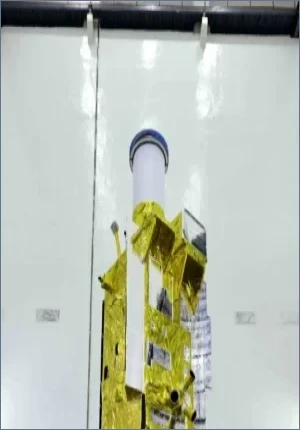
The Indian Space Research Organization (ISRO) has successfully launched a new surveillance satellite, designated EOS-05, into geosynchronous earth orbit (GEO). The launch, conducted on September 4 using the GSLV-F17 rocket, represents a milestone for India as it is the country's first earth observation satellite deployed in this specific orbit. The satellite will provide continuous observation of the subcontinent from an altitude ranging between 34,903 km and 35,884 km. V. Narayanan, the chairman of ISRO, noted that the EOS-05 will serve as India’s first dedicated imaging satellite from the geo orbit, providing critical strategic data for the nation.
This launch is a key element of India’s long-term strategy to enhance its intelligence, surveillance, and reconnaissance (ISR) capabilities. By transitioning from periodic snapshots to persistent monitoring, the satellite provides India with the ability to track military movements across the subcontinent in real-time. This includes the observation of naval warships, aircraft, strategic asset movements, and force mobilization during times of crisis. Such an asset is expected to bolster India's counterforce capabilities in an era defined by emerging and disruptive technologies.
India’s existing space architecture is composed of various navigation, communication, and scientific satellites. For military communication, India operates three dedicated satellites—two for the Indian Navy and one for the Indian Air Force—alongside approximately 10 dual-capable platforms. The nation’s navigation system, known as Navigation with Indian Constellation (NavIC), currently includes three operational satellites: IRNSS-1B, IRNSS-1I, and NVS-01. While four satellites are required for basic positioning, the launch of the NVS-03 is expected soon. Furthermore, India’s ISR framework includes the CROSAT series for optical purposes, the RISAT and NISAR series for synthetic aperture radar (SAR), and the EMISAT for electronic ISR. The EOS-05 is distinguished as the first ISR satellite to offer real-time, persistent observation.
The development of this capability is supported by the Space Based Surveillance Phase-III (SBS-III) program, approved in 2024 by India’s Cabinet Committee on Security. This project aims to deploy 52 defense satellites into low-earth and geostationary orbits, with ISRO tasked with 21 satellites and the private sector with 31. The strategic shift toward space-based assets was highlighted by former Chief of Defense Staff General Anil Chauhan at the 2026 Indian Defense Space Symposium, where he stated that failing in space would force the military to "fight blind," whereas dominating the domain would allow them to "fight with foresight."
The EOS-05 satellite is expected to strengthen India’s precision-strike capacity by providing the timely information required for target location. However, this advancement carries implications for South Asian deterrence. The enhanced ability to detect military assets, such as mobile missile launchers and naval deployments in the Arabian Sea, may compress decision-making timelines during crises. Analysts suggest this could induce neighboring Pakistan to prioritize early dispersal and further concealment of its assets, potentially creating a "use-it-or-lose-it" dilemma that increases the risk of miscalculation or inadvertent escalation.