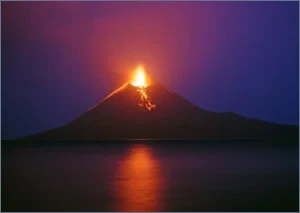
Indonesia has moved to restore air travel, reopening five airports early this morning after a two-day suspension caused by the volcanic eruption of Anak Krakatau. The volcano, situated on a small island in the Sunda Strait between Java and Sumatra, began its latest eruptive phase late on Friday and maintained activity for approximately 25 hours.
The eruption sent plumes of black volcanic ash into the atmosphere, which were driven by wind currents over the capital, Jakarta, located roughly 150 kilometers to the east, and across parts of Lampung province in southern Sumatra. The resulting ash cloud led to the closure of eight airports, including two that serve the capital. The disruption was significant; official figures released yesterday indicated that 2,961 flights were affected, leaving an estimated 341,000 passengers stranded. Images from the scene showed long queues at Jakarta’s Soekarno-Hatta International Airport as travelers sought information on flight status and potential refunds.
Transport Minister Dudy Purwagandhi confirmed in a statement that Soekarno-Hatta International Airport, the country's primary gateway, resumed operations this morning after favorable winds cleared ash from the area. Four other facilities, including a secondary airport in Jakarta and one in the neighboring city of Bandung, also returned to service. While one airport had resumed operations yesterday, two others remain closed.
Authorities are now focused on safety protocols. Minister Purwagandhi stated that inspectors must verify the airworthiness of the 178 aircraft that were grounded at Soekarno-Hatta during the closure. He noted that the process of preparing these planes for flight may require some additional time.
Anak Krakatau, often referred to as the “child of Krakatoa,” emerged in the 1920s within the caldera left by the 1883 eruption of Mount Krakatoa. The volcano has remained sporadically active over the last decade, including a 2018 event that triggered a tsunami, resulting in hundreds of fatalities and widespread displacement. Although the Center for Volcanology and Geological Hazard Mitigation reported on Sunday that the current eruption appears to have concluded, they maintain an alert status, cautioning that further activity remains possible.
You have reached the limit of 2 free articles this month.
Malaysia’s king, Sultan Ibrahim, gave his consent to end the state of emergency following reports from government agencies showing that air quality readings in Serian were no longer at a hazardous level, Prime Minister Anwar Ibrahim’s office said in a statement.