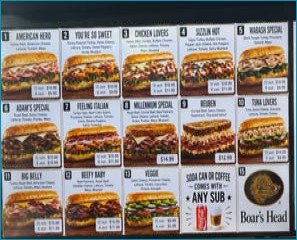
When Chris Murphy walked into his local Chicago deli in late August, he was greeted not by the familiar, comforting sight of classic sandwich listings, but by a series of uncanny, artificial intelligence-generated images. The digital screens above the counter, which had previously displayed standard text and generic food photography, now featured sandwiches with bizarre, repeating textures. The images attempted a hyperrealistic look but instead came across as aggressively fake, triggering a visceral reaction that instantly ruined Murphy's appetite. The deli, located directly across the street from his office, had replaced its entire menu with these AI-generated designs only about a month prior. On Yelp, photos of the establishment's older, traditional menu remained, showing standard descriptions and normal food photography. Murphy noted that if the original, human-designed menu had still been in place, he would have happily ordered his lunch. Instead, he left empty-handed, deeply unsettled by the visual display.
The experience was so jarring that Murphy shared photos of the new menu with his coworkers back at the office. Their reactions were immediate and intense. According to Murphy, his colleagues recoiled in disgust, with some begging him to take the images away and others stating they felt close to vomiting. This incident is far from isolated; it represents a growing, controversial trend where businesses are increasingly swapping out traditional advertisements and photography for generative AI designs. Across various cities, generic AI-generated flyers and signage are popping up in public spaces, often drawing irritation and discomfort from passersby. These artificial menu displays have earned a specific moniker among disgruntled consumers: "AI food slop."
While many find these images naturally repulsive, the phenomenon has simultaneously captivated the internet. In late August 2026, an X user named Julia, posting under the handle @REMARKSIST, shared a photo of an AI-generated restaurant sign she passes daily on her commute. Her post, which quickly amassed nearly 2 million views, described the display as one of the worst "AI shop horror food menus" she had ever encountered. The comment section overflowed with similar sentiments of disgust, with one user remarking that looking at the image made them feel as though bugs were crawling in their throat. The viral post also prompted a wave of other social media users to share their own photos of bizarre AI-generated menus they had discovered in the wild.
Psychologists suggest there is a clear neurological explanation for why people find it so difficult to look away from these unsettling images. Dr. Stephanie Sarkis, a practicing psychologist, explained that when an image appears almost real but is clearly fake, the human brain gets trapped in a conflict between "approach and avoidance" as it struggles to process the visual information. This cognitive friction can induce feelings of anxiety or a strong urge to look away, even as the brain simultaneously tries to study the image further to make sense of it. For some individuals, the reaction is even more severe. Those who experience trypophobia—an intense fear or aversion to clusters of small holes, repetitive patterns, or irregular textures—can find "AI food slop" highly triggering. While trypophobia is relatively rare, its effects can be deeply debilitating, and the repeating, unnatural textures generated by AI engines often mimic the exact visual patterns that trigger the condition.
According to Sarkis, these intense physical reactions are rooted in human evolutionary biology. Visceral disgust is an evolutionary mechanism designed to protect humans from environmental dangers such as contamination, disease, decay, or parasites. When we see something biologically bizarre, our brains immediately flag it as a potential threat that must be monitored. However, repeatedly looking at the image does not resolve the brain's alarm; instead, it can actually intensify the physical discomfort. Sarkis clarified that while individuals with trypophobia will experience heightened distress, these unnatural AI food images are inherently off-putting to the general public because they transform recognizable, nourishing food into something biologically alien.
For individuals who experience sudden distress or nausea upon encountering these digital displays, Sarkis recommends immediate distraction and grounding techniques. One effective exercise involves focusing on the physical environment by identifying three things you can currently hear, three things you can see, and three things you can touch. For those whose daily functioning is significantly impacted by such anxieties, seeking guidance from a licensed mental health professional can provide valuable support.
The backlash against AI-generated menus aligns with broader public skepticism toward artificial intelligence and major technology firms. A Pew Research Center survey conducted in August 2026 revealed that a majority of young adults under the age of 30—specifically 55%—are now more concerned than excited about the rise of AI. Furthermore, a YouGov poll from July 2026 found that 7 in 10 American adults believe that major technology companies have amassed far too much power. This growing public dissatisfaction is fueling a pushback against the automated replacement of human labor and authentic imagery.
Professional food photographer Hawkes emphasized that the human connection to food is deeply intuitive. Hawkes explained that humans possess an innate, deep-seated understanding of how real food should look, and they can instantly sense when something is wrong, even if they cannot easily articulate the exact flaw. The core objective of professional food photography is to present dishes as realistically and appetizingly as possible, establishing a baseline of trust with the consumer. Hawkes argued that customers ultimately want to see honest representations of the food they will actually be served, noting that even before the advent of generative AI, consumers frequently criticized overly generic or deceptive stock photography.
Hawkes remains highly skeptical that generative AI will ever be capable of capturing genuine appetite appeal, which relies on presenting something real that people can easily imagine themselves eating. For small businesses or restaurants that find professional photography cost-prohibitive, Hawkes advises against turning to automated AI tools. Instead, she suggests reaching out to local student photographers to negotiate mutually beneficial arrangements, such as offering free meals in exchange for high-quality promotional content. Alternatively, business owners can utilize free online resources, such as YouTube tutorials, to learn basic DIY photography techniques. Ultimately, Hawkes notes that a simple, thoughtful photo taken with an iPhone will always be superior to an AI-generated image because it depicts the actual food being served rather than an algorithm's bizarre interpretation of a sandwich.
Despite a seemingly innate aversion to these images, the internet is captivated. In a post with nearly 2 million views, an X user posted a picture of a sign outside a restaurant she passes on the way to work. "This is genuinely one of the worst ai shop horror food menus I’ve ever seen," she wrote. And while the replies overall express horror or disgust ("I feel like I have bugs crawling in my throat when I look at this," one said), it also sparked an influx of posts from other users sharing photos of AI slop menus in the wild.
"There are things about the way that food looks in the world, that even people who don’t spend all their time looking at it and thinking about it like I do, there’s an innateness that you can feel in your bones," Hawkes explains. "There's something wrong, and you might not be able to put your finger on it, but you know it when you see it."