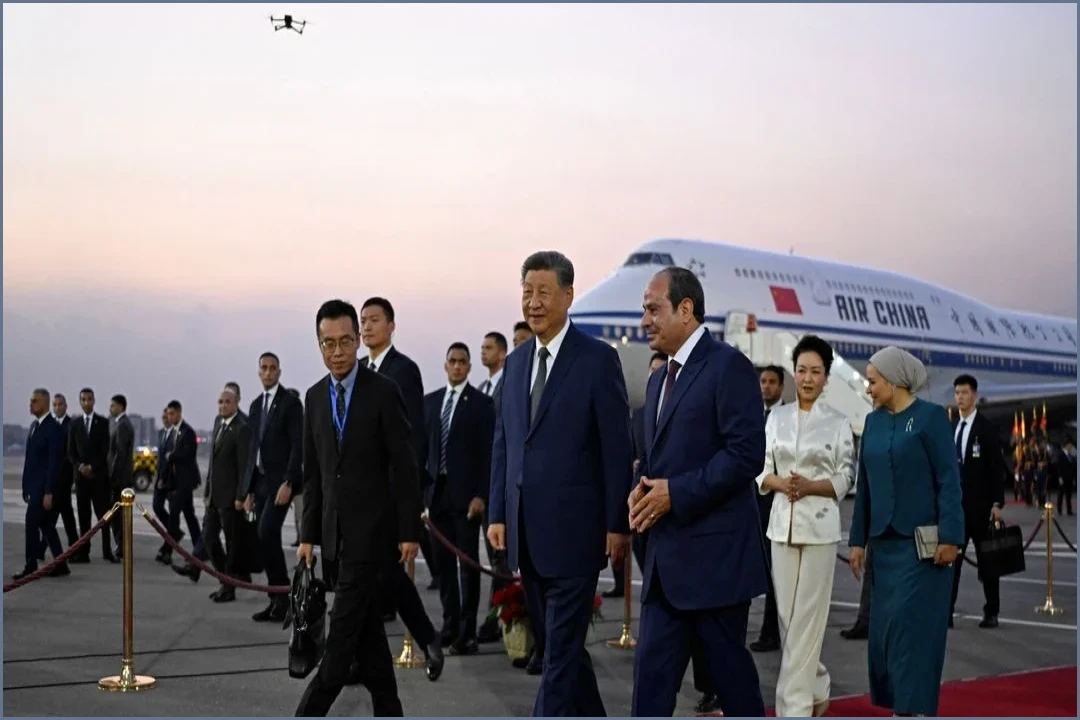
Chinese President Xi Jinping arrived in Egypt on Tuesday for a rare two-day state visit, aiming to strengthen diplomatic coordination and safeguard mutual economic interests amid the ongoing fallout from the Middle East conflict. Upon landing, Xi and his wife, Peng Liyuan, were greeted at the airport by Egyptian President Abdel Fattah al-Sisi and his wife, alongside a traditional Egyptian folk dance performance.
This high-profile diplomatic mission occurs against a backdrop of potential United States sanctions targeting countries with financial and economic links to Iran. Washington has warned of expanding punitive measures against institutions supporting Tehran, a development that could directly impact banks in both China and Egypt. While China is a prominent buyer of Iranian crude oil and has positioned itself as a neutral mediator calling for a lasting ceasefire, Egypt has consistently urged regional restraint to protect its own security and critical trade routes.
Scheduled to hold formal talks on Wednesday, Xi and Sisi are expected to address the war in Gaza, regional tensions involving Iran, and maritime security in the Red Sea and the Strait of Hormuz. Analysts suggest that Beijing highly values Cairo's unique position as a regional power broker due to its active mediation between Israel and Palestinian factions, as well as its deep diplomatic channels with Washington and other Middle Eastern capitals.
Gamal Salama, a political science professor at Egypt’s Suez University, noted that Cairo provides Beijing with vital political access and diplomatic leverage in a region where China seeks to expand its footprint. Both nations have expressed mutual support for an independent Palestinian state under a two-state solution. In an editorial published by Egyptian media on Tuesday, Xi expressed his eagerness to renew his friendship with Sisi and establish a new blueprint to deepen their comprehensive strategic partnership.
Marking 70 years of bilateral diplomatic relations, the visit also highlights rapidly expanding economic and military ties. According to Chinese customs data, China's trade surplus with Egypt reached $12 billion during the first seven months of 2026. During the visit, the two nations are projected to sign several bilateral agreements spanning artificial intelligence, transportation, energy, and investments within the Suez Canal Economic Zone.
Additionally, security cooperation between the two countries has grown closer. In August, the Chinese and Egyptian air forces conducted joint military exercises that featured China's J-16 fighter jets. For Egypt, bolstering relations with Beijing offers a pathway to secure new technology and foreign investment without jeopardizing its long-term alliance with the United States. Salama emphasized that Egypt is pursuing strategic autonomy by maintaining its relationship with Washington while creating sufficient space to advance its own national interests. The diplomatic tour also precedes an anticipated meeting between Xi and US President Donald Trump later this month, as Beijing works to reinforce its ties with US-aligned nations across the Middle East.