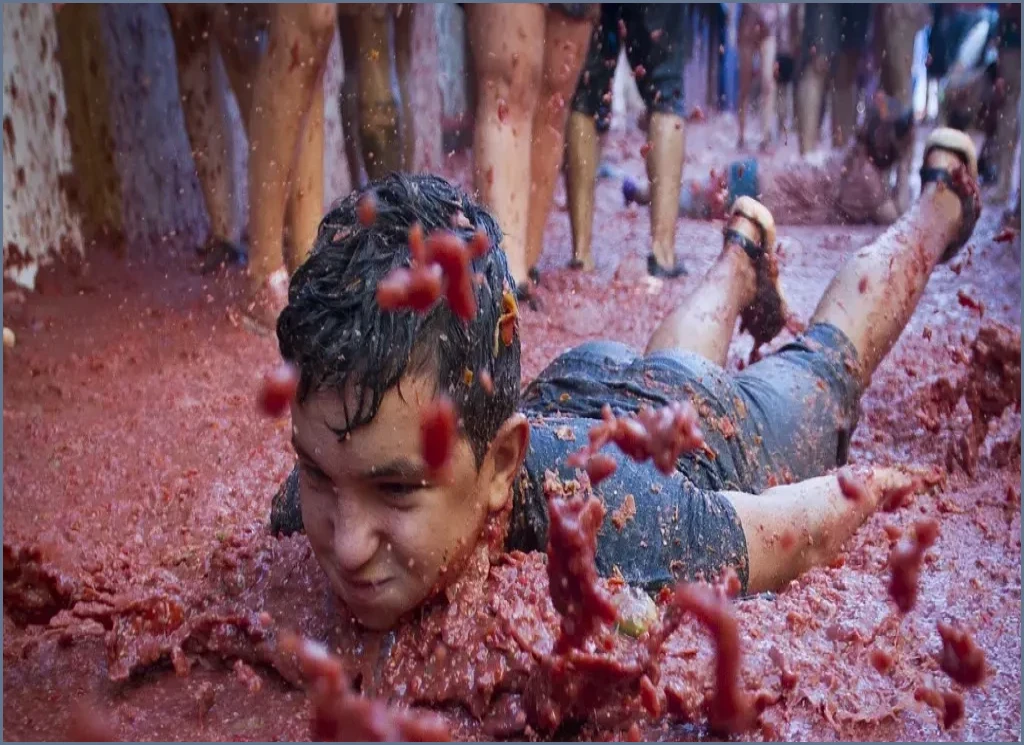
Every year on the last Wednesday of August, the Spanish town of Buñol, located in the Valencia region, transforms into the site of the world's largest food fight. Known as La Tomatina, this event draws massive crowds, with peak attendance reaching approximately 45,000 people. To manage the influx of visitors, the festival is now a ticketed affair. Standard entry begins at €15, while those seeking the unique experience of riding the tomato-carrying trucks to access the most active zones pay €500 for a VIP ticket.
The event is scheduled for midday on Wednesday, August 27th. Organizers prepare for the chaos by providing roughly 180,000 tomatoes, totaling an estimated 145 metric tonnes. These specific tomatoes are sourced from Extremadura; they are selected for their low quality, inferior taste, and inexpensive price, ensuring that participants do not feel they are wasting high-value food. Before the tomato pelting begins, the festival tradition requires a participant to successfully climb a greased wooden pole to retrieve a leg of ham, a feat known as the ‘palo jabón’.
The origins of La Tomatina date back to 1945, when a street brawl erupted near a vegetable store in Buñol. The participants enjoyed the encounter so much that they returned the following year with their own tomatoes to repeat the fight, inadvertently starting a tradition. Despite the festive atmosphere, the event maintains strict safety requests: participants are advised to wear goggles to protect their eyes and are asked to squash the tomatoes before throwing them to minimize impact injuries.
While the tomato is now a symbol of fun, its history is complex. Tomatoes originated in the South American Andes, near present-day Peru, and were first cultivated by the Aztecs in Southern Mexico. Upon their introduction to Europe in the 16th century, they were part of the deadly nightshade family and were widely believed to be poisonous. Their golden color at the time led to the Italian name 'pomodoro,' or 'golden apple.'
Beyond the spectacle, the festival offers surprising practical outcomes. Once the streets are cleaned, the town appears remarkably pristine because the acidity of the tomatoes acts as a natural disinfectant. Furthermore, tomatoes are considered a beauty superfruit, with pulp and juice used to tone skin and condition hair. Nutritionally, they are low-calorie—containing only 18 calories per 100g—and are rich in antioxidants, fiber, minerals, and vitamins. They also contain lycopene, an antioxidant that helps protect skin from ultraviolet rays and may assist in reversing signs of aging.
The festival began in 1945 after a street brawl broke out near a vegetable store in the Valencian town of Buñol. The young people of the town decided they had so much fun that the next year they brought tomatoes from home, picked a quarrel in the street and had the food fight all over again.
It wouldn’t be a true Spanish festival without ham or a Valenciano one without paella. So alongside a paella cooking contest during the festivities, the actual street fight can only begin after the ‘palo jabón’, where a few brave participants climb up a greased wooden pole to reach a leg of ham.