Russian President Vladimir Putin made an unprecedented visit to Iturup Island on August 13, 2026, severely escalating long-standing territorial tensions between Moscow and Tokyo. The trip marks the first time Putin has personally traveled to the disputed Southern Kuril Islands—known in Japan as the Northern Territories—which have been occupied by Russia since the end of World War II but remain claimed by Japan. The unresolved sovereignty dispute has historically prevented the two nations from signing a formal peace treaty to officially conclude World War II.
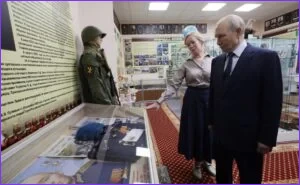
During his visit to Iturup, which is the largest of the disputed islands and known as Etorofu in Japan, Putin visited a secondary school named after E.D. Norpolov. There, the Russian president viewed a display honoring Norpolov, a "Hero of Russia" who was killed during the Russian invasion of Ukraine. While former Russian President Dmitry Medvedev visited the disputed territory in 2010, Putin's arrival represents a significant escalation in Russia's assertion of sovereignty over the region.
Japanese Prime Minister Takaichi Sanae swiftly condemned the visit in a televised statement on the same day. Takaichi declared that Putin's trip "hurts the feelings of the Japanese people and is absolutely unacceptable," adding, "We hope that the Russian side will take the seriousness of the matter fully to heart." Speaking to reporters, the prime minister warned that the visit "has further hardened public sentiment toward Russia in Japan, making it difficult to restore relations over the medium to long term." Observers noted that Takaichi chose to deliver the statement personally rather than delegating the response to the Foreign Ministry, signaling her administration's unyielding stance on territorial integrity, though this high-level escalation may complicate future quiet de-escalation efforts.
In response to Tokyo's criticism, Moscow took immediate diplomatic action. Russian Deputy Foreign Minister Mikhail Galuzin summoned Japan's ambassador to Moscow, Muto Akira, to deliver a formal protest over Takaichi's "anti-Russia" remarks. According to a press release from the Russian Foreign Ministry, Galuzin told Muto that "Russia’s sovereignty and jurisdiction over the southern Kuril Islands are inviolable," asserting that "any attempts by the Japanese side to directly or indirectly call this obvious reality into question are categorically unacceptable and illegitimate."
The timing of Putin's visit appears heavily calculated. It occurred just two days before the 81st anniversary of Japan's announcement of its intent to surrender in World War II, a period of heightened historical sensitivity. Coinciding with the visit, the Chinese and Russian ambassadors to Japan released a joint statement declaring that "the contribution of our people to the victory [in World War II] laid a solid foundation for the postwar world order," while warning against regional remilitarization. Furthermore, Russia is preparing for its first lower house legislative elections this September since the 2022 invasion of Ukraine, making patriotic displays highly useful for domestic political consumption.
Putin's trip also coincided with active military maneuvers. The Russian Pacific Fleet is currently conducting live-fire naval exercises around two of the four disputed islands, which are scheduled to run until August 29 under a designated maritime exclusion zone. Putin personally oversaw these military exercises before traveling to Iturup Island, drawing additional sharp protests from Tokyo.
Historically, Japan sought to resolve the dispute through economic cooperation, an initiative championed by former Prime Minister Abe Shinzo, who viewed the issue as a continuation of his father Abe Shintaro's legacy as foreign minister. However, bilateral relations collapsed after Japan joined the United States and European nations in imposing sanctions on Moscow following the 2022 invasion of Ukraine. In response to those sanctions, Russia formally suspended peace treaty negotiations and terminated visa-free travel for Japanese citizens wishing to visit ancestral graves on the islands.
Currently, Japan's diplomatic leverage is constrained by its acute energy vulnerability. The ongoing war in Iran has closed the crucial Strait of Hormuz, through which 90 percent of Japan's petroleum imports and 6 percent of its liquefied natural gas (LNG) imports transit. Consequently, Japan has sought exemptions to maintain its Russian energy imports, which account for 9 percent of its total LNG. Tokyo recently secured an extension from the United States to continue importing LNG from the Sakhalin-2 project from June to December 2026, and Japan also began importing Russian petroleum in May. Analysts suggest that to counter Russian pressure in the long term, Japan must treat its energy security with greater urgency by accelerating the deployment of renewable energy sources.