President Donald Trump has directed the Pentagon to scale back joint military exercises with South Korea, citing a lack of support from Seoul during the conflict with Iran. The decision represents another sharp warning to a key American ally, whom Trump has repeatedly pressured to contribute more financially to its own defense.
Speaking in the Oval Office on August 17, Trump criticized the terms of the alliance, stating, "We can't go around and protect all of these countries, especially when they're not there to help us." Trump revealed he had personally called South Korean President Lee Jae Myung to ask for assistance with operations in Iran, only to be turned down. According to Trump, he told Lee, "We have 39,000 soldiers over there, guarding you, from Kim Jong Un, your next door neighbor, and you’re not going to help us on a very easy military operation in Iran? That’s strange."
The president also complained about the financial burden of maintaining American forces in South Korea. He asserted that during his first term, South Korea agreed to pay $3 billion annually for its protection, but the Biden administration subsequently rolled back that demand. Currently, under a deal negotiated by the Biden administration, South Korea is scheduled to pay $1.19 billion in 2026 to help support the estimated 28,500 American troops stationed on the peninsula—an 8.3% increase from its previous payments, according to the Congressional Research Service. However, a July study by the Center for International Policy estimated that the U.S. government spends between $5.5 billion and $6 billion every year to maintain its bases and forces in South Korea.
In response, the South Korean government defended its contributions. In a statement, the South Korean embassy in Washington noted that it has actively engaged in talks aimed at securing a ceasefire and reopening the strategic Strait of Hormuz, while remaining in close consultation with the U.S. on potential military contributions. South Korea’s defense spending in 2024 stood at approximately $47.6 billion, representing 2.6% of its GDP, with a commitment to raise that figure to 3.5%. Additionally, Seoul has pledged to spend $25 billion on purchasing U.S. military equipment by 2030 and another $33 billion to support American forces stationed on the peninsula.
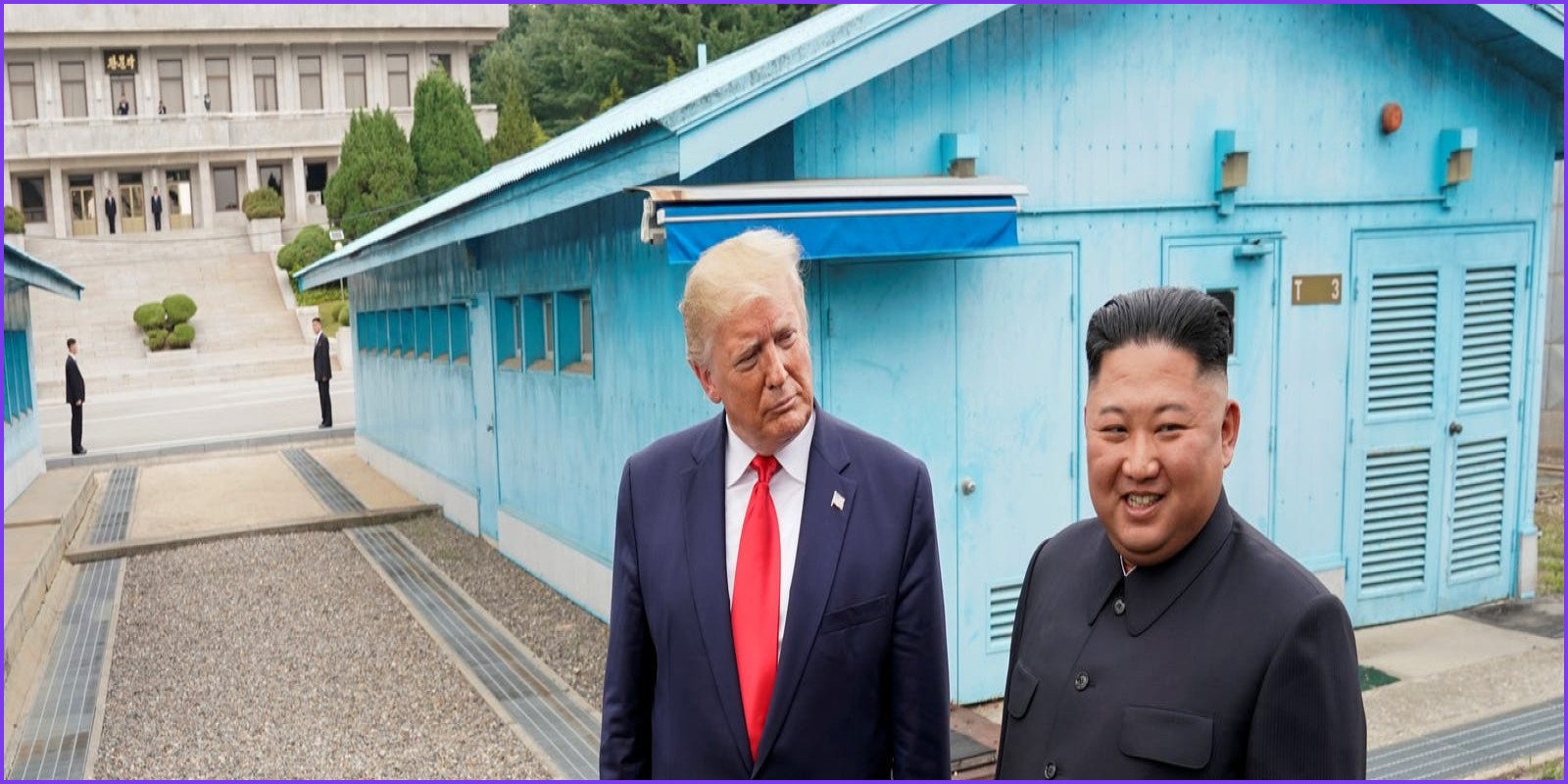
On August 16, Trump announced on Truth Social that the U.S. was scaling down its joint military exercises with South Korea, which he claimed were already too late to cancel entirely. Trump criticized the drills as overly expensive, writing, "These exercises are not only costly, with much of these costs paid for by the United States of America (as usual!), but send a signal that is totally inappropriate and hostile, to a Country that, as long as Donald J. Trump has been President, has been unthreatening and respectful." This post came shortly after South Korean President Lee Jae Myung called for talks over the weekend to formally end the Korean War. Trump responded by posting a photo of himself with North Korean leader Kim Jong Un, writing, "Despite the unfriendly look on this particular picture, there are many where we’re smiling, Kim Jong Un and I get along GREAT!"
Regional experts have questioned the timing and logic of Trump's diplomatic maneuvers. Retired Rear Admiral Mark Montgomery, a senior fellow at the Foundation for Defense of Democracies, described Trump's actions as "befuddling and illogical," arguing that the president is reaching out to North Korea partly to punish South Korea. Montgomery, who co-authored "Axis of Aggressors: Countering the Cooperation of China, Russia, Iran, and North Korea," expressed skepticism about the prospects of these diplomatic efforts, stating, "He's not going to be able to convince Kim Jong Un to give up his nuclear weapons. There's no Nobel Prize waiting at the end of this rainbow. So I don't know what the president's up to." Montgomery added that Trump seems to view resolving North Korea's nuclear isolation as a personal triumph.
Sydney Seiler, a senior adviser at the Center for Strategic and International Studies and former National Intelligence Council intelligence officer for North Korea under the Biden administration, observed that Trump has long sought to reengage Kim Jong Un. Seiler noted that during their 2018 negotiations, Kim demanded a rollback of joint military exercises in exchange for North Korea halting nuclear tests and intercontinental ballistic missile launches. While Trump has signaled a desire to restart denuclearization talks, Seiler remarked that Pyongyang has not responded to recent messages. "Trump's had a lot of other things on his plate," Seiler said. "He's not necessarily interested in aggressively chasing after Pyongyang when there's no evidence that they'll be receptive."
Trump's desire to meet with Kim has been consistent. Last year, he repeatedly expressed interest in a meeting while attending the Asia-Pacific Economic Cooperation (APEC) summit in South Korea, or during his spring visit to China as a guest of President Xi Jinping. During the APEC CEO Summit last October, South Korea's then-Prime Minister Kim Min-seok told Trump, "I believe that we've been planting good seeds for a better future." Despite these diplomatic hopes, the Korean Peninsula remains highly tense. The two nations have technically remained at war since a 1953 armistice. South Korea's constitution claims the entire peninsula, while North Korea recently amended its constitution to officially classify South Korea as a "hostile state."
Alexander Gray, who served as chief of staff at the National Security Council during Trump's first term, explained that Trump has always believed his personal relationship with Kim, combined with regional alliances, gives him a unique ability to broker a historic agreement. Gray noted that the broader framework of American alliances is shifting under Trump. "If you're going to get all those things, there needs to be an expectation that when the United States undertakes a major military campaign or undertakes a major initiative globally, that the allies who are supposedly closest to us and benefit the most from the security umbrella step up and contribute, even in small ways," Gray said. Meanwhile, the South Korean embassy stated it is coordinating closely with Washington on the military exercises, expressing hope that "the friendly relationship between the leaders of the United States and North Korea will lead to meaningful dialogue between them, paving the way for discussions aimed at advancing peace and stability on the Korean Peninsula."