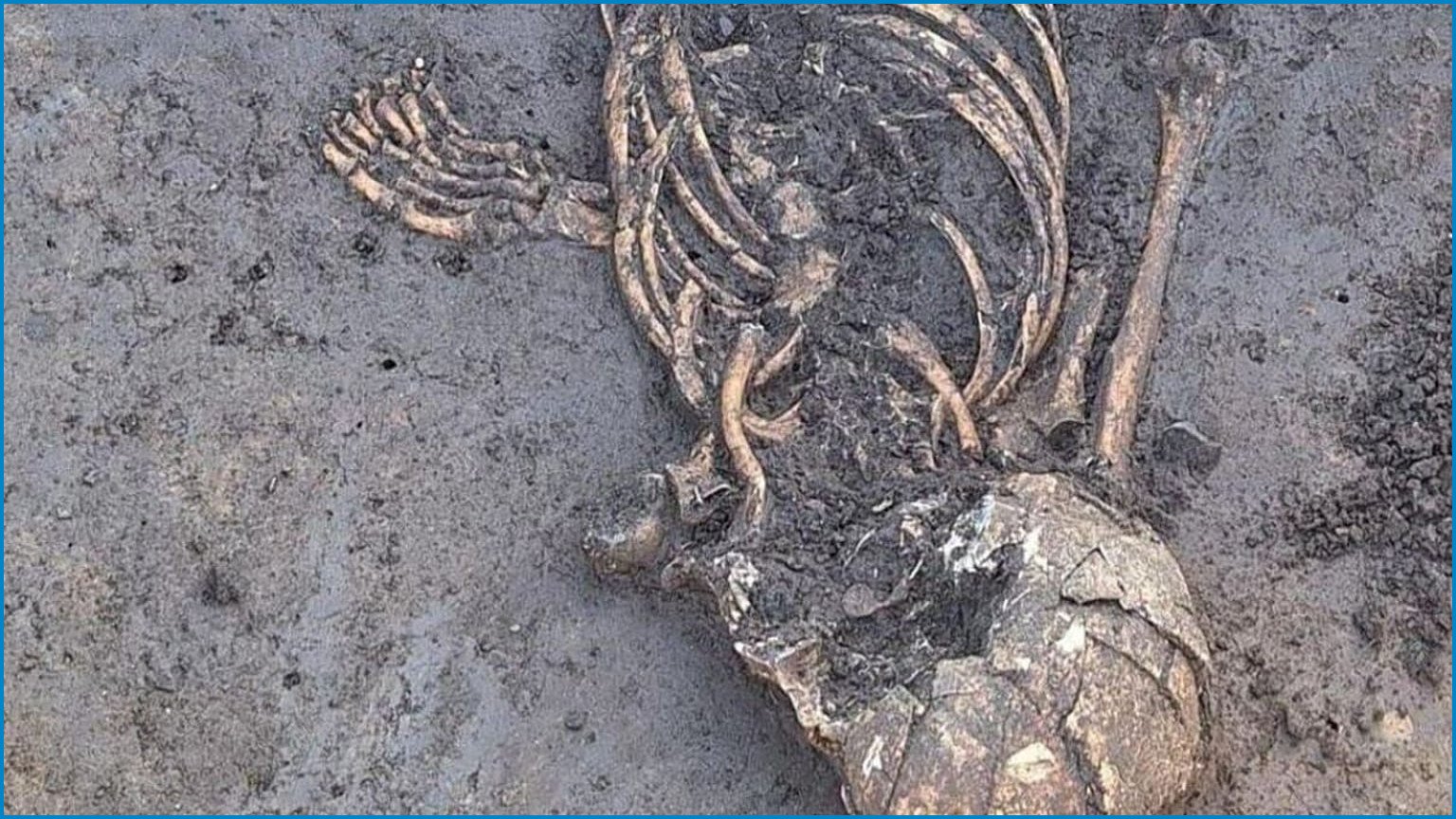
Archaeologists working in the Lower Bavarian village of Großköllnbach, located in the Dingolfing-Landau district, have unearthed the remains of a person who lived approximately 7,000 years ago. The discovery, made in a pit, is posing new questions for researchers, primarily due to the skeleton's unusual and striking twisted posture, which deviates significantly from customary burials of that era.
The find came to light during archaeological investigations in the future Steigäcker IV development area. After five weeks of examining the site, the excavation team identified a dark discolouration in the soil that led to the discovery of human bones within a pit.
Dr. Florian Eibl, the district archaeologist, highlighted the distinct nature of the burial. People of the Linear Pottery culture (Linienbandkeramik), one of Central Europe's earliest farming societies, typically interred their dead in crouched positions, lying on their side with legs drawn up, resembling a sleeping person. However, the Großköllnbach skeleton presents a different scenario: its right leg was bent sharply upwards, while the left leg was angled outwards, a clear departure from established practices.
The pit itself adds to the enigma, featuring an uneven and sloping base. Archaeologists speculate that the body might have slipped down this incline after burial, potentially causing individual bones to shift or become pressed into the soft clay. This raises the question of whether the unusual posture was intentional or a result of the grave's conditions.
Initial examinations have confirmed the deceased was an adolescent, indicated by growth plates on the bones that had not yet completely fused. Experts are also focusing on a pronounced deformation observed in the cervical spine. Further analysis is needed to determine if this anomaly was due to an illness, a physical peculiarity during life, or if it developed post-mortem due to the position in the grave.
Beyond the individual skeleton, the excavations have revealed an extensive settlement landscape belonging to the Linear Pottery culture. This culture, which emerged in the 6th millennium BC, is significant for marking the spread of the first farming way of life across large parts of Central Europe.
During their five-week tenure, archaeologists documented approximately 150 features at the site. Traces of three large longhouses are visible in the ground, though it is believed that no more than two stood simultaneously. Particularly informative are several preserved hearths and cooking areas, including domed clay ovens with floors insulated by tightly packed pebbles. These areas were likely central to food preparation, grain processing, and communal life.
The discovery of grinding slabs also offers clues about ancient trade. Archaeologists suggest the stone used for these slabs may have originated from areas beyond the Danube or the Bavarian Forest. If this origin is confirmed, it would indicate that early farmers engaged in procuring and transporting materials over considerable distances.
The excavation site is not accessible to the public. The skeleton has been fully recovered and transferred to the district archaeology department for a detailed anthropological analysis. This further study aims to uncover more about the young person's life, though some questions may remain unanswered after seven millennia.
Until then Großköllnbach remains a place where the soil reveals not only the traces of an ancient settlement but also the story of a person whose final resting place still poses riddles even after seven millennia.