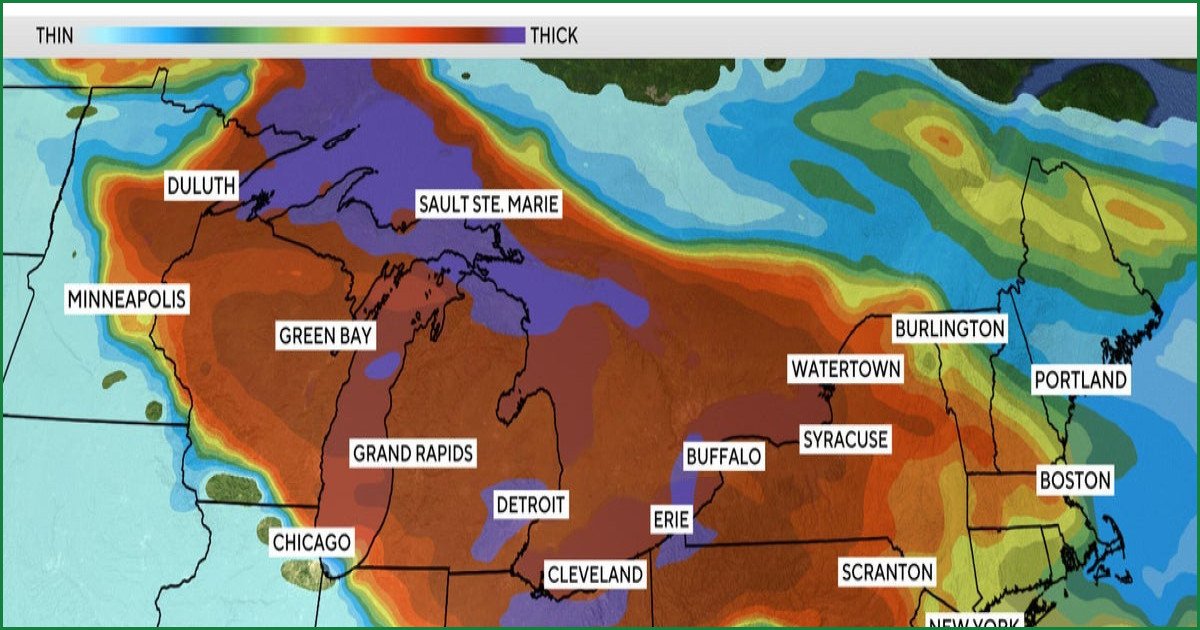
Heavy smoke from more than 100 wildfires burning in Canada and multiple blazes in northern Minnesota is currently engulfing large swaths of the Midwest and Northeast United States. The smoke, driven southeast by winds, has led to hazardous levels of air pollution, impacting millions of people across the region.
By Thursday, major cities including Detroit, Minneapolis, and Chicago were ranked among the top five most polluted major cities in the world.
Air quality alerts are currently stretching from Minnesota to parts of the Northeast. Minnesota officials have issued an alert that remains in effect through Friday, covering areas such as the Twin Cities metro. In the state's northeastern corner, smoke levels reached hazardous territory, rendering the air unsafe for all residents.
Similarly, officials in Michigan and Wisconsin have issued warnings regarding air quality issues that are expected to persist for several days. The entire state of Michigan was placed under an air quality alert on Thursday, with the possibility of an extension if conditions do not improve.
The impact extends further east, where an air quality advisory was in effect for all of New York state on Thursday. In New York City, authorities announced that N95-style masks would be distributed to commuters. Pennsylvania’s Department of Environmental Protection declared a Code Red air quality alert for the state, citing unhealthy pollution levels for everyone.
Additionally, the Massachusetts Department of Environmental Protection issued air quality alerts for the entire state. Residents across Vermont, New Hampshire, and Maine have reported a distinct yellowish and brownish tint in the sky, a phenomenon also observed in the Boston area, where skies shifted from a milky white to an ominous brown and yellow.
Tyler Hasenstein, a meteorologist with the National Weather Service in Chanhassen, Minnesota, noted that the most intense smoke was expected to reach as far south as Washington, D.C., by midday Thursday. Hasenstein urged residents to stay indoors as much as possible to avoid both the smoke and extreme heat, noting that the combination of these two factors is particularly detrimental from a health perspective.
Health experts warn that fine particulate matter from wildfire smoke can cause dizziness, coughing, shortness of breath, and fatigue, while also aggravating chronic heart and lung diseases. Dr. Alexander Azan, an assistant professor of population health and medicine at NYU Langone Health, stated that long-term exposure to this level of pollution increases the risk of developing chronic health conditions.
He advised that anyone who must be outdoors, whether for work or essential errands, should wear an N95 or KN95-grade mask. A study released earlier this year linked chronic exposure to wildfire-related air pollution to tens of thousands of deaths annually in the United States.
The severity of the current situation is attributed to a combination of heat and drought. Dan Westervelt, an associate professor at Columbia University's Climate School, described the conditions as a "perfect storm" that provides significant fuel for wildfires. Research indicates that warming temperatures resulting from the burning of coal, oil, and gas are making these fires more frequent and intense.
The intensity of the Canadian blazes was highlighted by a recent incident near Armstrong, Ontario, where a freight train was surrounded by a wall of burning trees. A video captured the crew’s panic as they were unable to move until another train passed. While the Canadian National Railway subsequently suspended rail operations in that area, the company confirmed that all crew members were safe.