Vietnam is evolving its military modernization strategy, shifting away from the naval-heavy procurement focus of the 2010s toward a more versatile approach centered on long-range surface-to-surface and ground-based anti-ship missiles (ASMs). This transition is designed to address the country's unique maritime-continental dilemma by utilizing land-based systems that offer greater adaptability across diverse geographical domains.
The core of this doctrine involves defending the nation early and from a distance, leveraging the quick reaction times and extended range of missile platforms. Land-based missiles provide a distinct survival advantage over maritime vessels like frigates or patrol boats, which remain exposed on the open ocean. Vietnam's mountainous and jungle terrain, combined with the use of silos, offers natural cover for these systems, while land-based logistics and maintenance lines are notably more robust. The military draws on extensive historical experience in operating, concealing, and moving missile systems, a practice dating back to the Second Indochina War, and has maintained Scud-B missiles for over 40 years.
Cost-efficiency is a significant driver behind this shift. By prioritizing ASMs and surface-to-surface missiles, Vietnam can deny enemy access to its waters or protect naval vessels without the high costs associated with traditional single-domain platforms. The nation has long utilized the 4K44M Redut-M and K-300P Bastion-P systems, and the development of the domestic Truong Son coastal defense missile system underscores a desire to reduce reliance on foreign suppliers. These land-based assets serve as an asymmetrical threat to surface warships and aircraft carriers, with a long coastline providing extensive coverage of the South China Sea.
Hanoi’s strategic reach also extends westward, as it remains the only Southeast Asian nation armed with Scud-Bs. These missiles, upgraded to a range of 550-700 kilometers, enable the military to engage targets across most of Indochina from bases in Hai Phong and Dak Lak. Furthermore, the integration of 63 missile batteries and 34 specialized support units reinforces the strategy of denying enemy access to western Indochina and maritime zones.
To ensure these capabilities are effective, Vietnam established the Artillery-Missile Command last year. This command is tasked with streamlining decision-making and accelerating the kill chain across various military units. Following the administrative consolidation of cities and provinces in July 2025, the military aims to equip each theater of operations with a surface-to-surface missile brigade, a long-range ground-based ASM brigade, and a mixed artillery brigade. Strategic theaters will receive additional force allocations, and the unified command will serve as a framework for future development and system adoption.
While these missile forces significantly bolster defensive posture, officials acknowledge that they cannot replace the need for single-domain platforms required to physically hold or reclaim territories. Nevertheless, by assigning these expanded duties to artillery-missile forces, Vietnam is signaling its commitment to closing defensive gaps while pursuing long-term weapon domestication. The nation is expected to continue enhancing both the quality and quantity of its missile forces as part of a broader porcupine strategy to navigate a multi-threat environment.
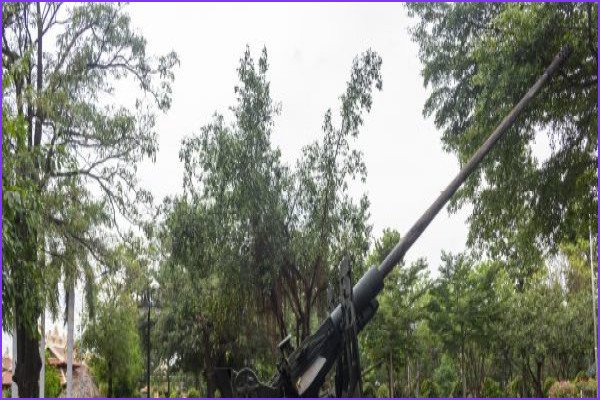
An air defense gun on display at a military museum in Binh Duong, Vietnam, Nov. 16, 2021.
You have reached the limit of 2 free articles this month.