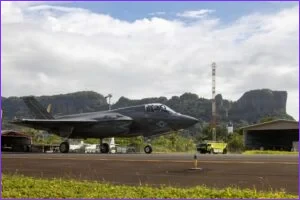
The United States is threatening to pull a $2 billion infrastructure project in Yap, marking the second time in recent months that major problems have surfaced in defense negotiations with a Compact of Free Association (COFA) partner. On June 26, 2026, a U.S. Marine Corps F-35B Lightning II prepared for takeoff after receiving fuel from a KC-130J Hercules during an aviation-delivered ground refueling as part of exercise Slingshot in Pohnpei, Micronesia, highlighting the ongoing regional defense activities. However, negotiation failures are now leading U.S. Pacific Command (PACOM) to look for alternative locations for the $2 billion Department of Defense investment in Yap, Federated States of Micronesia (FSM).
On June 29, 2026, Admiral Samuel Paparo, the PACOM commander, wrote to FSM President Wesley Simina stating that the country’s demand for a $1.3 billion compensation package is “unreasonable, unanchored to demonstrable costs, and divergent from the spirit of our partnership under the Compact of Free Association.” Consequently, Admiral Paparo noted that PACOM intends to move forward by assessing alternative locations across the region to meet the needs of Pacific defense. A map of the region was provided by Cleo Paskal and Pavak Patel to illustrate the strategic landscape.
Yap state, which comprises over a hundred islands, serves as a core component of the Second Island Chain. Its main island, also called Yap, is situated just over 500 miles southwest of Guam. The strategic importance of the Yap group was established during World War II; after the United States captured the region from Japan, the atoll of Ulithi became the busiest and largest American naval base in the world. Following the war, Yap joined neighboring island groups to form the independent Federated States of Micronesia, which subsequently signed a COFA with the United States. This agreement ties the two nations together, allowing FSM citizens to live and work freely in the U.S. and granting the U.S. full authority and responsibility for security and defense matters in the FSM.
Howard Hills, a former lead counsel and advisor for COFA negotiations under Presidents Ronald Reagan, Joseph Biden, and Donald Trump, explained that while the U.S. power to deny third-nation military access to the FSM, Palau, and the Republic of the Marshall Islands is absolute and permanent, military use and operating rights remain subject to mutual agreement. The current impasse in Yap follows the collapse of Department of Defense negotiations for increased access in Angaur, Palau, which was another key location in the Second Island Chain. Experts suggest that these issues persist due to a perception that the U.S. is a “bottomless piggy bank,” fueled by the lavish lifestyles of visiting officials and the high rates paid to consultants. This perception is often encouraged by lawyers and negotiators who stand to benefit, leading some local leaders to overreach.
The $1.3 billion demand equates to over $185,000 for each of the approximately 7,000 residents of Yap. This, combined with the $1.4 billion already appropriated in the National Defense Authorization Act (NDAA) for the Yap airport, makes other locations like the airport on the main island of Palau appear more cost-effective. Furthermore, the national government of FSM has been described as heavily infiltrated by Chinese political warfare operations. In a series of letters from 2022 and 2023, former FSM President David Panuelo warned that some national-level leaders have an interest in seeing U.S. negotiations fail, noting that officials have been bribed to be complicit and silent. Admiral Paparo also testified before the Senate in April 2026 that information, influence, and cyber operations are achieving strategic effects in the Pacific by disrupting decision-making.
The failure to address these influence operations or counter unrealistic demands stems from a broader U.S. failure to understand local dynamics. There are no permanent U.S. government officials in Yap, whereas a Chinese state-owned company has established a seemingly permanent presence. Many locals view visiting U.S. officials as “spies,” a sentiment that benefits Chinese cognitive warfare. While an August 3 letter from President Simina to Yap Governor Francis Itimai acknowledged the setback and left the door open for progress, the situation remains unresolved. The failure to move forward on the project, for which $1.49 billion was appropriated, suggests that PACOM has not adequately invested in understanding the local information and cognitive environment. Thinking a change of location without a change of approach will solve things could cost the U.S.—and a free and open Indo-Pacific—years it does not have to waste. You have reached the limit of 2 free articles this month.