The United Kingdom has formally banned the import of goods produced in Jewish settlements within the Israeli-occupied West Bank, accompanied by a sharp escalation in diplomatic rhetoric. Speaking in the House of Commons on Tuesday, British Foreign Secretary Ed Miliband accused Israeli settler "terrorists" of carrying out "ethnic cleansing" against the Palestinian population.
The trade restrictions, which are expected to take effect in six to nine months, specifically target products originating from the settlements—such as wine, dates, and various fruits and vegetables—rather than imposing a blanket boycott on all Israeli goods. Miliband explicitly stated his opposition to the international Boycott, Divestment, and Sanctions (BDS) movement, emphasizing that the measures are designed to pressure Israel over settlement expansion. According to the U.K. government, such expansion directly undermines the prospects of establishing an independent Palestinian state alongside Israel under a two-state solution.
In a coordinated diplomatic push, Canada and France joined the U.K. in announcing similar bans on settlement products. French officials are also advocating for a European Union-wide prohibition. The three nations join Ireland, Spain, Norway, Belgium, and the Netherlands, which have either already restricted trade in settlement goods or are currently in the process of doing so. The coordinated action comes exactly one year after the U.K., Canada, and France recognized Palestinian statehood in an effort to revive the peace process.
U.K. Prime Minister Andy Burnham, French President Emmanuel Macron, and Canadian Prime Minister Mark Carney released a joint statement on Tuesday defending the decision. "Settlements are illegal under international law," the leaders stated. "The UK, France and Canada will therefore take steps to ban the importation of goods from settlements and enforce targeted measures against settlements and those who facilitate them or profit from them." The statement urged action "before it is too late" to preserve the two-state solution. Ahead of the announcement, Prime Minister Burnham spoke with U.S. President Donald Trump on Monday, emphasizing Britain's commitment to regional peace and the critical importance of a two-state framework.
During his address to Parliament, Miliband sought to distinguish between the Israeli state and its current leadership. "Our argument is not with the people of Israel, with whom the U.K. has unshakeable bonds, our argument is with the conduct of its government," Miliband said. He told lawmakers that the British government agrees "ethnic cleansing" is occurring in parts of the West Bank, pointing to bulldozed homes, destroyed public infrastructure, wrecked roads, and displaced families.
Miliband also shared his personal background, describing himself as a "proud British Jew" who holds "the deepest gratitude" to Israel for providing a refuge for his grandmother after she lost her husband and 60 other family members to the Nazis.
The policy shift has triggered a severe diplomatic rupture between London and Jerusalem. Israeli Foreign Minister Gideon Sa'ar fiercely rejected Miliband's accusations, calling them "outrageous lies." In retaliation, Sa'ar announced that Israel will close the British Consulate in Jerusalem. Furthermore, Israel plans to expel British representatives from a joint military center that monitors the Gaza ceasefire, halt British-led training of Palestinian Authority security forces in the West Bank, and bar 12 British citizens, including several lawmakers, from entering the country. Sa'ar characterized the U.K.'s policy as "a gross interference" in Israel's domestic politics ahead of its national elections scheduled for October. He warned that "whoever acts against Israel, Israel acts against them," adding that the trade ban would also harm tens of thousands of Palestinian workers employed within the settlements.
Among the blacklisted British citizens is Member of Parliament Jeremy Corbyn, who responded by defending his record of advocacy. Corbyn stated that he has visited Palestine on multiple occasions and witnessed "the horrors of occupation," pledging to continue speaking up for "peace, freedom and justice for the Palestinian people."
Meanwhile, the domestic political opposition in Britain voiced strong concern over the government's decision. Tom Tugendhat, the Conservative Party's shadow foreign secretary, warned that the policy risks turning Israel into a "pariah" and could trigger a "further rise in antisemitic violence on our own streets."
International reactions to the trade ban were sharply divided. U.S. Ambassador to Israel Mike Huckabee criticized the British government's decision during an interview with the BBC's Radio 4, labeling the move "irrational." Conversely, Palestinian President Mahmoud Abbas warmly welcomed the measures enacted by the U.K. and its allies. Husam Zomlot, the Palestinian Authority's ambassador to the U.K., hailed the announcement in an online video address. Zomlot called the decision a "reset of policy" that affirms the illegality of the occupation, describing it as "a turning point in U.K.-Palestine relations."
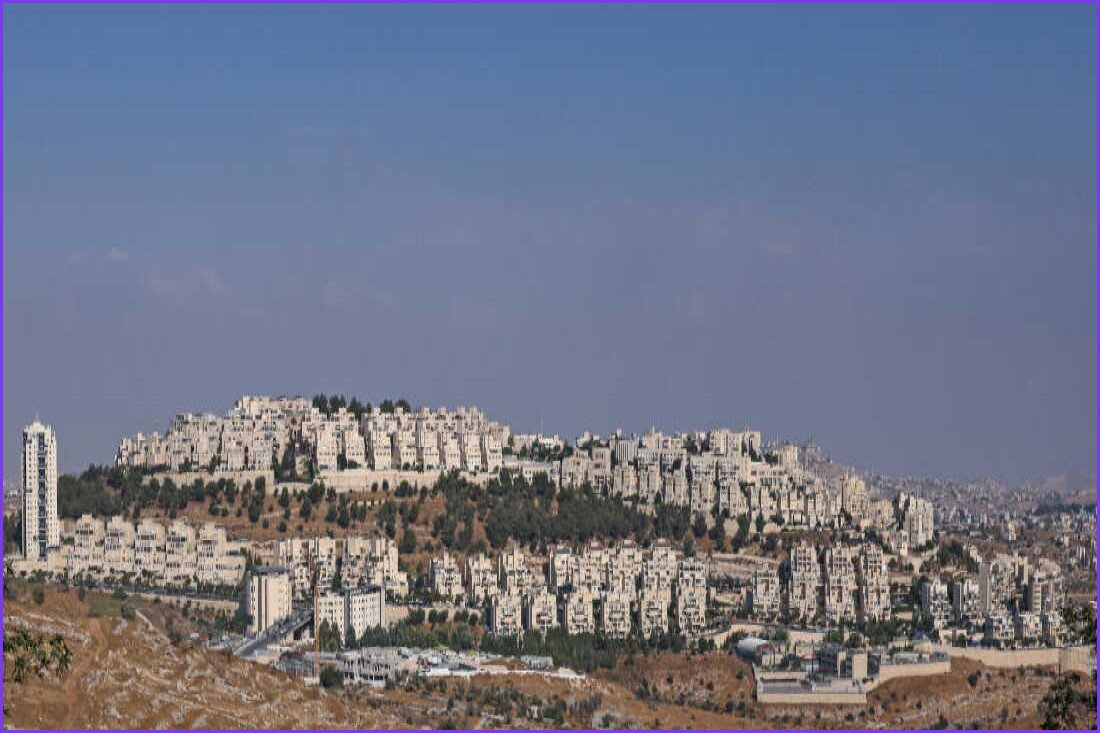
The Israeli settlement of Har Homa, backdropped by the Israeli-occupied Palestinian West Bank city of Bethlehem (right), is seen in the Israeli-annexed East Jerusalem on Aug. 14. Ahmad Gharabli/AFP via Getty Images hide caption