President Donald Trump announced he will allow the bipartisan housing legislation passed by Congress to become law without his signature. The President stated his refusal to sign the bill is a protest against the United States Senate, which he claims is incapable of passing the Save America Act, a strict voter ID bill he has been advocating for. Trump had a 10-day window to either sign the bill, veto it, or allow it to take effect automatically, and he chose the latter option.
The legislation, known as the 21st Century Road to Housing Act, represents a significant federal effort to address housing affordability by reducing construction regulations, streamlining environmental reviews, and limiting corporate acquisition of single-family homes. White House economists previously projected a national shortage of 10 million homes, suggesting the bill could help mitigate the crisis. But Trump called the bill “a yawn” and “so unimportant” compared to legislation that would require proof of citizenship for all voters.
This decision creates friction within the Republican party during a midterm election year. House Speaker Mike Johnson, R-La., had previously encouraged the President to sign the bill, noting that even without a signature, the measure would still become law. Johnson remarked that he understood Trump’s desire to prioritize the election bill, calling it an effective point-making strategy.
The bill passed the Senate with an 85-5 vote and the House with a 358-32 vote. While it has garnered support from housing advocates and the real estate industry, it does not address all housing challenges, such as construction labor shortages, wage stagnation, and rising insurance costs. According to the National Association of Realtors, the median sales price for homes reached a record high of $440,600 in June, marking a 1.8% increase from the previous year.
Democrats have utilized the President’s refusal to sign the bill as a point of criticism. Senate Democratic leader Chuck Schumer stated on social media that the move highlights Trump’s priorities as being focused on his own power rather than family costs. Trump had previously surprised lawmakers on June 24 by canceling a planned signing ceremony, signaling that he would withhold his approval until the voting legislation was addressed. The Save America Act currently lacks the necessary Republican support to pass through Congress. Associated Press reporter Kevin Freking contributed to this report.
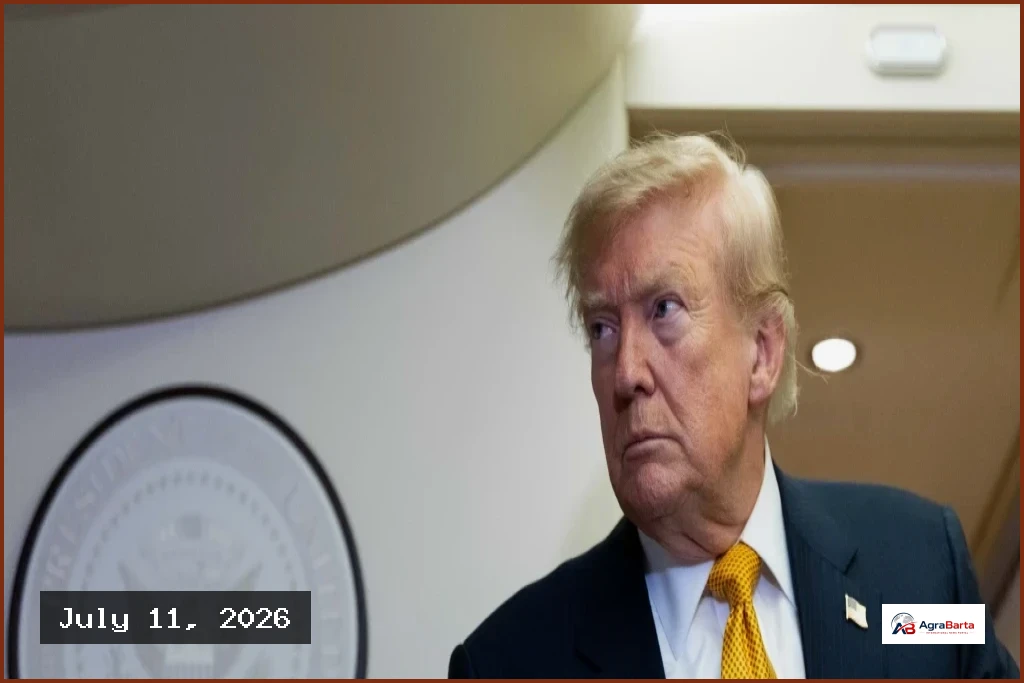
President Donald Trump speaks with reporters in flight on Air Force One after landing at U.S. Air Force Base at RAF Mildenhall, in Suffolk, Eastern England, Wednesday, July 8, 2026. (AP Photo/Alex Brandon)
Trump had 10 days until the Friday deadline to sign the bill, issue a veto, or allow the measure to take effect without his signature. He has chosen to let the measure become law without his express approval, undercutting his administration’s claims that he considers it a priority to combat inflation.