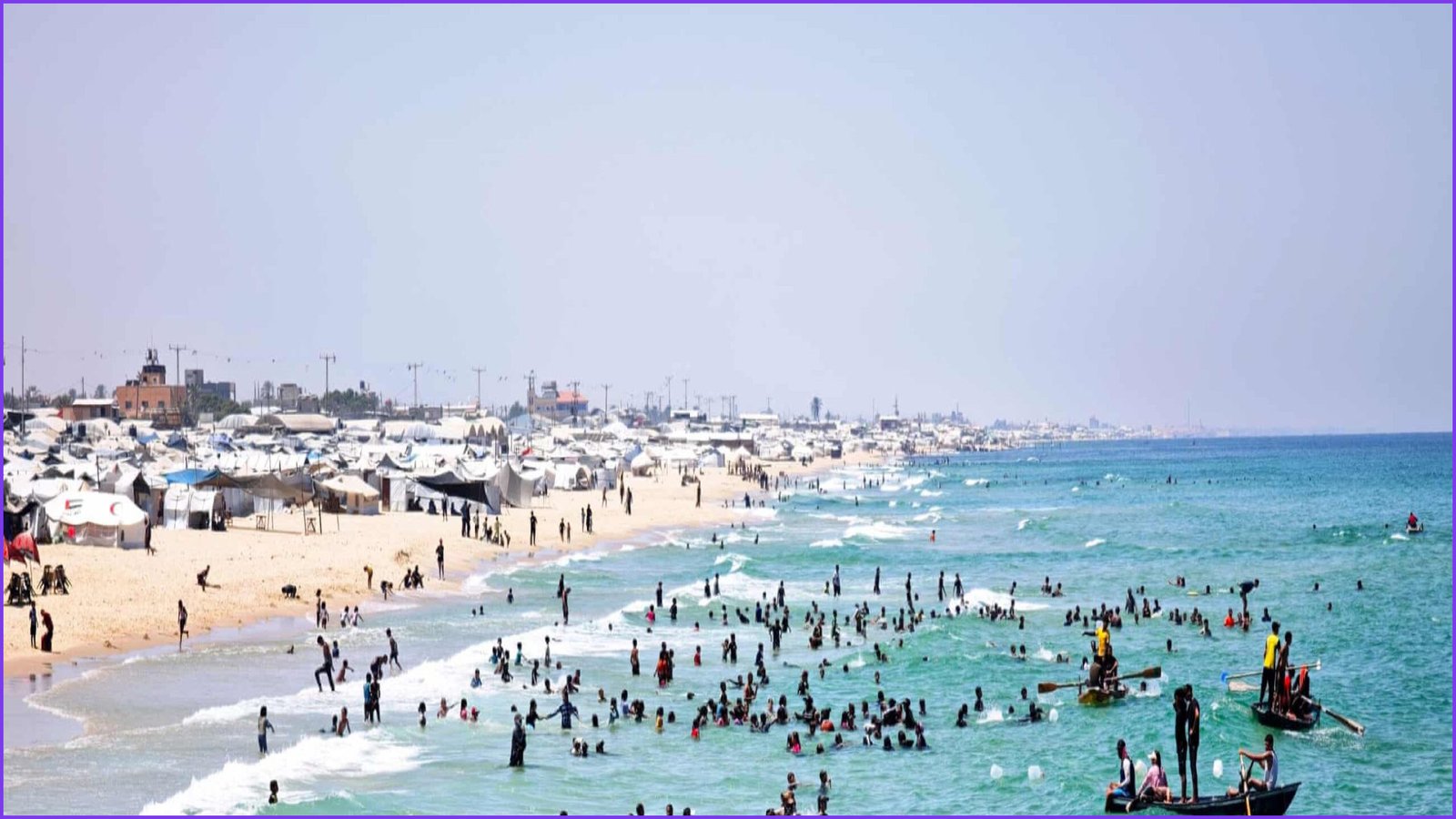
Swimming classes have resumed in Gaza after a three-year hiatus caused by war, with hundreds of children learning to float, doggy paddle, and take their first strokes in five makeshift sea pools constructed from sandbags and rubble. These lessons offer a few hundred girls and boys a chance to reclaim their childhood for a few hours in a region where playgrounds and formal education are absent, and children live in constant fear of ongoing Israeli attacks. A UN survey from March indicated that 96% of children felt death was imminent.
For 13-year-old Alma Shabat, who witnessed her mother’s death in an Israeli strike in May, the classes provide a necessary escape from the worries of war. After three weeks of instruction, she has made new friends and overcome her fear of the waves and open sea. Her favorite stroke is freestyle, and she describes coming to the beach as a beautiful and enjoyable experience. Other children participating include Tulin Al-Othmaneh, 10, and Aseel Al-Kafarna.
The program holds free morning classes for children who lost parents in Israeli attacks, while the afternoons are open to all children. Instructor Ali Al-Attar also works with groups of children at the site. Tantesh emphasizes that the pools offer a rare chance for children to relax and reclaim their stolen childhoods. Most Palestinian children have endured years of extreme trauma, with one in ten of the prewar population killed or injured, and thousands more believed to be buried under rubble. A UN commission report noted that Gaza has the highest concentration of child amputees in the world, stating that disability has become a defining demographic reality for these children. Additionally, the human-made famine caused by the Israeli siege last year threatens to leave children with lifelong mental and physical stunting.
With no formal schooling for three years and nearly all school buildings damaged or destroyed, only a minority of the nearly 700,000 school-age children in Gaza have access to makeshift tent schools. Survivors are crammed into crowded, hot, and noisy tent camps in just a third of the prewar Gaza, lacking adequate water or sanitation. For 10-year-old Maryam al Musri, who lost her father, the classes provide a way to train and breathe fresh air away from the tents. Laila Qahman, 14, who lost her seven-year-old brother when a nearby mosque was bombed, said swimming allows her to relax and forget the sounds of shelling. She dreams of becoming a pharmacist and feels more confident in the water now.
To date, 700 children have attended six weeks of classes. Tantesh hopes to teach thousands more if he can secure funding to pay the volunteer teachers and cover basic expenses. The work is also a source of healing for Tantesh, who mourns his brother Bahjat, a karate champion killed in an Israeli attack last year while they were fleeing their home. Bahjat had taught him to swim and inspired his pursuit of sporting excellence. The academy was originally founded to provide safety after drowning incidents and to help children compete on the world stage, inspired by Palestine’s 1996 Olympic debut.
Amjed Tantesh, who founded Gaza’s first swimming academy more than two decades ago, has mobilised dozens of volunteers this summer to create the string of pools on the beaches of central Gaza, with tarpaulins providing some shade from the fierce Mediterranean sun.
Amjed Tantesh takes a selfie while a swimming class takes place behind him