Ukrainian citizens evacuated from the devastated, Russian-occupied city of Oleshky have safely crossed the northern border into the Ukrainian-controlled Chernihiv region, President Volodymyr Zelensky confirmed on Saturday. The evacuees had been trapped in the frontline city without electricity, running water, or food, with some residents reduced to cooking garden weeds to survive before a local ceasefire allowed for their rescue.
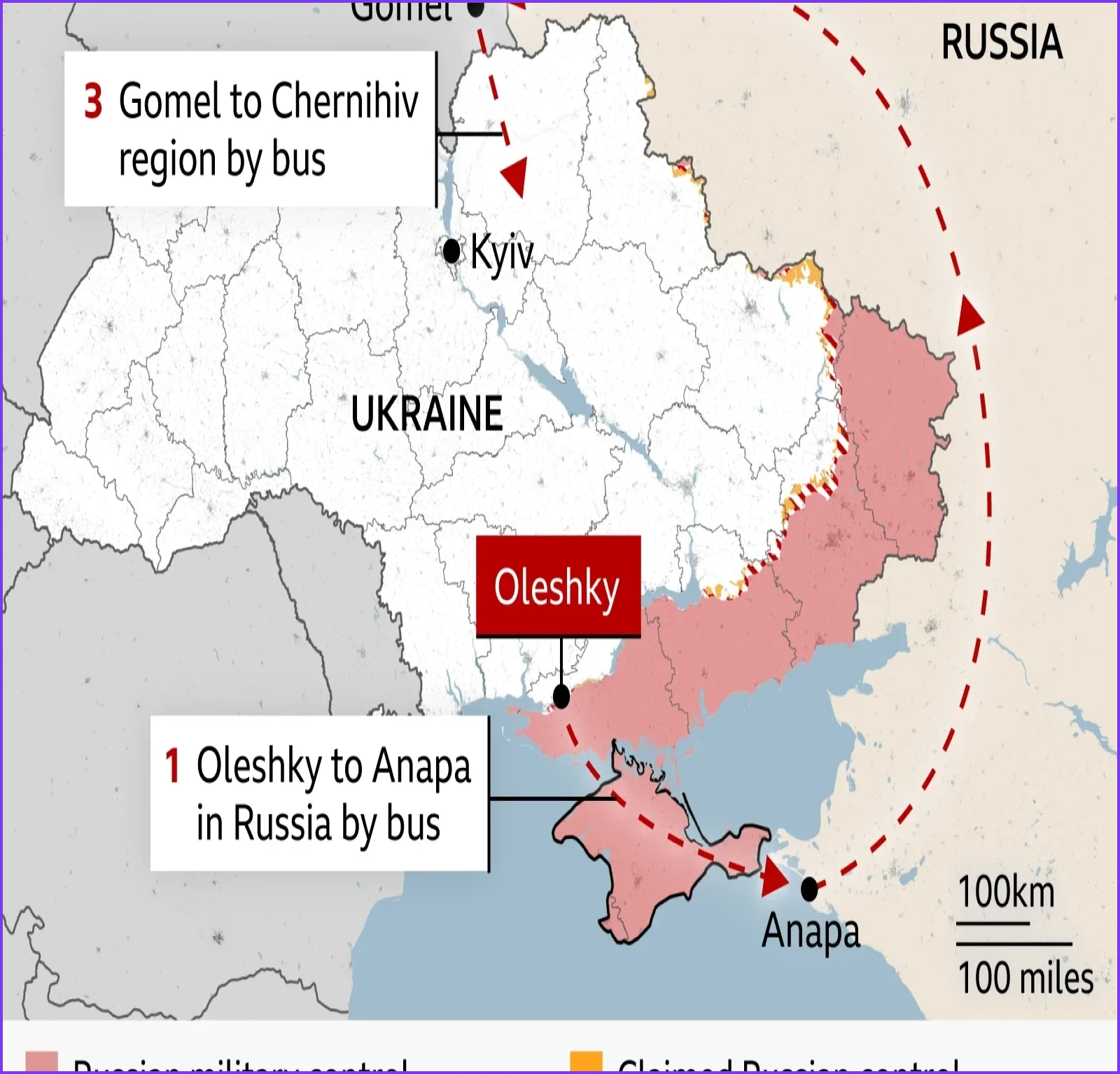
The multi-stage evacuation began on Friday afternoon following a local ceasefire that opened a four-hour departure window. A convoy comprising 25 buses with space for 750 people, alongside ambulances for individuals with limited mobility, transported the evacuees out of Oleshky. Because Ukrainian military positions sit just 5 kilometers (3.1 miles) away across the frontline, the evacuees had to travel deep into Russian-controlled territory to the southern Russian city of Anapa, fly to Gomel in Belarus, and finally cross into Ukraine's Chernihiv region by road on Saturday.
President Zelensky expressed gratitude to US First Lady Melania Trump for her role in brokering the local truce that made the evacuation possible on Friday. Writing on X, Zelensky stated, "As of now, Ukrainian citizens from Oleshky have crossed the Ukrainian border in the Chernihiv region." He added that all evacuees will receive necessary assistance, emphasizing that "it is important that government agencies and all the regional and local authorities involved work effectively and help our people adapt."
The broader humanitarian ceasefire came into effect across the Kherson frontline region on Tuesday, providing the local population with their first period of peace in four years following Russia's full-scale invasion of Ukraine in February 2022. Ceasefire measures are scheduled to remain in place until the end of Sunday, November 1. Before the truce, escaping Oleshky was extraordinarily dangerous due to destroyed bridges over the nearby River Dnipro, mined riverbanks, and roads littered with landmines and targeted by drone strikes. Demonstrating the severity of the situation, one resident who fled three weeks earlier reported walking through 15 miles (24 kilometers) of minefields to reach safety. The temporary truce enabled clearance teams to demine the exit road and deliver urgent humanitarian aid.
The evacuation effort involved unprecedented diplomatic coordination on the ground. Ukrainian human rights ombudsman Dmytro Lubinets and his Russian counterpart, Yana Lantratova, set off together from Armiansk in Russian-occupied Crimea and traveled to Oleshky on Friday. Lubinets became the first Ukrainian official to visit Russian-occupied territory since the 2022 invasion began. Zelensky praised Lubinets and his team for securing the evacuees' safe transfer and acknowledged those who highlighted the "true humanitarian catastrophe in Ukrainian territory temporarily occupied by Russia." While Lubinets defended his direct cooperation with Lantratova as necessary to save lives, the visible collaboration with a representative of the occupying Russian power sparked backlash among some critics in Ukraine.
Despite the widespread destruction and absence of gas, water, and power, several hundred people have chosen to remain in Oleshky. Prior to the invasion, the city had a population of 24,000 before being captured by Russian forces during the initial days of the war. Ukrainian Ombudsman Lubinets assured on Friday morning that those remaining "will receive all the necessary humanitarian assistance." Additionally, Russian officials claimed on Thursday that "dozens of tonnes" of aid—including food, medicine, hygiene items, and generator fuel—had been prepared for residents who opted not to evacuate.