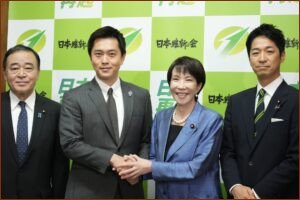
Through a strategic alliance with Prime Minister Takaichi Sanae, the political party Nippon Ishin no Kai has managed to exert an influence on the Japanese government that far exceeds its actual parliamentary strength. This political dynamic was on full display on February 9, 2026, just one day after the Liberal Democratic Party (LDP) secured a sweeping landslide victory in a snap winter election. Standing alongside Takaichi were Osaka Governor Yoshimura Hirofumi and Fujita Fumitake, who leads Nippon Ishin's Diet delegation. Despite belonging to a different party, Yoshimura delivered a stump speech that sounded less like an opposition leader and more like a dedicated partner, declaring that they would never back down or leave Takaichi standing alone in their shared mission to move Japan forward.
This partnership was far from inevitable. During the October 2025 LDP leadership race to succeed Ishiba Shigeru, Nippon Ishin's initial favorite was Koizumi Shinjiro, who now serves as Japan's minister of defense. Yoshimura had openly praised Koizumi as a "true reformer" and a "politician who embodies the spirit of reform," aligning with Nippon Ishin's neoliberal agenda to challenge vested interests. By offering the LDP the votes required to secure a parliamentary majority, which the ruling party then lacked in both houses of the Diet, Nippon Ishin hoped to push through its ambitious reform agenda. Takaichi's eventual victory came as a surprise to Nippon Ishin, which initially had no close political connections to her or her inner circle.
However, a sudden political deadlock changed the landscape. The LDP's long-term coalition partner, Komeito, refused to join a government under Takaichi, citing frustrations with the LDP's handling of a major political funding scandal and skepticism over the timing of proposed reforms. With former members of the Democratic Party of Japan attempting to reassemble and block her path to the premiership, Takaichi wryly referred to herself during the impasse as "the woman who may never become prime minister." Sensing an opportunity, Nippon Ishin's Takashi Endo, known for his cross-party relationships, stepped in as an intermediary to connect Yoshimura and Takaichi. The two leaders quickly found common policy ground, resulting in a formal coalition agreement just a week after their initial discussions.
Since taking office, Prime Minister Takaichi has actively implemented key elements of this coalition agreement, many of which align with her own long-term conservative goals. Among these is a bill criminalizing the desecration of the Japanese flag, an initiative she had unsuccessfully championed in both 2012 and 2021. Furthermore, replacing Komeito with Nippon Ishin has removed previous constraints on national security and public defense reforms, allowing the LDP's conservative wing to pursue long-sought defense objectives.
Takaichi's political debt to Nippon Ishin has also led her to champion policies that were not previously on her personal agenda. In a striking display of this indebtedness, she introduced highly contentious legislation to cut the number of seats in the House of Representatives by 10 percent, explicitly framing the proposal as a promise made to Nippon Ishin. The bill provoked a fierce backlash and a legislative boycott from rival parties that rely heavily on proportional representation, where the bulk of the cuts would occur. Though Takaichi ultimately withdrew the bill after consulting Yoshimura, the attempt demonstrated her willingness to accommodate her coalition partner despite Nippon Ishin lacking the robust electoral machine of Komeito.
Some political observers have gone so far as to describe Nippon Ishin as "Takaichi's faction" outside of the LDP. Historically viewed as an outsider within her own party, Takaichi built her rise to power on grassroots conservative support and a close relationship with the late Prime Minister Abe Shinzo, rather than through the backing of LDP party elders. Her decision to call the early 2026 snap election was largely seen as an effort to solidify her control over moderate and fiscal conservatives within the LDP who remained skeptical of her social conservatism and expansionary fiscal policies.
Nippon Ishin has embraced its role as Takaichi's external shield. During the snap election campaign, Nippon Ishin Secretary General Hiroshi Nakatsukasa pointed out that "forces of resistance" still existed within the LDP, asserting that his party's job was to monitor those elements, support the prime minister, and serve as the "accelerator" for the government. This rhetoric highlighted the party's dual self-perception as both Takaichi's protector and the driving force behind her administrative reforms.
Now that the LDP has secured a sole supermajority, voices within the party are calling to reconsider the alliance, with some viewing Nippon Ishin's neoliberal policies as a political nuisance. Nevertheless, Takaichi remains committed to honoring her political debts. The LDP recently extended the Diet session specifically to pass the deputy capital bill, a major achievement for Nippon Ishin, which was founded on the principle of decentralizing Japan's government.
Looking ahead, Takaichi and LDP defense hawks may continue to use Nippon Ishin as an external catalyst to push the government further to the right on issues like constitutional revision and nuclear policy, including potential nuclear-sharing arrangements with the United States. While the LDP favors keeping the current wording of Article 9, Paragraph 2 of the Constitution, which renounces "war potential," Nippon Ishin advocates for its total deletion to replace the Self-Defense Forces with a constitutionally recognized National Defense Force. This partnership has effectively sidelined Takaichi's moderate rivals within the LDP, leaving them with little room to challenge her trajectory. Although some of Nippon Ishin's key proposals, such as banning corporate political donations and sweeping social security reforms, remain stalled, the party has successfully integrated many of its national security priorities into official government policy, reversing its previous decline and securing a powerful hand in Japan's governance.