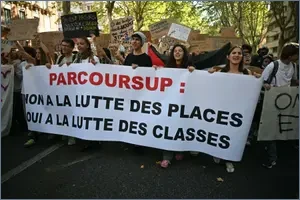
A wave of high school student demonstrations across France has transformed from practical demands over school funding into an intense ideological dispute regarding university admissions and educational selection. Although the French government announced concessions—including securing €1 billion for secondary schools, hiring 500 new teachers, reducing class sizes, and creating 15,000 additional university places—lycée student unions have rejected the measures as insufficient. The student organizations are demanding an immediate €10 billion injection into education, the instant abolition of the Parcoursup admissions platform, and an immediate termination of all university candidate selection.
Government officials anticipate that high school walkouts may lose momentum following the return from the All Saints holiday break on Monday, hoping that a decline in student blockades will ease broader social unrest. However, student movement leaders continue to press their demands, supported by Jean-Luc Mélenchon’s hard-left La France Insoumise (LFI) party. Critics characterize the stance of the student leadership and LFI as "jusqu'auboutisme," a French term describing an unyielding insistence on abstract solutions when dealing with complex, systemic challenges.
While high school students express frustration over tangible infrastructure problems—such as deteriorating school buildings, overcrowded classrooms, frequent teacher absences, and disorganized daily schedules—the central focus of the conflict remains the national university matching platform, Parcoursup. Opponents criticize the system for being slow and opaque, but the core of the resistance is rooted in political ideology. Both student organizations and LFI contend that allowing universities to evaluate and select applicants inherently fosters racial and social exclusion.
The student unions and their political allies advocate for a return to France’s historical system, under which any student who passed the baccalauréat exam held an automatic right to enroll in any university program anywhere in the country. Under that former framework, if there were insufficient places, students were chosen by lottery. Some students were enrolled in courses for which they were unsuited; others were excluded from the studies in which they might have excelled. Only 40 percent of students completed their degrees, compared to an average of 78 percent in Britain. Do the student protesters really want to go back to lotteries for places? Some do, arguing that it was at least egalitarian.
Designed in 2018 under President Emmanuel Macron by his first education minister, Jean-Michel Blanquer, Parcoursup permitted explicit academic selection for highly competitive disciplines such as medicine, law, and engineering. For other fields, selection based on academic merit was formally prohibited in theory, though permitted in practice. Admissions decisions are determined through a combination of automated algorithms and human review panels evaluating motivation letters and high school transcript records. Although applicants' personal names are hidden from university review panels, critics highlight that institution names and geographic locations remain visible, potentially subtly discriminating against applicants from economically deprived inner suburbs, known as banlieues.
While alternative admissions models—such as the United Kingdom’s UCAS platform based on predicted A-Level marks or Ireland’s points-based allocation scheme—are widely regarded as transparent despite their flaws, such systems are often viewed within France as inegalitarian or even unconstitutional. Consequently, France created a complex system where candidate selection occurs without being fully acknowledged. Observers point out that the hypocrisy does not end there: a separate, third level education system exists in France – the Grandes Ecoles – which is brutally selective. In theory these élite institutions are open to all; in reality only young people from the better private and state schools have much chance of passing the entrance exams.
Performance metrics under Parcoursup present mixed results. While drop-out rates in generic university courses remain elevated, success rates in highly competitive fields have shown measurable improvement. For example, one university law program reported that first-year student pass rates rose to 56 percent in 2024, up from 37 percent in 2018 prior to Parcoursup's implementation. Despite these numbers, the government plans to amend the platform before replacing it entirely next year. The National Assembly is scheduled to debate the matter on Wednesday, though political observers expect the session to reflect existing legislative divides, leaving long-term structural decisions to the outcome of next year's presidential and parliamentary elections.
Militant student leaders and LFI politicians continue to push for massive capacity expansions, insisting that tens of thousands of university seats should be created immediately to guarantee open enrollment. During a recent television appearance, LFI parliamentary leader Mathilde Panot was asked how an LFI administration would handle Paris’s highly sought-after Assas university—which specializes in law and political science and receives 20,000 applications for just 1,000 first-year slots—without selection or lotteries. Panot responded that her party would simply establish 19,000 additional places to accommodate all applicants.
The current debate over university access stems from four decades of policy decisions beginning in 1984, when a Socialist administration set a target to increase the baccalauréat pass rate from 30 percent to 80 percent of secondary students. Over the subsequent 40 years, that target was achieved, though critics contend it relied on reducing academic standards for the exam. Today, France faces a shortage of university capacity relative to qualifying students, while many degree candidates struggle academically or face limited job prospects in an oversupplied graduate market. The recent government allocation of 15,000 new places specifically targets vocational and healthcare fields, reflecting growing recognition that future employment opportunities will rely heavily on practical training, particularly as artificial intelligence begins disrupting traditional graduate occupations.
The rebellious lycée students have won – writes John Lichfield – the government has found a billion euros for schools down the back of the education minister’s sofa.
READ ALSO: France announces education reforms, but students to continue protests