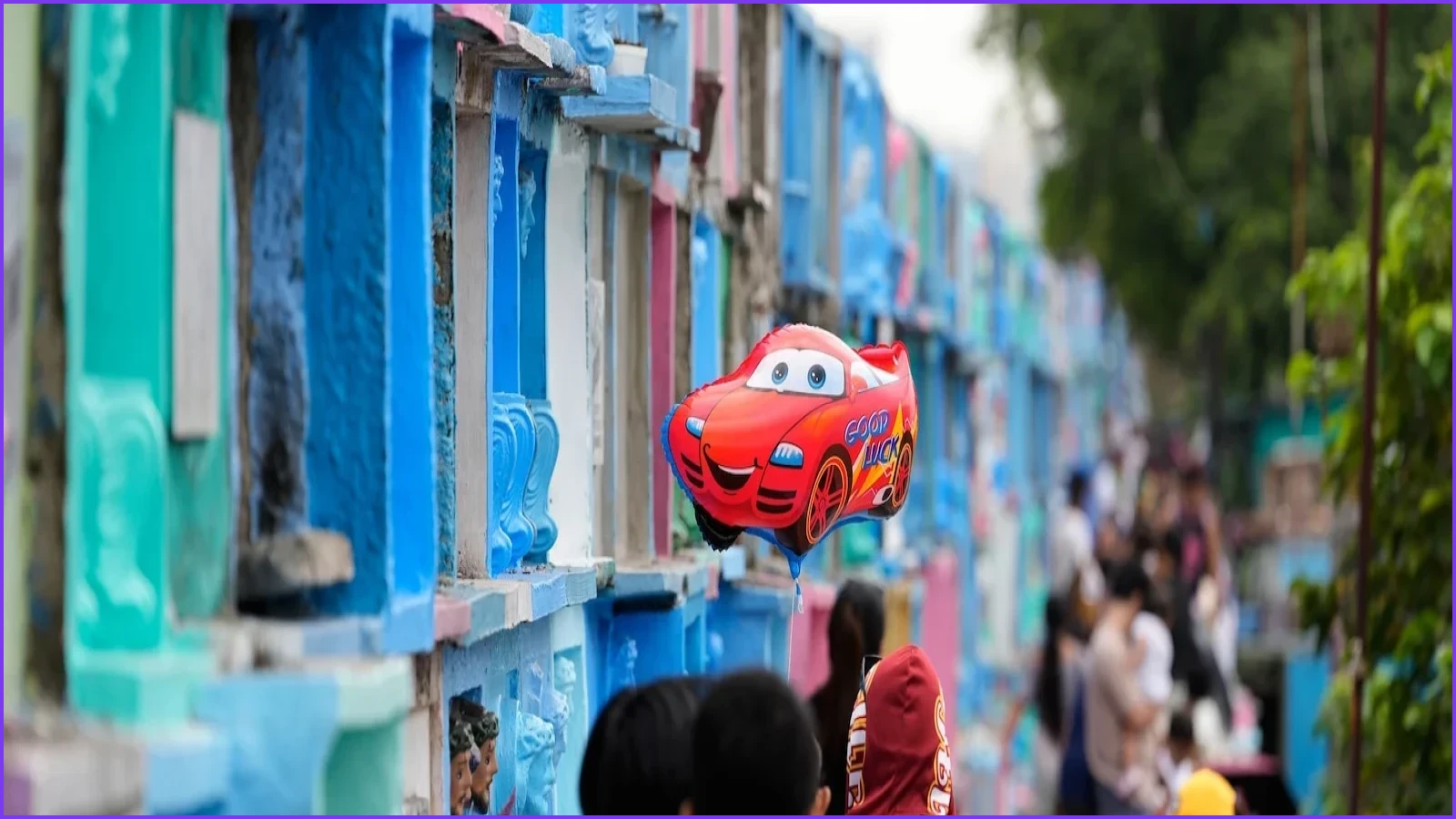
Lorita Santos remains deeply connected to the memory of her father and other relatives, joining thousands of Filipinos who visited cemeteries throughout Manila on Sunday to mark All Saints' Day. For many families, this period, known locally as Undas, serves as a vital time to honor the deceased. The term itself is derived from the Spanish word “honras,” which translates to “honors.”
“Just because they have passed away does not mean we should forget them,” Santos said, noting that she visited the graves of her father and three other relatives. She emphasized the importance of maintaining this connection, adding, “We will never forget that.” Santos, who has visited these gravesites since her own childhood, is now ensuring the next generation learns the practice. “We pass this on to our children to make sure they are aware of the tradition, so that if something happens to us, they know what to do,” she explained.
The Undas observance, which encompasses both All Saints' Day and All Souls' Day on Nov. 1 and 2, is rooted in Catholic tradition but also incorporates customs that predate Spanish colonization. Nestor Castro, an anthropology lecturer at the University of the Philippines Diliman, noted that there is a very long history of ancestor worship in the Philippines. Before the arrival of the Spanish in 1565, Filipinos venerated ancestral spirits known as anito through offerings of food and gifts. These practices were not confined to specific dates but were part of a broader cultural framework.
The tradition underwent further evolution following the introduction of Catholicism by the Spanish, with some customs potentially arriving via Mexico. The historical connection between the two nations, forged during the centuries-long Manila-Acapulco galleon trade, remains visible in their shared ways of honoring the dead. In Mexico, families often spend time at gravesites or maintain home altars, creating a festive atmosphere with music, food, and marigolds. Similar gatherings involving candles, flowers, and prayers are also observed in countries such as Hungary, Poland, and Bolivia.
Beyond the religious aspects, Castro highlighted that death in Filipino culture serves as a significant occasion for family reunions. He noted that during funeral wakes, families often wait for distant relatives to arrive before proceeding with burials, viewing these moments as binding events. This sense of unity continues during Undas, where families share sticky rice cakes to symbolize their enduring bonds. “These events foster and solidify kinship relationships,” Castro said.
For others, such as 42-year-old school maintenance employee Mike Mamaril, the annual visit is a custom inherited from his grandparents. He makes time for the trip despite limited opportunities, finding it a meaningful chance to reminisce about his parents. “We always talk about who among us got scolded the most,” Mamaril said, reflecting on the lighter childhood memories shared during these gatherings.