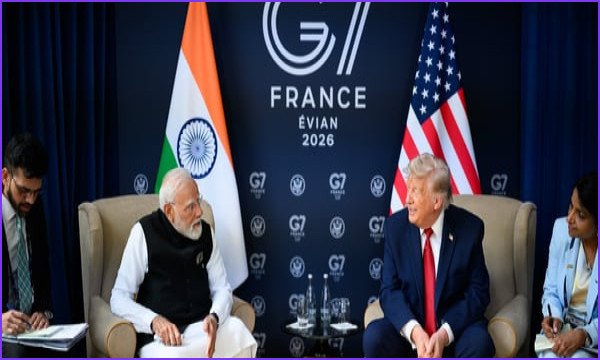
The strategic partnership between India and the United States is facing a critical juncture under U.S. President Donald J. Trump’s second term, sparking an intense debate in New Delhi over the future of bilateral relations. Following a meeting between Trump and Indian Prime Minister Narendra Modi on the sidelines of the G7 summit in France on June 17, 2026, foreign policy analysts are questioning whether the current friction represents a temporary phase or a fundamental rupture with long-term consequences for India's growth trajectory.
Signs of a cooling relationship emerged even before President Trump’s inauguration. New Delhi was caught off guard when Trump extended an unusually early invitation to Chinese President Xi Jinping to attend the ceremony, while Prime Minister Modi received no similar gesture. This marked a sharp departure from the celebrated "personal chemistry" between Trump and Modi, which had fueled high expectations of a rapidly deepening strategic partnership after both leaders secured election victories in 2024. For decades, particularly since the July 2005 U.S.-India civil nuclear understanding, India’s strategic community had anticipated that Washington would actively support New Delhi's rise as a global power. However, that confidence has eroded, and the strategic unease has deepened significantly in the wake of Operation Sindoor.
Officially, India has responded with caution, choosing to weather the policy shifts from Washington rather than adopting an adversarial stance. New Delhi's diplomatic approach remains defensive, characterized by observers as leaving foreign policy deliveries outside the stumps and blocking only those that directly threaten its vital interests. In contrast, the broader strategic community in India has reacted with anger, disbelief, and frustration. Many feel a deep sense of betrayal, pointing to how quickly Washington has distanced itself from New Delhi while warming its ties with Pakistan. This has triggered a profound debate over whether India’s trust in the United States has been permanently compromised.
While official channels remain quiet and the domestic opposition criticizes Modi's silence alongside Trump's unpredictability, the intellectual debate has intensified. At the India International Center (IIC) in New Delhi—a key gathering point for retired diplomats, military officers, academics, and public intellectuals—the conversation has turned toward whether India should make minor tactical adjustments or fundamentally alter its grand strategy. In Washington, veteran India experts continue to warn the Trump administration of India’s strategic importance, urging corrective measures before the partnership suffers irreparable damage.
The intellectual divide in New Delhi is best captured by two contrasting viewpoints from prominent scholars. Happymon Jacob, a strategic affairs scholar and the founder-director of the Council for Strategic and Defence Research, argues for a fundamental shift in his paper "A Case for ‘De-Americanising’ India’s Grand Strategy," published in India’s World. Jacob presents a hard realist critique, advising New Delhi to stop "borrowing Washington’s eyes" to view the global order and China. He urges India to discard two major illusions: first, that the U.S. will unconditionally support India's rise to great-power status, and second, that the Indian diaspora possesses enough political leverage to sway American policy. Instead, Jacob advocates for India to focus on building its own national capabilities independently.
Conversely, C. Raja Mohan, a leading scholar of Indian foreign policy, counsels patience in his article "India Should Stop Panicking About Trump," published in Foreign Policy magazine. Raja Mohan views the current frictions as a natural consequence of deeper engagement rather than a sign of structural divergence. He criticizes what he describes as an entitled attitude among some Indian elites regarding easy access to American jobs and technology. According to Raja Mohan, the core strategic objective of both nations remains identical—preserving a free and open Indo-Pacific devoid of hegemony. He urges New Delhi to remain calm and maintain its partnership with Washington.
Despite this ongoing debate, India's foreign policy is already showing tangible signs of evolution. In West Asia, New Delhi has shifted away from its traditional non-alignment and multi-alignment postures, aligning more closely with Israel and the United Arab Emirates. Simultaneously, India has reached out to improve relations with China and is working to revive the Russia-India-China (RIC) trilateral mechanism. Furthermore, Prime Minister Modi is actively strengthening India’s Indo-Pacific strategy under the MAHASAGAR initiative, forging deeper defense and diplomatic ties with Japan, Indonesia, and Australia, notably bypassing a U.S.-centric framework. While these maneuvers do not yet constitute a complete overhaul of India's grand strategy, they indicate that New Delhi is actively seeking a new path forward in an increasingly unpredictable global landscape.
You have reached the limit of 2 free articles this month.
Nearly everyone I spoke with appeared to be deeply emotional. The sense of both betrayal and anger was palpable among those who are engaged with, or closely observe, U.S.-India relations.