You have reached the limit of 2 free articles this month. On June 17, China’s State Council Information Office released a policy paper titled “More Just and Equitable Global Governance: China’s Principles, Proposals and Actions.” The document emphasized that countries should uphold the international system centered on the United Nations, safeguard the order based on international law, and adhere to the norms governed by the U.N. Charter. This stance highlights a deliberate strategy: Beijing is not attempting to reinvent the wheel, but rather to reorder global governance from within by preserving existing institutions while reweighting their core principles.
This approach was further evidenced on July 16, when 29 governments signed the founding agreement of the World Artificial Intelligence Cooperation Organization (WAICO) in Shanghai. Headquartered in China, the new body explicitly invokes the U.N. Charter and adopts a “people-centered” approach. These actions reflect a broader pattern where China creates new venues to operationalize its vision, which prioritizes sovereign equality, noninterference, and state-led development over independent scrutiny or adverse judicial judgments.
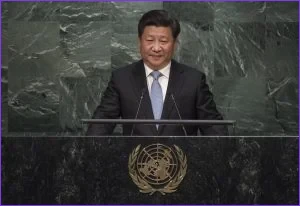
The Global Governance Initiative (GGI), launched by President Xi Jinping on September 1, 2025, at a Shanghai Cooperation Organization Plus meeting in Tianjin, serves as a primary vehicle for this strategy. The June 2026 white paper presented development, security, civilization, and governance as the four subjects of China’s global initiative. The GGI identifies three critical deficits: the underrepresentation of the Global South, weakened rules, and institutional ineffectiveness regarding development and emerging domains like artificial intelligence. It promotes five principles, including sovereign equality and the international rule of law, while insisting that reform does not require overturning the existing order.
Beijing’s interpretation of sovereignty acts as a primary lens for its governance doctrine. China’s argument draws from the U.N. Charter, where Article 2 affirms sovereign equality and limits U.N. intervention in domestic matters, while the preamble, Article 1, and Article 55 also invoke dignity, human rights, development, and fundamental freedoms. By recasting “democracy in international relations” as a demand to narrow the gap between legal equality and unequal influence, China positions itself as both a major power and an advocate for developing nations.
The tension in this approach is visible in China’s relationship with international legal bodies. For example, regarding the 2016 South China Sea arbitration, China maintained that the tribunal exceeded its jurisdiction and violated state consent, declaring the award null and void. While Beijing critiques Western states for selective legalism and unilateral sanctions, the question remains whether international law can effectively constrain a great power when an adverse judgment conflicts with its core national interests.
Regarding human rights, China increasingly champions economic and social rights. Foreign Minister Wang Yi has advocated for a “recalibration” of human rights governance, offering 10 priorities for further discussion. This method seeks to shift the focus from individual claims against governments toward state-mediated performance. Xinyuan Dai and Lucie Lu, analyzing more than 93,000 Universal Periodic Review reports, found that China’s U.N. diplomacy contested the implications of human rights norms more often than their formal validity.
While China claims that nearly 160 countries and international organizations support the GGI, the level of association varies significantly across the globe. Many developing nations support specific aspects of China’s critique without necessarily aligning with China’s entire political program. The Global South is not a monolithic bloc, and many governments seek to balance Chinese finance with strategic autonomy and the preservation of their own national interests.
Ultimately, Beijing is building channels through which its interpretations become standard practice. Through organizations like the SCO, BRICS, and the Group of Friends, China is engaging in “institutional layering.” As WAICO begins its operations, providing 30 AI training opportunities and meteorological warning systems, its success will depend on whether China can deliver the “real results” it promises. The future of global governance may well be decided by who has the power to interpret the U.N. Charter and whether major powers will accept those interpretations when they are not in their own favor.