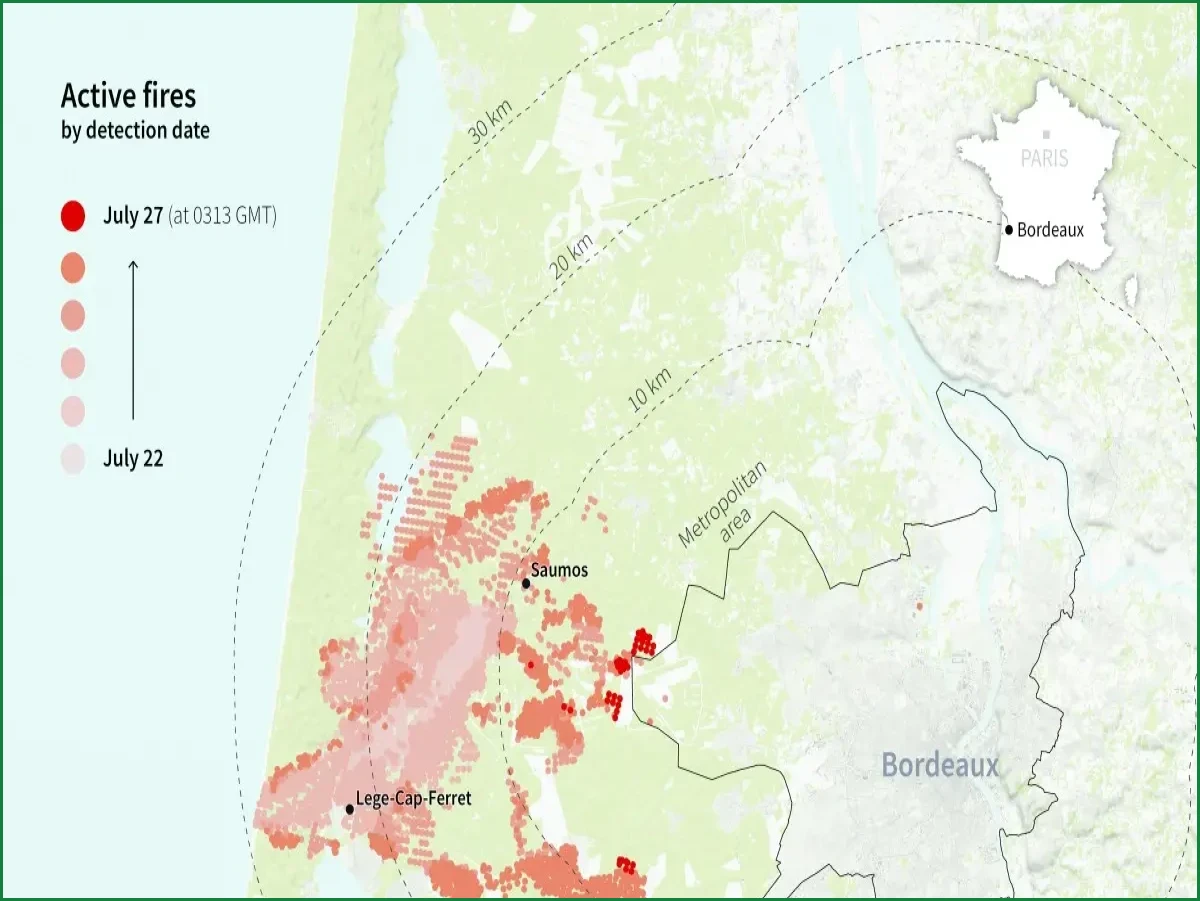
Approximately 4,000 tourists have been evacuated from campsites, holiday villages, and leisure parks surrounding Lacanau lake in south-west France. The order was issued by the préfecture on Tuesday morning as a precautionary measure in anticipation of adverse weather conditions, specifically a forecast heatwave that is expected to bring temperatures up to 40C in the region. This area, located about 15km north of the primary fire zone, gained attention last Friday when a viral photo showed beach-goers watching smoke rise from the wildfires.
The massive wildfire, which has consumed 42,000 hectares in the Gironde department since July 22nd, was reported to be under control on Tuesday morning following a quiet night. However, authorities remain deeply concerned that the incoming heatwave will fan the flames once again. While the Interior Ministry stated on Monday evening that the fire had been stabilized, it is not yet fully under control, and officials warned that the coming days will likely be challenging.
Since the blaze broke out on Wednesday at Le Porge, it has moved steadily toward Bordeaux. By Sunday evening, the fire was just 15km away from the Bordeaux metropolitan area, according to city mayor Thomas Cazanave. The fire's progression has been dictated by strong and changeable winds, which have made the situation extremely difficult to predict. On Friday evening, the local Préfet noted the fire was moving at speed toward the city, pushed by a strong westerly wind. Although the situation improved on Monday after a calmer day, the effects of shifting winds and rising temperatures remain highly unpredictable.
Mayor Cazanave confirmed that there are currently no plans to evacuate the city's 270,000 residents, though he emphasized that officials are remaining very vigilant and are prepared for any scenario. The air quality within the city is currently extremely poor due to the smoke, and authorities are advising anyone with a planned trip to Bordeaux to cancel it. Residents have been advised to stay indoors, keep windows closed, and wear FFP2 masks when outdoors. The government has already supplied thousands of these masks to the local population, and those with respiratory issues are strongly urged to avoid the area.
The disruption to travel and infrastructure is widespread. All high-speed TGV trains south of Bordeaux have been cancelled, with severe disruption reported on local lines and some services heading north. The national rail operator, SNCF, has announced that passengers can cancel or reschedule pre-booked tickets free of charge until at least July 31st. On the roads, the A63—the main route to the south and Spain—is closed. The traffic watchdog Bison Futé is advising travelers heading to or from Spain to utilize the A20 and A64 as alternative routes. In the immediate vicinity of the fire, multiple road closures are in effect, and motorists are asked to avoid the entire area to keep roads clear for emergency crews.
The Gironde blaze is part of a broader wildfire crisis in France. Approximately 60km to the south, a fire in Biscarrosse in the Landes department has burned 3,500 hectares, leading to the evacuation of 31,000 people. While firefighters believe that blaze is now stabilized, it remains a significant concern. Additionally, a severe wildfire broke out on the Mediterranean island of Corsica over the weekend. According to the government-backed Feux de Forêt app, there were 18 wildfires in progress across the country as of Monday morning.
Since the start of the Gironde blaze, around 20 communes have been fully or partially evacuated, including seven within the greater Bordeaux area. Official figures from Sunday morning indicated that 251,000 people have been evacuated due to fires in the Gironde and Landes departments, a number exceeding the populations of cities like Rennes or Lille. Even if firefighters manage to bring the current blazes under control within the next few days, experts note that a fire of this size usually takes weeks to fully extinguish. With large parts of France remaining parched and tinder-dry, it appears unlikely that the country will escape the summer without further wildfire incidents.
READ ALSO: Should you cancel your French holiday due to wildfires?
READ ALSO: French vocabulary to understand wildfire warnings and evacuations