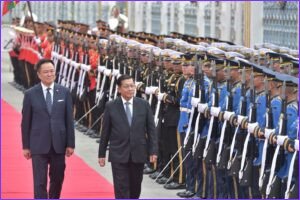
Thailand has formally pledged to work toward the full reintegration of Myanmar into ASEAN, a move that follows a two-day visit to Bangkok by Myanmar’s military-appointed president, Min Aung Hlaing. Thai Prime Minister Anutin Charnvirakul and Myanmar President Min Aung Hlaing walked past a guard of honor in Bangkok, Thailand, Aug. 6, 2026. The summit, which concluded on August 7, 2026, marked the first official visit to Thailand by the former general since he initiated a military coup in 2021.
Upon his arrival, Min Aung Hlaing received a red-carpet welcome from Thai Prime Minister Anutin Charnvirakul. The itinerary included formal talks at Government House, an official dinner, meetings with leaders from both houses of the Thai parliament, and an address at a Thai-Myanmar business forum. In a joint statement released following their discussions, Thailand reaffirmed its commitment to supporting Myanmar’s “full and equal participation” in ASEAN mechanisms. In response, Myanmar expressed appreciation for Thailand’s role in facilitating the normalization of its relations within the regional bloc.
The two leaders agreed to deepen dialogue regarding trade, security, and environmental protection, while emphasizing a shared commitment to achieving a peaceful and stable border between the two nations. This diplomatic outreach reflects Thailand's ongoing strategy of “calibrated engagement” with the junta in Naypyidaw, a policy aimed at addressing transnational crime and border security. Foreign Minister Sihasak Phuangketkeow has previously advocated for Myanmar’s return to the “ASEAN family,” a sentiment that has gained momentum since the current government took office in April.
During the business forum, Min Aung Hlaing claimed that his administration is focused on national stability and reconciliation, inviting investors to engage with Myanmar’s energy, agriculture, manufacturing, and healthcare sectors. However, the visit has drawn sharp criticism from human rights advocates. Phil Robertson, director of Asia Human Rights and Labour Advocates, condemned the invitation, labeling the Myanmar military leadership as the core problem rather than a solution. Similarly, editor Aung Zaw argued that the Thai government should not provide legitimacy to the regime.
Addressing these concerns at a press conference, Sihasak rejected the notion that the meeting granted legitimacy to the junta, framing the engagement as a pragmatic necessity. “It’s not about legitimacy, it’s about reality,” he stated, noting the importance of direct talks with those in power to manage border issues and regional stability. Meanwhile, junta-linked accounts on X celebrated the red-carpet reception as a diplomatic success that reinforces their international standing.
Despite Thailand’s efforts, Myanmar’s path back to the regional bloc remains uncertain. The 11-nation ASEAN continues to demand the implementation of the Five-Point Consensus agreed upon in 2021, which calls for an end to violence and humanitarian access. At the same time, Min Aung Hlaing’s government has moved from implicit to full-throated rejection of the Five-Point Consensus. In a speech on July 31 marking his administration’s 100th day in office, Min Aung Hlaing declared that the Consensus was “not the consensus of all ASEAN member states” and that it was merely an internal political development. Philippine Foreign Secretary Ma. Theresa Lazaro, serving as the current ASEAN special envoy, has previously noted that full reintegration remains a distant goal.
You have reached the limit of 2 free articles this month.
“It’s not about legitimacy, it’s about reality,” he said, according to the Straits Times. “We have problems that we face along the border, and at the same time, we have to be proactive in terms of helping Myanmar on the path of peace, stability.” He added, “And the best way to achieve that is to have talks with those who are in the position of power.”