A sweeping transformation has reshaped the leadership of Ukraine's armed forces in the span of a single week, replacing the old military guard with a new generation of commanders. The high-level military shake-up culminated in the dismissal of Commander-in-Chief Oleksandr Syrskyi and the appointment of Major General Mykhailo Drapatyi as the new army chief. This sudden reset was triggered by intense public backlash and street protests following the firing of the country's reform-minded defense minister, Fedorov.
The political turmoil, which lasted almost a week, began when President Volodymyr Zelenskyy dismissed Fedorov from his post as defense minister. The decision sparked immediate demonstrations, with protesters overwhelmingly rallying behind the departed minister and demanding his reinstatement. Fedorov, who was previously known as the architect of Ukraine's digital transformation, had emerged during his six months in office as one of the country's most influential wartime reformers, building a broad base of public support. His dismissal followed months of increasingly bitter disagreements between him and Syrskyi.
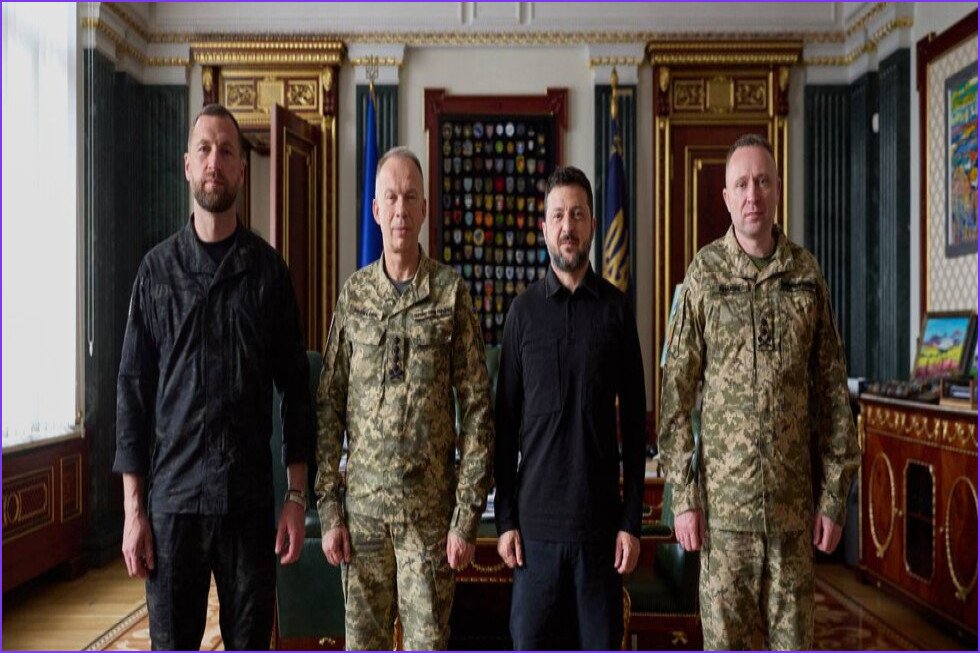
For President Zelenskyy, the public uproar marked the second time in a year that a major wartime decision triggered a severe political backlash. In mid-2025, the president had faced similar public anger after moving to curb the powers of Ukraine's anti-corruption agencies. Seeking to contain the latest political fallout, Zelenskyy acted swiftly by dismissing Syrskyi and appointing Drapatyi. To mark the transition, Zelenskyy met with Drapatyi in Kyiv on Monday, July 20, 2026, and later held a joint meeting on Wednesday, July 22, 2026, alongside former Commander-in-Chief Syrskyi and the acting Minister of Defense, Major General Yevhen Khmara.
The appointment of Drapatyi represents a sharp generational and philosophical break from Syrskyi, whose leadership style was shaped by Soviet military tradition. Much of the public's accumulated frustration since Russia's full-scale invasion in 2022 had focused on Syrskyi, who became a symbol of rigid, outdated structures. In contrast, Drapatyi belongs to a younger generation of Ukrainian generals who rose through the ranks during the ongoing fight against Russian aggression, earning widespread respect on the battlefield rather than inheriting status from the Soviet military system. Drapatyi first gained prominence for his daring actions in 2014, the year Russia illegally seized and annexed the Crimean Peninsula.
Military analysts believe Drapatyi could serve as a crucial bridge between the traditional and reformist factions of the armed forces. Oleksandr Musiienko, a military analyst based in Kyiv, noted that Drapatyi enjoys a high level of trust within the military, which could significantly boost troop morale and strengthen their fighting spirit. Musiienko praised the new commander's ability to adapt to the realities of modern warfare, adjust to changing battlefield conditions, and efficiently reallocate resources. This flexibility contrasts sharply with the rigid, highly centralized command style of Syrskyi, who was frequently criticized for micromanagement and struggle with ongoing mobilization challenges.
The divide between the former defense minister and the ousted commander-in-chief was stark. One Western defense official, speaking on the condition of anonymity, described Fedorov and Syrskyi as existing on "different planets." While Syrskyi adhered to traditional ground-forces doctrine, Fedorov championed a data-driven, technology-led approach to modern warfare. Fedorov publicly identified Syrskyi as the primary obstacle to these critical modernization reforms, bringing deep-seated military and public grievances to light.
Public anger toward Syrskyi was further intensified by his association with the 425th Separate Assault Regiment, known as Skelia. For many Ukrainians, the regiment became a symbol of military tactics that sacrificed soldiers' lives for minimal territorial gains. The regiment also became the center of a major public scandal following an investigative report by the Ukrainian publication Babel. The investigation revealed allegations of systemic abuse, torture within training camps, and dozens of noncombat deaths. These revelations triggered an official investigation, resulted in the suspension of the regiment's commander, and fueled intense public scrutiny of the military's command culture.
Despite the military reset, Zelenskyy has faced significant political costs. Ukrainian social media platforms quickly filled with memes mocking the president's search for a new army chief. Some of these jokes depicted Zelenskyy interviewing absurd candidates, such as the fictional character Jon Snow from the television series "Game of Thrones," alongside an alien and a dolphin. This political embarrassment came shortly after Zelenskyy weathered a damaging corruption investigation that involved some of his closest associates, including his former chief of staff, Andriy Yermak, who was eventually dismissed under intense public pressure.
The public protests surrounding Fedorov's dismissal reflected a deeper demand for systemic reform rather than just support for an individual. Tetiana Shevchuk, a board member of Ukraine's Anti-Corruption Action Center, explained that Fedorov's vision of preserving soldiers' lives while increasing efficiency had given Ukrainians a renewed sense of hope. Shevchuk noted that over the previous six months, the public felt Ukraine was finally gaining an advantage and that the war was winnable, rather than just taking loans while slowly losing territory. Shevchuk observed that in the absence of elections under martial law, public protest became one of the few ways citizens could make their voices heard. While she cautioned that such street protests are not a healthy precedent, she emphasized that they should serve as a clear signal for the government to address systemic problems before they boil over.
The precedent set by the leadership change has divided Ukrainian lawmakers and analysts. Some view the episode as a sign that democracy and institutional accountability remain active in Ukraine despite martial law, showing that Zelenskyy is still responsive to public demands. Conversely, other lawmakers warned that allowing public sentiment to dictate top-level military appointments could set a dangerous precedent, undermining institutional decision-making during a time of war.
The political drama remains unresolved as Fedorov has reportedly refused to accept any other government post unless he is fully reinstated as defense minister, a demand still echoed by many protesters. During his brief six months in office, Fedorov pursued an ambitious agenda to accelerate military modernization. He proposed overhauling military service contracts to make front-line duty more sustainable, offering higher pay, expanded leave, and greater flexibility for infantry soldiers—reforms that resonated deeply with the troops. Whether Fedorov returns to the government or remains outside of it is expected to significantly influence the next phase of Ukraine's wartime political landscape.