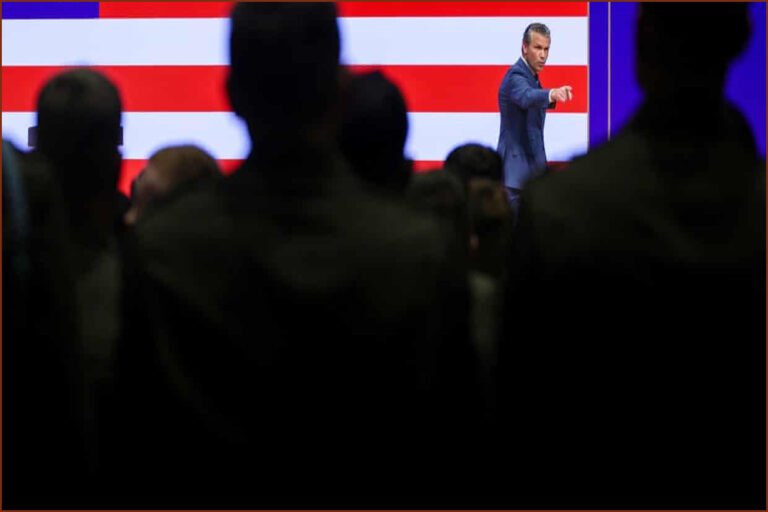
US Defense Secretary Pete Hegseth is advocating for a massive $1.5 trillion military budget for 2027, a 44% increase that would, when adjusted for inflation, rival spending levels seen at the height of the second world war. This proposal comes as the Pentagon navigates a complex financial landscape, attempting to secure billions in emergency funding for the ongoing war in Iran while managing a vast, multifaceted military enterprise alongside his deputy, private equity executive Stephen Feinberg.
The push for this record-breaking budget follows a period of volatile shifts in Pentagon fiscal policy. In February 2025, Hegseth had initially ordered subordinates to find annual budget cuts of 8% over five years, a move that briefly impacted defense stocks before the plan was abandoned. Now, the department is pursuing what Hegseth terms a “generational investment,” while simultaneously seeking $67 billion in emergency defense funds for 2026 to address the conflict in Iran.
During a recent Senate appropriations committee hearing, Hegseth and the chair of the joint chiefs of staff, Dan Caine, faced pointed questions from lawmakers. Senator Patty Murray questioned the correlation between the requested emergency funds and actual military operations, noting that the request includes $800 million for National Guard patrols in Washington DC, over $1 billion for army border patrols, and $900 million for Caribbean boat strikes. Hegseth defended the spending, attributing the need for such funds to the “gross negligence and neglect of the Biden administration.”
Financial transparency remains a point of contention. The Department of Defense currently holds $75 billion in unobligated funds from the previous “One Big Beautiful Bill Act,” for which Hegseth could not provide specific expenditure plans during the hearing. Furthermore, the secretary provided a $37.5 billion estimate for the cost of the Iran war, though he noted the figure was subject to change and included costs only through September 30. Defense expert Becca Wasser of the Center for New American Security suggested this timeline implies the conflict is expected to continue well beyond that date.
Unlike past practices where combat costs were funneled through “overseas contingency operations” funds, the Trump administration is utilizing legislative reconciliation to steer spending, a move that prevents senators from filibustering the measures. While the House recently passed a $1.15 trillion bill, experts remain skeptical of its prospects in the Senate.
The proposed $1.5 trillion budget includes significant allocations for modernization and technology. Plans include $58.5 billion for artificial intelligence, overseen by former Uber executive and current head of research and engineering, Emil Michael. Additionally, $20 billion is earmarked for the office of strategic capital, a Pentagon agency that functions like a private equity firm. The office is currently led by a former employee of Cerberus Capital, the firm previously headed by Feinberg, and recently committed $620 million to a mining company linked to a fund associated with Donald Trump Jr.
The disclosure briefly sent Palantir and defense stocks tanking – though soon the plan evaporated, as if it never existed.
Messy efforts to fund wars are not new: back during combat operations in Iraq and Afghanistan, the two Bush administrations, the two Obama administrations and the first Trump administration tagged the combat costs on to the defense budget under what were called “overseas contingency operations” (OCO) funds.