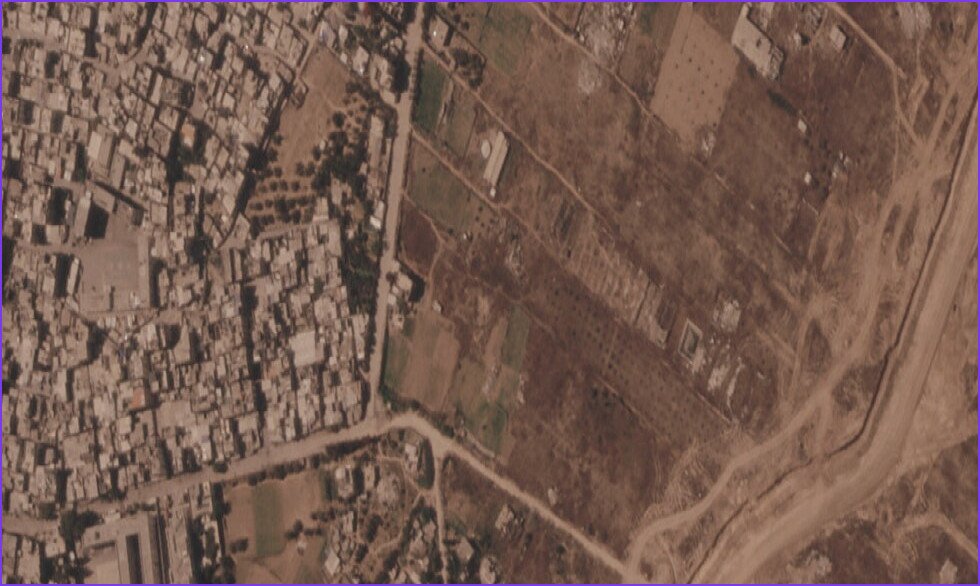
The Israeli military is rapidly constructing a massive earthen barrier, extending over 23 kilometers (14 miles) inside the Gaza Strip. This barrier effectively separates the more than 50% of the territory now under Israeli control from the remaining areas, according to recent satellite imagery. The construction is further entrenching the division of the small Palestinian enclave and intensifying Palestinian concerns that this new line could evolve into a permanent border.
The coastal strip of Gaza is approximately 40 kilometers (25 miles) long and 11 kilometers (7 miles) wide, home to over 2 million Palestinians. The more than 23 kilometers of barrier built in recent months already accounts for over half the length of the territory, running through Palestinian communities that have been leveled by the military.
The Israeli military has stated that alongside the barrier, it has established a “security zone” equipped with intelligence and technological assets. When questioned about the barrier’s route and potential extension, the military declined to provide specific details, but affirmed its purpose is to prevent infiltration and safeguard Israeli troops and communities situated near Gaza.
Satellite images provided by Planet Labs PBC illustrate the rapid pace of construction. A section of the berm network in southern Gaza, for instance, was extended by more than 2 kilometers (1.2 miles) in just two weeks this month. This particular berm measured approximately 500 meters (0.3 miles) on July 1, but by July 15, it had grown to about 2.4 kilometers (1.5 miles), effectively cutting off the Israel-controlled ruins of Rafah from Muwasi, a site hosting some of the largest Palestinian tent camps.
If construction continues in its current trajectory, this segment is expected to connect with the longest existing stretch of the barrier, which runs almost continuously for about 17 kilometers (10 miles) from the southern city of Khan Younis to an area near Gaza City in the north. Work on this longer stretch commenced in February, and satellite images indicate ongoing efforts to extend it further south. More than a kilometer (0.6 miles) was added to this section between June 21 and July 7, passing close to an Israeli military base built on the ruins of Bani Suheila, near Khan Younis. In the far north of Gaza, several disconnected segments of berms are visible just outside the largely leveled town of Beit Lahia.
The exact height of these berms remains unclear, and in some locations, the barriers appear to extend beyond the established “yellow line.”
On one side of this dividing line, Gaza’s population is largely concentrated in the coastal area to the west, with many residing in crowded, squalid tent camps and relying heavily on aid. On the other side, satellite imagery reveals extensive destruction, with Israeli forces having leveled the vast majority of buildings using bulldozers and explosives. This has virtually erased several towns and the city of Rafah, which once housed over a quarter million people. New road networks have been carved out, and new military bases have been erected on the ruins of Palestinian towns, with agricultural land also being destroyed. The Israeli military maintains that these demolitions target infrastructure used by Hamas.
Incidents near the line have resulted in casualties among Palestinians who approached or crossed it. While the Israeli military states it fires upon individuals believed to be militants threatening its troops, those killed have included children and other civilians who appeared unaware of the demarcation. Some soldiers have reportedly indicated that they do not always know whom they are firing upon and have orders to kill anyone crossing the boundary.
The construction unfolds as a truce in the region stagnates. Since the ceasefire began, Israeli forces have killed more than 1,100 Palestinians, predominantly through airstrikes and drone attacks across Gaza. In the same period, militant attacks have resulted in the deaths of five Israeli soldiers.
A recent strike early on Tuesday in Gaza City killed Firas al-Masri, his wife, and their four children, aged 6 to 13, according to Shifa Hospital. The Israeli military stated it conducted a strike on Hamas militants in the area at that time. Ahmad al-Masri, Firas’ brother, who lives nearby, recounted hearing the children’s voices calling out, “Uncle! Uncle!” at the moment of the blast, but noted that the raging fire prevented any rescue efforts.
A former U.N. diplomat, now tasked with coordinating the ceasefire, has attributed the lack of progress to Hamas’ failure to disarm. Sporadic talks aimed at decommissioning Hamas’ weapons have shown little advancement, while Hamas, in turn, accuses Israel of violating the ceasefire. Neither U.S. Central Command, responsible for monitoring the ceasefire, nor the Board of Peace, the body led by U.S. President Donald Trump intended to eventually oversee Gaza, offered comments on the barrier’s construction.
The current conflict began on October 7, 2023, when Hamas-led militants attacked Israeli communities, killing approximately 1,200 people, mostly civilians, and taking 251 others hostage. Israel responded with a punishing military offensive that has since killed more than 73,000 people, according to the Gaza Health Ministry. The ministry, formerly part of the dissolved Hamas-run government, maintains detailed records that are generally considered reliable by U.N. agencies and international organizations, though it does not differentiate between civilians and militants, stating that women and children constitute about half of all fatalities.