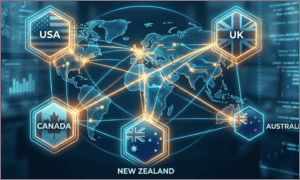
The Five Eyes, a long-standing intelligence partnership linking Australia, Canada, New Zealand, the United Kingdom, and the United States, has historically operated as a unique collaborative network. Since the mid-20th century, these nations have pooled resources ranging from cybersecurity to cryptoanalysis. While U.S. agencies hold a dominant position, the arrangement has thrived on mutual trust and the ability to collect and analyze information beyond the capacity of any single member. However, the alliance is now brittle due to its deep dependency on an increasingly volatile United States.
President Donald Trump has maintained a hostile stance toward the U.S. intelligence community. In a July 16, 2027, speech regarding election interference, the president accused "corrupt" officials within the FBI and CIA of covering up evidence related to vulnerabilities in U.S. election security involving China and other actors. The administration has also leveraged the power asymmetry within the partnership, reportedly threatening to punish nations that diverge from Washington’s policy goals. For instance, Canada faced potential removal from the alliance in 2025 over tariff disagreements, and a leaked Pentagon memo suggested the White House threatened to withdraw support for British sovereignty over the Falkland Islands due to the U.K.’s lack of enthusiasm for U.S. actions against Iran.
These pressures have forced partner nations to navigate difficult diplomatic waters. The U.K. reportedly suspended Caribbean intelligence sharing with the U.S. last year over concerns regarding potential illegal military use, while the Canadian government issued a reminder to respect its sovereignty after separatist leaders from Alberta visited U.S. government offices in Washington, D.C. Despite these frictions, day-to-day cooperation remains steady at the staff level, where professional solidarity often transcends the shifting priorities of political leaders. The unpredictability of the current geopolitical moment makes it difficult to assess the future of the Five Eyes. Yet this challenge is also compounded by a set of persistent misunderstandings about what the partnership is, and what it actually does.
Ultimately, the human factor enables and sustains the Five Eyes, as professionals interpret and adapt to the tools at their disposal. Shared workplaces act as incubators for institutional relationships that extend across national boundaries, where trust is built and repaired. A common myth is that the partnership operates under strict democratic oversight. In reality, intelligence agencies often face limited accountability, with oversight bodies struggling to restrain mass surveillance activities. Some critics view the Trump administration’s attacks on the "deep state" as a challenge to these unchecked powers.
Another misconception is that the group is an exclusive circle of five. While the core partnership is defined by the five member states, it exists within a broader social and political space that includes a network of "third-party" intelligence agencies. These relationships, which include long-standing ties between the U.S. National Security Agency and Germany’s Federal Intelligence Service, often involve high levels of interoperability. In one notable instance, Denmark’s military intelligence assisted the NSA in monitoring European leaders, including Chancellor Angela Merkel. Focusing narrowly on the five member states therefore obscures important insights into the wider patterns and practices of intelligence cooperation.
Furthermore, while Beijing often characterizes the Five Eyes as a monolithic bloc aimed at containing China, the alliance is less homogeneous than it appears. New Zealand has previously resisted the "Five Eyes-ization" of its foreign policy, and Canada has sought strategic openings in Beijing. While the U.S. considers China an "existential threat" and an "epoch-defining challenge," the alliance remains a complex network. By any reasonable measure, Trump-driven disruptions are bad news for the Five Eyes. History shows that political and strategic divergence can reduce intelligence sharing. Diplomatic damage control can only go so far, particularly when senior U.S. figures, including ambassadors in Europe and Secretary of State Marco Rubio, are so consistent in taking controversial positions. Should these disruptions continue or intensify, they will likely undermine confidence in exchanged information and erode trust overall.
Despite these risks, the human dimension of intelligence work can absorb some of these shocks. Agencies and their personnel are not merely passive recipients of political pressure; they can resist, adapt, and navigate interference. Recent examples illustrate this dynamic, such as senior officials within the FBI who refused to dismiss employees involved in investigations tied to the January 6 U.S. Capitol attack. Until these misunderstandings are addressed, assessments of the Five Eyes will remain incomplete, obscuring both its resilience and its vulnerabilities in an increasingly uncertain world.
You have reached the limit of 2 free articles this month.