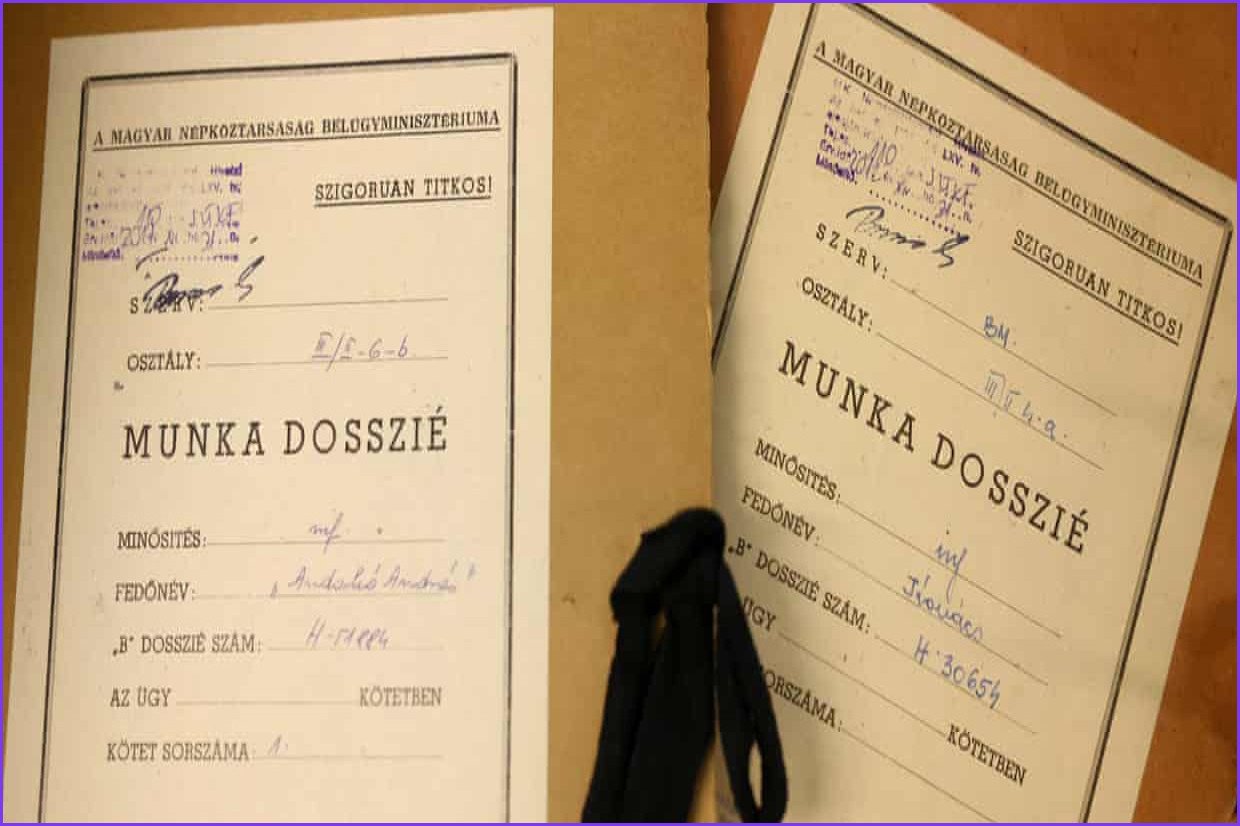
Hungary’s government is set to reveal the identities of tens of thousands of state-security informants from the communist era this Wednesday, marking a significant effort to confront the nation's past and restore public trust. Between 1945 and 1989, the communist state-security services maintained a vast network of spies to monitor society and suppress dissent. These individuals were often recruited through coercion, blackmail, or promises of personal advantage, and were tasked with reporting on their own neighbors, friends, colleagues, and family members.
For decades, these "agent files" were kept in the basement of the Historical Archives of the State Security services, remaining largely inaccessible to the public despite repeated calls for their release and partial leaks. The current government, led by Péter Magyar, is fulfilling a campaign promise made during the lead-up to the April parliamentary elections. A law passed in September paved the way for this disclosure, which polls indicate is supported by more than two-thirds of the country. Although the release was initially planned for the anniversary of the 1956 anti-Soviet revolution, it was rescheduled for 4 November.
Zoltán Tarr, the minister of social relations and culture, stated on Facebook that a democratic society has the right to know its past. With the introduction of a new, searchable online database, Hungary’s former state-service records will become the most transparent in the former eastern bloc, according to researchers. István Papp, a historian and head of the academic department of the archives, described the move as opening a door that had previously been left only ajar. Papp noted that while he supports the release as a historian, he feels for those who will confront their family history for the first time. Of the 50,000 to 60,000 names in the files, historians estimate that 10% are still alive today.
The former eastern bloc has long been divided on the timing and method of publishing such files. East Germany opened its Stasi files in 1992, the Czech Republic followed in 2003, and Latvia published its informant files in 2018. Miklós Kiss, a survivor of a Hungarian forced labor camp and president of a victims' association, noted that he would have preferred an earlier release, stating that the issue could have been resolved long ago. He added that people will soon learn there were traitors in every family and neighborhood, though he questioned how society should process this information now.
The documents, which would stretch for three miles if placed side by side, are smaller than those of the Polish or Romanian secret services. Many files were destroyed during the 1956 uprising, while others disappeared during the 1989 transition. Because many records are incomplete, the motivations or the full extent of an informant's reporting will often remain unknown. Detailed files, including background checks and statements for 9,000 people, will be released in February, following the redaction of sensitive personal information such as health, addictions, and sexuality, as well as details about victims, in accordance with privacy laws.
The identities of secret-service agents have long been a source of fascination in Hungary. Since the 2000s, partial lists have occasionally emerged, naming politicians and prominent artists, often triggering political crises. Despite this, few former agents have spoken publicly, and the subject remains a taboo. In July, the independent religious journal Szemlélek issued a call for former agents to come forward, as religious figures were frequently targeted and blackmailed by state services, with estimates suggesting 7-10% of them cooperated. To date, no one has volunteered to share their story, with editor-in-chief Szilárd Szőnyi noting that many may feel their stories are too complex or that they are not ready to speak.
Historian Domokos Szokolay, whose father was outed as an informant in 2005, expressed hope that the release would not lead to public shaming but rather a better understanding of these complex issues. By speaking openly about transgenerational trauma, he hopes to reassure others who discover their loved ones were agents. Alexander Faludy, a freelance journalist and Anglican priest who read his own family's files nearly two decades ago, noted that his initial anger toward an informant who betrayed his grandmother evaporated after he realized the informant was being coerced through threats against her own elderly parents. He emphasized that while exile was painful for his family, it also provided moral luxuries that make him hesitant to judge those who had to remain in Hungary.
Szokolay has yet to read all the reports on his father, who died in 2020. By speaking openly about transgenerational trauma, he hopes to reassure others who discover their loved ones were agents that they are not alone, and to encourage them to start conversations about what they find.