A youth-led rally against rearmament and budget cuts brought demonstrators to Berlin’s iconic Brandenburg Gate on Saturday afternoon, where calls for increased education spending fused with prominent pro-Palestine activism and far-left political mobilization. Organized by the youth initiative “Gen Z regelt,” the demonstration commenced at 2 p.m. under a pledge from organizers that the gathering would remain peaceful. Participants demanded substantial government investments in schools and climate action, relief from rising living costs, and an end to both rearmament and any reintroduction of compulsory military service.
Despite assurances of peace from the organizers, commercial businesses along major Berlin thoroughfares—including Unter den Linden, Friedrichstraße, and Kurfürstendamm—erected protective barricades to safeguard against potential looting. At the gateway entrance, activists distributed promotional literature, including a man clad in a jumper matching the colors of the Palestinian flag who handed out flyers. Alongside him, a representative from the daily newspaper "Junge Welt" offered brochures and copies. The publication is monitored by Germany’s domestic intelligence agency, which classifies it as far-left extremist.
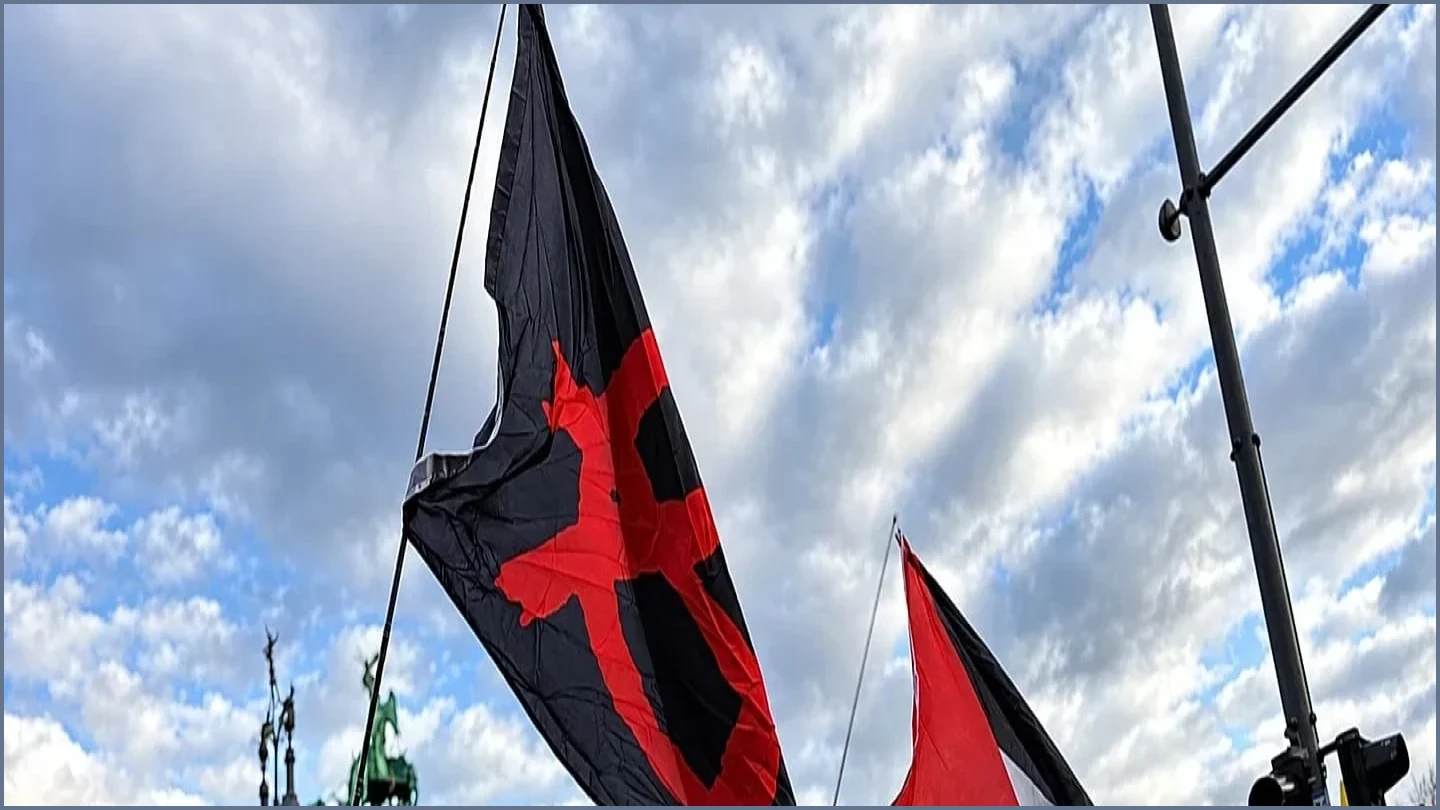
Moving further into the demonstration area at Platz des 18. März, Palestinian flags were prominently displayed beside anarchist banners and Antifa flags. A significant portion of the crowd, largely composed of young men and women, wore red or black kufiyas—the traditional Palestinian scarf—draped across their shoulders like capes, wrapped around their heads, or worn around their necks. Demonstrators carried signs displaying an array of messages addressing domestic defense spending and international conflicts, with slogans such as “Flunked the PISA test but passed the military medical” and “Money for social causes instead of war.” Other placards carried explicit political condemnations, reading “German weapons kill children in Palestine,” “No money for children’s homes, schools & women’s refuges, but money for war and genocide,” and “Stop the genocide in Gaza.”
Among those attending were young women aged 19 and 20 participating in a voluntary social year (FSJ). They explained that their participation stemmed in part from a desire to show solidarity with high school student movements in France and broader European protest actions, but primarily to highlight how young people feel overlooked and dismissed by political leaders. One demonstrator emphasized that “there is constant militarisation and rearmament, and there is simply not a single cent left for education and social spending.”
Addressing the connection between Middle East conflict activism and local school protests, one volunteer, who wore a kufiya around her neck, asserted that German youth carry a direct responsibility regarding national arms production. “It has to do with the fact that we as young people, or as people in Germany in general, also have to take responsibility for the fact that weapons are produced here that are used to kill civilians and children in Palestine, in Gaza and in the West Bank,” she said, adding, “I do not think I could ever live with myself if I never paid any attention to this.”
A chemistry student at Freie Universität Berlin (FU), wearing a Palestinian scarf, described the compounding economic pressures facing students, including recurring university funding cuts, escalating rents, and the necessity of working side jobs alongside academic studies. Noting that “at some point it simply becomes impossible,” he expressed deep anger over the arms build-up and highlighted FU’s eleven cooperative projects with Israeli institutions, arguing that these partnerships indirectly support military research. Stating that Germany purchases military equipment from Israel, he insisted, “I do not want our universities to exist to build war products. I do not want FU to support a genocide.”
The rally in Berlin formed part of a wider wave of youth protests extending across Europe. In France, actions that originated last month as a high school movement expanded to include trade unions and citizens protesting against President Emmanuel Macron, alongside concurrent demonstrations reported in Spain, Italy, and the Netherlands on Saturday. However, critics in Germany drew attention to the presence of radical left-wing entities within the Berlin gathering. Present at the event was the youth organization "Linksjugend ['solid]," affiliated with the Left Party, which has long faced scrutiny over allegations of antisemitism, particularly involving its Neukölln branch and controversial resolutions on the Middle East.
The radical organization "Revolutionäre Linke" also maintained a dedicated stand at the demonstration. Members of this group had previously established a separate body named "Jugend für Sozialismus" in early 2023 following disputes with youth organization leadership over perceived political compromise, undemocratic internal structures, and a lack of focus on class struggle. Representatives argued that shifting public funds to the Bundeswehr while reducing support for hospitals and social services heavily burdens the younger generation, stating, "We see that it is our young generation that will be hit hardest and for the longest time," and asserting their goal was to build a better society.
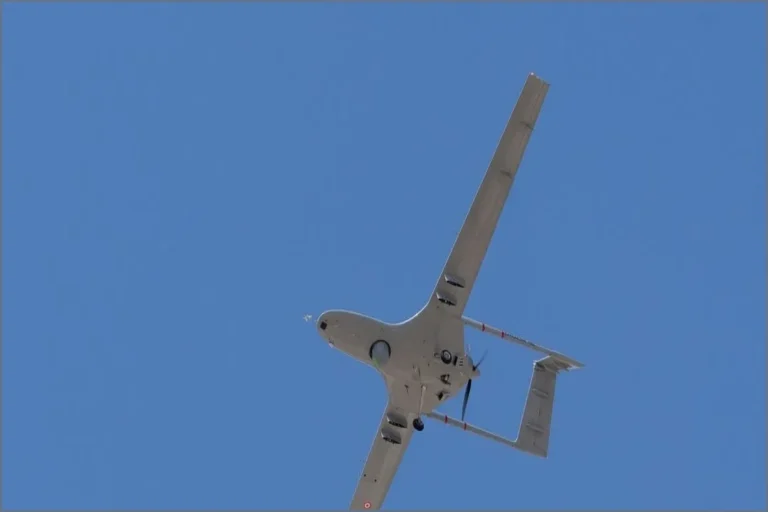
A representative from the group explained that their participation aimed to distribute informational materials while drawing explicit connections between domestic military expansion and foreign policy. “We always put out all our information materials. However, there is also a link here. One of the major problems is that, despite everything that is happening, the Bundeswehr continues to carry out drone tests together with the Israeli army, and weapons are still being sold to Israel. We strongly condemn this. And of course it is also connected with conscription and the expansion of the Bundeswehr here,” he stated.
In response to inquiries two days prior to the event, the press office for the Berlin police acknowledged that left-wing political groups were leveraging the momentum of French demonstrations to mobilize participants, though authorities stated, "However, there is currently no reliable evidence of targeted extremist influence or control over this group." Subsequent findings, however, revealed that explicit threats of violence had circulated within private Telegram channels shortly before the protest. Reports from the "Berliner Zeitung" highlighted messages where one user wrote "I am going out with a machete," alongside threats targeting synagogues, arson, and looting. Security observers noted that radical actors frequently seek to co-opt civil protests, seeking to reinterpret legitimate protest as a struggle against the rule of law and liberal democracy while fostering escalation.
The initiative "Gen Z regelt" experienced significant internal instability leading up to the Saturday protest. Former spokesperson Gianni Matheja resigned from his role citing internal disagreements and doubts regarding whether the demonstrations would remain non-violent. Additional Berlin organizers, including Max Schneller and Battal Yali, also withdrew, pointing to unclear organizational hierarchies and a lack of financial transparency. Reports in Tagesspiegel indicated that the Berlin organizing team had temporarily collapsed before recruiting new members.
Despite internal disruptions, "Gen Z regelt" reiterated its commitment to non-violent protest across nationwide events scheduled for Saturday, October 31. Co-organizer Konrad Schmitz, a 16-year-old from Wuppertal, stated, "We want to fight peacefully for our cause," explicitly rejecting political extremism from both left and right wings. Meanwhile, 18-year-old co-founder Akram Selo disclosed receiving numerous threats in recent days, noting, "They think we want to copy the French; they think we want to destroy the country."
Through 5 p.m., the demonstration at the Brandenburg Gate proceeded peacefully. However, law enforcement turned their attention toward a secondary gathering scheduled for 5:30 p.m. at Rosenthaler Platz under the slogan "Gen Z has had enough!" Police initially anticipated 400 to 500 attendees, while noting the potential for larger crowds. Although "Gen Z regelt" explicitly disavowed the evening event, dozens of individuals at the Brandenburg Gate distributed promotional flyers for the Rosenthaler Platz rally without intervention from stewards or press representatives. Security authorities noted that the evening march—routed through Kastanienallee, Schönhauser Allee, and Danziger Straße toward the Prenzlauer Allee suburban railway station—was heavily promoted within far-left extremist networks and expected to draw pro-Palestine groups.