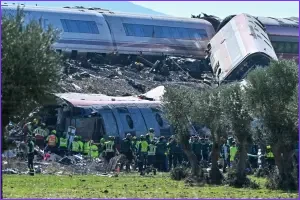
At least 64 people have been confirmed dead after two high-speed trains collided on Wednesday morning in the central Spanish province of Toledo. The fatal crash occurred at 8:54 a.m. along the rail corridor connecting Madrid to Seville, involving a Renfe AVE train and an Iryo train carrying an estimated total of 544 passengers.
According to emergency services sources from Spain's 112, one train slammed into the back of another train that was stationary on the tracks at a speed of 100 km/h. The violence of the impact caused two carriages to derail and plunge down an embankment. The site of the collision lies in Castilla-La Mancha between the municipalities of Mora, Orgaz, and Urda, roughly an hour and 40 minutes' drive south of Madrid.
Regional officials warned that the death toll has continued to climb throughout the day. Castilla-La Mancha Regional President Emiliano García-Page confirmed the current mortality figure and stated that 12 forensic experts have been sent to the crash site. "Unfortunately, we expect more fatalities," García-Page remarked, noting that emergency crews anticipate further casualties given the high number of passengers and the severe impact.
In addition to the fatalities, medical teams have treated 30 individuals for minor injuries, while approximately 50 others sustained injuries ranging in severity, with several passengers described as being in very serious condition. Emergency responders fear the total number of injured could increase as search efforts continue.
Initial investigations into the disaster point toward human error following a major technical failure. Spain's Ministry of Transport and railway infrastructure manager Adif reported that preliminary findings indicate "human error by an Adif operator" occurred after a "failure in the main signalling system" was detected. The breakdown forced controllers at Madrid's Atocha station to switch the line's signalling system to manual operation, halting trains along the route for several minutes. Early evidence suggests the Renfe train was directed to proceed normally even though the Iryo train remained stopped on the line a few kilometres ahead.
On the ground, Civil Guard officers have cordoned off a 500-metre radius around the crash scene to search for survivors and victims. Emergency personnel are also attempting to retrieve passengers' personal belongings and collect forensic evidence to aid the ongoing official investigation. Renfe President Álvaro Fernández Heredia has travelled to Toledo to oversee the response firsthand.
Local communities have mobilized quickly to support rescue operations. In the nearby town of Los Yébenes, residents organized an urgent drive to collect water and food for people affected near the tracks. Meanwhile, local authorities in Urda converted a town sports pavilion into a field triage facility and reception centre for survivors and families.
To assist affected families, authorities activated the Plan for Assistance to Victims of Railway Accidents and their Families, opening a dedicated helpline at 900 10 10 20. Train operator Iryo has established a separate support line at 900 001 403 for impacted passengers and relatives.
Rail travel across the region faces widespread disruption. Adif has suspended all train services between Madrid and southern Spain until further notice. The Ministry of Transport advised ticketed passengers for the affected route not to travel to stations, recommending instead that they contact their rail operators regarding refunds. To maintain essential transit, regional air carriers and bus companies have started deploying emergency replacement routes.