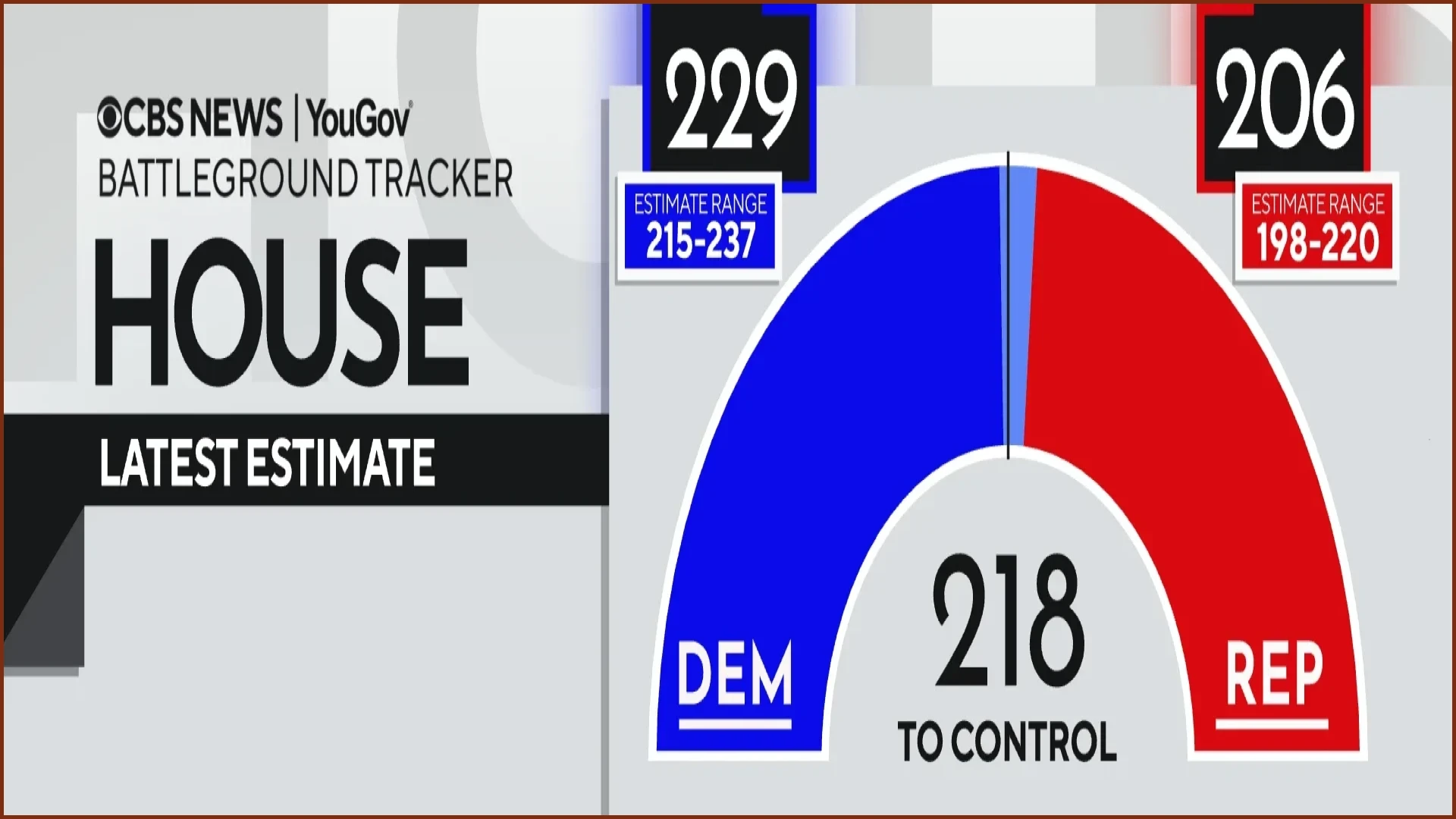
Democrats are currently on pace to secure 229 seats in a statistical model estimating congressional preferences for the 2026 House midterms, maintaining a durable lead in their bid to recapture the majority. Potential outcomes in the statistical projection extend into the 230s, though Republicans retain a narrow numerical path to keep control of the chamber. While the Democratic advantage has remained consistent over recent weeks, it has not expanded into a broader national wave.
Undecided and uncertain voters currently profile as more Republican, making their ultimate turnout on Election Day a decisive factor in the overall race. A key factor driving the current Democratic margin is higher declared turnout intent, with more Democrats stating they will definitely vote or have already submitted early ballots. Conversely, voters who describe themselves as only "probably" or "maybe" intending to vote lean more Republican, creating potential for shifts if those individuals become motivated to participate.
Voters across the political spectrum describe an "avoidance" dynamic in this cycle, reporting higher motivation to prevent unwanted outcomes than to achieve specific policy gains. Widespread cynicism permeates the electorate, with majorities viewing neither political party as having a clear plan for governing. Most voters do not believe that either party winning control of Congress will improve their financial standing or bring down fuel prices, though relatively more voters report feeling they would be better off financially under Democratic leadership than under Republican control.
Concerns regarding gas prices reflect this comparative preference. Few voters expect fuel costs to decline regardless of which party wins, but a higher proportion believes gas prices will rise under Republican leadership than under Democratic management. Government corruption also stands out as a primary voting factor for large majorities of both Democratic and Republican supporters, with a majority of overall voters expecting government corruption to increase if Republicans retain congressional control.
The president remains a central motivating force across the electorate, with high numbers of voters indicating their congressional choice is aimed directly at supporting or opposing him. Over seven in 10 voters backing Democratic candidates state that their vote is explicitly intended to oppose Donald Trump. For four in 10 Democratic voters, stopping the president and Republican policies is cited as the primary driver of their vote, eclipsing interest in advancing the Democratic Party's own legislative platform.
On the Republican side, the president acts as a key motivator, particularly among MAGA-aligned voters. However, four in 10 voters backing Republican candidates indicate their vote is not centered on the president. These non-MAGA Republicans typically express only "somewhat" favorable approval of the president, but remain squarely in the Republican camp due to strongly unfavorable views of the Democratic Party. While campaign appearances by the president energize MAGA voters to turn out, non-MAGA Republicans report that these events do not significantly alter their likelihood of voting.
A significant portion of the electorate views a victory by the opposing party as a threat to their personal way of life. This perception of threat is particularly strong among MAGA Republicans regarding a potential Democratic win. On specific policy issues, Republicans hold a lead among voters who identify transgender issues as a major voting factor, though the topic ranks behind primary economic concerns in overall importance.
Immigration policy reveals stark voter divisions. One-third of voters believe the Democratic Party prioritizes the interests of recent immigrants over those of U.S. citizens, and this group overwhelmingly supports Republican candidates. Another third of voters believes Democrats prioritize both groups equally, and these voters strongly align with Democratic candidates.
Overall public ratings of the national economy remain deeply negative, dipping back to levels recorded during the previous spring. Persistent inflation and rising living costs remain top concerns. Voters who identify inflation as a paramount issue, as well as those who report personal financial hardship, lean heavily toward Democratic candidates. A majority of likely voters feel the president's policies have made them financially worse off, with more voters believing he prioritizes his personal and family financial interests over those of the American public—a view strongly linked to Democratic support. Conversely, most Republicans believe he prioritizes the country's financial interests.
Regarding election administration, most voters express confidence in their local and county officials to administer elections, verify eligibility, and count ballots accurately. However, Democrats express higher levels of complete confidence in ballot accuracy than Republicans. Additionally, Republicans are far more likely to hold the belief that non-citizens vote illegally in federal elections.
The survey data was collected from a nationally representative sample of 2,355 U.S. adults interviewed between October 21 and October 23, 2026. The sample was weighted according to gender, age, race, education, and 2024 presidential vote based on the U.S. Census American Community Survey and Current Population Survey. The margin of error is ±2.6 percentage points for the total sample, ±2.9 points for registered voters, and ±3.0 points for likely voters. Congressional seat estimates were generated using a statistical model incorporating district characteristics, historical voting patterns, and demographic data, with a 95 percent confidence interval applied to seat ranges.
Whether they decide to show up is perhaps the key question of 2026.
Here's how prevalent opposition to either party is as a motivating force this year.