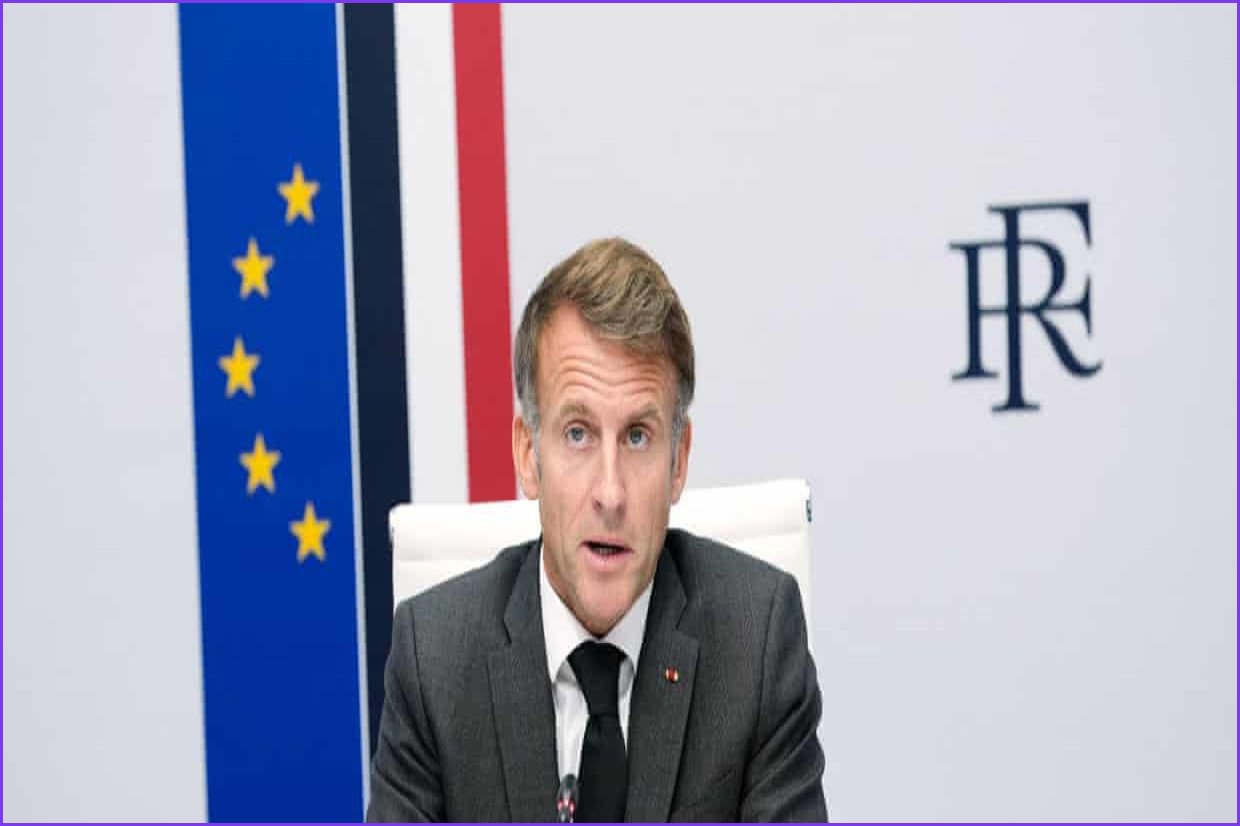
French President Emmanuel Macron announced on Thursday that demonstrations organized by unauthorized individuals or groups will be banned in the coming days, as the government attempts to regain control following some of the country's most violent civil unrest in recent years.
Speaking after a meeting with intelligence chiefs and senior government ministers, Macron explained that while demonstrations organized by recognized groups would be permitted, their routes could be modified. Requests submitted by established organizations such as trade unions will be examined in accordance with the law, though they may be required to take alternative paths.
"The rules are simple and I think they're commonsense. The general recommendation is that there should be no demonstrations in the coming days," Macron stated, adding that the restrictions are necessary to safeguard city centres, local businesses, and public buildings. "The priority is a return to calm."
The French president attributed much of the violence and looting over the previous weekend to opportunistic individuals who came specifically to steal. However, he charged that the worst incidents stemmed from "political and seditious acts by ultra far-left groups who aimed to bring down the republic."
To determine concrete next steps ahead of newly planned nationwide demonstrations on Saturday and beyond, Macron announced he will chair a defence council meeting of key ministers on Friday.
Ahead of the weekend, regional authorities have already put strict measures in place. In Lyon, France's third-largest city, all protests have been banned in the city centre on Saturday after between 200 and 300 shops were ransacked and looted last weekend and the local tourist office was set on fire. Similar central protest bans for Saturday were announced by officials in Marseille, Nice, and Toulon.
In Paris, authorities have permitted a march scheduled for Saturday starting at the Place de la Bastille in the east, provided it does not move into the city centre. However, a separate march planned through the capital by students alongside members of the gilets jaunes (yellow vests) movement—whose demonstrations over fuel prices shook France in 2018 and 2019—will not be allowed. Meanwhile, UNEF, France's primary student union, has called for rallies on Saturday. In anticipation of potential violence, central Paris businesses and shops in other major cities have begun hiring private security guards and boarding up windows.
Legal challenges to protest bans yielded mixed results on Thursday. While a court overturned an initial police ban on a student demonstration planned in Paris, scheduled marches in Rouen, Grenoble, Le Havre, and Toulon were successfully halted by authorities.
Giving an update on law enforcement actions, Justice Minister Gérald Darmanin confirmed that out of 2,500 people arrested since the rioting began last weekend, 174 have been remanded in custody and more than 900 are being prosecuted. Additionally, two individuals were arrested in connection with a arson attack that set the Limoges town hall on fire.
Broader security measures currently in effect include partial night-time curfews across parts of several cities, including Paris, as well as strict bans on public gatherings around the Élysée presidential palace, the national parliament, and major railway hubs.
As part of political efforts to manage the crisis, Prime Minister Sébastien Lecornu held talks on Thursday with leaders from France's major political parties to seek cooperation and gather input, with further meetings scheduled with big-city mayors later in the day.
The current wave of unrest began last month with pupil strikes, blockades, and demonstrations at a high school in Créteil, south-east of Paris, over dilapidated facilities and severe staff shortages. The movement rapidly expanded nationwide, eventually morphing into broader protests over soaring living costs just six months before France's upcoming presidential election to determine Macron's successor.
Angry lawyers and bewildered defendants: the fallout from fast-tracking French rioting cases