In an effort to rejoin the Southeast Asian regional alliance, Myanmar's military-backed administration has formally set up a new ASEAN Affairs Committee aimed at regaining the country's full status and participation rights within the 11-member bloc. The committee held its inaugural meeting on Tuesday in preparation for the 49th ASEAN Summit scheduled for next month in Manila.
The regional bloc excluded Myanmar from its high-level summits and ministerial gatherings in late 2021 after the regime failed to abide by ASEAN's Five-Point Consensus. Established in April 2021, two months after the military seized power in a February coup, the peace plan demands an immediate end to violence, inclusive dialogue involving all parties to the conflict, and unhindered access for humanitarian assistance across the nation.
According to a report published Wednesday by The Irrawaddy, the inaugural committee session was chaired by Foreign Minister Tin Maung Swe. The meeting brought together representatives from the President's Office alongside senior officials from the ministries of Defense, Home Affairs, Information, and Social Welfare. During the discussions, Tin Maung Swe asserted that Myanmar has been subjected to "discriminatory treatment" by ASEAN since 2021, while attendees evaluated "Myanmar‑led approaches" to restore the country's official standing.
The formation of the committee aligns with a wider diplomatic strategy initiated by Min Aung Hlaing's quasi-civilian government since taking office in April. To build key partnerships and attract urgently needed foreign investment, the regime leader has conducted foreign trips to India, China, Russia, Belarus, and Kazakhstan. Normalizing ties with ASEAN has remained a central goal of this outreach, with several member nations showing receptivity toward Naypyidaw.
In recent months, five ASEAN nations—Laos, Thailand, Cambodia, Vietnam, and Malaysia—have warmly hosted the coup leader, with potential visits to Indonesia and Brunei under consideration. Stances elsewhere in the region also show signs of shifting. Philippine President Ferdinand Marcos Jr., whose country holds the rotating ASEAN chairmanship for 2026, remarked in a recent interview that although the Five-Point Consensus was "absolutely correct," the bloc must explore a "new approach" regarding Myanmar.
Despite seeking re-entry, Myanmar's military leadership has repeatedly repudiated the consensus framework. In July, the regime's proxy parliament passed a motion officially rejecting the plan as an unwarranted intrusion into domestic affairs that fails to reflect current political realities. Min Aung Hlaing reiterated this stance in an August address, criticizing certain member states for adopting "positions and practices that it regarded as discriminatory towards Myanmar."
While Thailand and Malaysia have openly advocated for bringing Myanmar back into the fold, full normalization requires a unanimous consensus among all 11 ASEAN member nations. Singapore and Timor-Leste remain the primary hold-outs, reflecting ongoing internal disagreements over the pace and conditions of engagement. Furthermore, analysts note that full reconciliation would require at least token progress on the Five-Point Consensus—a prospect made remote as the military continues to intensify attacks against resistance forces and civilians accused of supporting them.
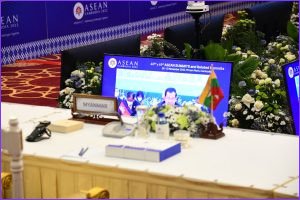
Myanmar’s empty seat, as seen during the 40th ASEAN Summit (Plenary Session) in Phnom Penh, Cambodia, Nov. 11, 2022.
Get unlimited access to in-depth analysis you won't find anywhere else, from South China Sea tensions to ASEAN diplomacy to India-Pakistan relations. More than 5,000 articles a year.