A growing trend known as "dark tourism" is taking root in China, where travellers are increasingly seeking out simulated disaster experiences and visiting historic sites of tragic events. Online social platforms across the country have seen phrases such as "paying to suffer" and "paying to buy fear" trend, reflecting a shift among younger demographics who prefer immersive encounters over conventional sightseeing.
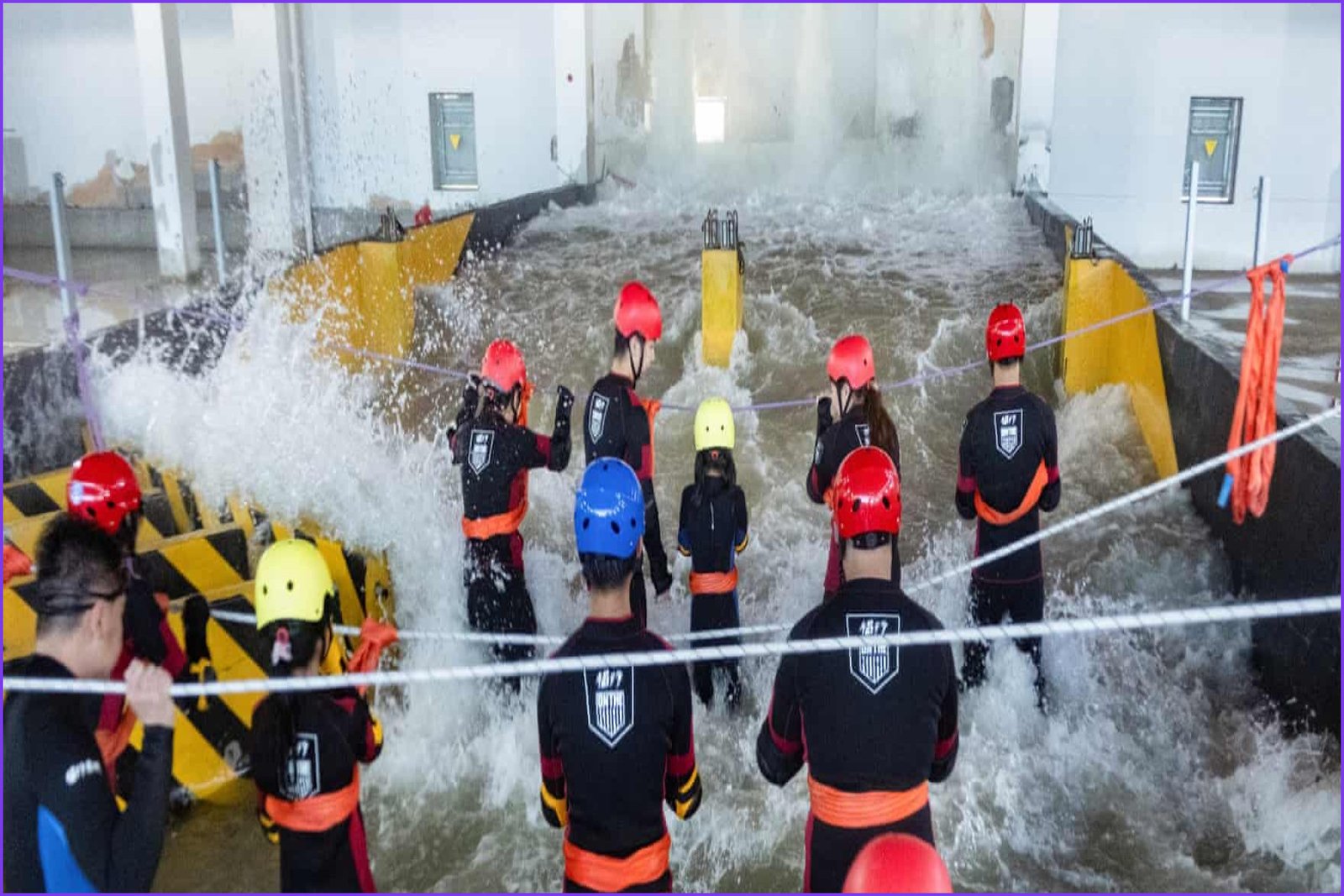
Among those engaging in this trend is 28-year-old Leon Lv from Chongqing in south-west China. After encountering social media videos on the app RedNote depicting individuals battling flash floods and typhoon-force winds, she chose to travel over 1,300 kilometres to Hangzhou in eastern China. She noted that having only seen typhoons on the news, she wanted to find a safe place to experience one and learn survival skills. Joining a group of 20 participants, Lv took part in a simulated flooding scenario fueled by a typhoon inside a specialized facility.
During the simulation, hundreds of tonnes of water swept participants off their feet toward a safety barrier. Lv recounted that her mind momentarily went blank and that she forgot she was in an artificial environment. However, the experience offered practical lessons on flood safety. She explained that she learned how to stay calm and use the proper body position to protect herself during a surge, adding that no book or school could provide that level of instruction.
The surge in public interest has propelled Hangzhou-based company Lvxing Base into viral popularity. Established by founders who spent a decade filming documentaries in the world's most extreme environments, the firm opened a 200,000-square-metre facility in 2024 to recreate severe conditions such as mudslides and typhoons. General manager Wang Kuanghan acknowledged that while excitement draws many visitors seeking to test whether they can withstand torrential rain and violent winds, most individual customers are between 20 and 30 years old. Over the next three years, the company plans to establish five additional centres across China while introducing fire and earthquake simulations.
Immersive disaster simulation is not limited to private enterprises. At Beijing's Haidian public safety museum, visitors experience simulated fires, tsunamis, and earthquakes inside a 4D theatre fitted with sound effects and moving platforms. In southern China, Guangzhou opened a five-storey emergency response learning centre last year featuring an earthquake simulator capable of replicating ground shaking equivalent to a 7.2 magnitude quake.
These offerings align with official directives issued in 2024, when local governments were instructed to promote immersive disaster education through safety training bases, museums, and simulation facilities. The initiative comes amid a sharp rise in extreme weather events across China. In 2025, the nation recorded its highest number of hot days since official records began and was struck by 10 typhoons—far exceeding the long-term annual average. Data from China's Ministry of Emergencies showed that 67 million people were affected by natural disasters nationwide.
According to Robert Li, director of the School of Hotel and Tourism Management at the Chinese University of Hong Kong, the trend reflects changing preferences among travellers. He observed that the new generation of Chinese travellers prefers actively experiencing a location over simply viewing well-known tourist attractions.
Parallel to synthetic disaster simulations, many tourists are seeking out real-world sites of past tragedies. In Sichuan province, where a devastating magnitude 8.0 earthquake in May 2008 killed more than 70,000 people, preserved ruins continue to draw visitors. Alice, a 30-year-old writer from Sichuan, recently toured Beichuan, an affected town where collapsed structures are held in place by metal beams. In nearby Yingxue, close to the epicentre, a middle school site displays a broken clock frozen at 2:28, the exact moment the earthquake struck. Reflecting on the ghost town environment and collapsed schools where students were crushed, Alice noted that dark tourism can help a nation reconcile with its past, even when official memory is guided by government policy. She plans to launch a Chinese-language Substack account documenting her travels to sites of tragedy.
Historic human tragedies are also seeing elevated visitor numbers. Tour guide Samantha Wang reported an increase in Chinese tourists visiting the Nanjing Massacre Memorial Hall. Official Chinese historical accounts state that 300,000 civilians and soldiers were killed over several weeks following the capture of Nanjing by the Japanese Imperial army in 1937, whereas Japan's official position acknowledges high civilian casualties while maintaining that the exact victim count is difficult to determine. Although admission to the memorial hall is free, visitors must book online, with the local government capping entry at 25,000 daily reservations. Tickets frequently sell out in advance during August. Wang observed that seeing pictures of killed children evokes deep sadness, but leaves visitors feeling relieved and inspired to work harder to make China stronger.
In Yingxue close to the epicentre, a broken clock surrounded by the remains of a middle school is frozen at 2.28, the moment the earthquake struck.